
Working from home has exploded in popularity over the past few years. What used to be seen as an unusual perk offered by some forward-thinking companies has now become commonplace for millions of professionals. According to Forbes, 12.7% of full-time employees work from home, and the number is growing.
Find Out: How I Make $5,000 a Month in Passive Income Doing Just 10 Hours of Work a Year
Try This: 6 Unusual Ways To Make Extra Money (That Actually Work)
While remote work offers many advantages, like flexibility and no commute, it also comes with its own unique challenges. Employees need extra discipline to stay on task away from managers’ watchful eyes. The boundaries between work and personal life can become blurred when your office is your dining room. Zoom meetings often replace watercooler chats and face-to-face collaborations.
Here are the 14 best parts of working from home, as well as the 15 worst downsides to consider. Understanding the pros and cons can help both managers and employees make the most of the remote work revolution.

Best Things About Working From Home
There’s a reason 90% of employees who work from home said they want to continue doing so. Actually, there are several reasons. These are some of the biggest perks of escaping the 9-to-5 office grind.
Read Next: Grant Cardone: Here’s How To Become Rich If You’re Earning an Average Salary
For You: 26 Ways To Make $1,000 Fast — In a Week or Less

You Save Time by Not Commuting
The average American’s commute time is roughly 27 minutes, according to the U.S. Census Bureau. That means that most people spend just under an hour driving to and from work every day. That’s extra time you could use to get in an at-home workout or spend with your family.
Explore More: 30 Best Games That Pay Real Money in 2024

You Can Avoid Distracting Co-Workers
Working in an office environment means you’re opening yourself up to constant interruptions from co-workers. Some actually might want to chat about something useful, but others might just want to talk your ear off about what they did this weekend or what their kids have been up to. When you work from home, you avoid these daily interruptions.

You Can Work From Anywhere With an Internet Connection
You might be confined to your home, but you can work anywhere in your house that has Wi-Fi access. If it’s nice out and you have outdoor space, consider working outside. Even if you’re confined indoors, you can make the most of your home by setting up a cozy at-home office space. Consider taking meetings while standing up by a counter to switch things up.

You End Up Saving Money
As mentioned above, by working from home, you save money on gas, public transportation or Uber costs by cutting out your commute. Even better, you’ll save money in other ways, too. Since going out to eat is no longer an option in many places, you’ll save on going out for lunch every day. Plus, with no co-workers to impress with your outfit of the day, you’ll save money on clothes and dry cleaning.

You Don’t Have To Get Dressed Up
There’s no need to put on a suit or spend an hour fixing your hair and putting on makeup when you work from home. Not only is it more comfortable to work in your sweats, but you save the time it takes to get ready.
Learn More: 7 Things You Must Do To Start Making $1K a Month in Passive Income

You Can Take Phone Calls Without Co-Workers Listening In
Many people now work in an office with an open floor plan, making it nearly impossible to have a sense of privacy at work. When you work from home, you can freely make and receive phone calls without having to worry about nosy desk neighbors.

You Can Make Your Own Schedule
Depending on your job, you might be able to choose your own work hours when you work remotely. This means you can have a leisurely morning or get the kids off to school and start your day later, or you can bang out all of your tasks first thing and have the rest of your day free.

You Can Literally ‘Phone It In’ During Meetings
If you’re a remote worker, it’s especially important to be engaged during phone or video meetings, as these are your main opportunities for “face time” with your managers and co-workers. However, when you’re obligated to attend a meeting that’s really a waste of your time, you can just call in, put your phone on mute and work on a task that’s a more productive use of those minutes.

You’re Home To Accept Packages
It’s always a bummer when you’ve been eagerly awaiting a package, only to come home to find you missed the delivery person, and you now have to wait an extra day or two to get the package or retrieve it from a pick-up center. When you work from home, you’re always there when FedEx or UPS shows up.
Discover More: Ramit Sethi: 5 Easy Steps To Getting Rich in 2024

You Can Blast Your Music as Loudly as You Want
There’s no need for headphones and low-volume listening when you work from home. You can blast your favorite playlist at a louder volume since you’re at home, but be courteous of your neighbors, who might also be working from home.

You Can Create Your Dream Office Space
Whether your dream office is full of pink, fluffy details or is dark and austere, you can create the vibe that you want when you’re in total control of the décor.

It Forces You To Become More Independent
When you work in an office and you encounter a problem that you can’t find an easy solution for, you can ask your co-workers for help or constructive feedback. However, this can sometimes be used as a crutch, and leaning on others all the time can prevent you from gaining independence and growing your skills and confidence in your work.
When you work remotely, you’re forced to be independent and figure a lot of things out on your own — which can definitely be a good thing.

Communication Tends To Be More Efficient
When you don’t have access to your co-workers all the time and vice versa, you can’t just pop by each others’ desks to ask for clarification about something you discussed earlier. Knowing this, you might spend more time crafting emails to make sure they’re clear or be more effective at communicating all the important points during a meeting.
This more efficient communication can be a major time saver and can free up your time to take on more tasks during the day.
Find Out: 10 Ways to Double Your Income With ChatGPT

You Can Stay Out of Office Gossip
With everyone working remotely, it’s less likely that office gossip will be as prevalent. This can help you avoid sticky situations that could potentially arise with co-workers.

Worst Things About Working From Home
Sure, working in your pajamas every day can be great. But there are some real negative aspects of working from home, too.

A Lack of Face Time Can Make It Harder To Get a Promotion
Research has shown that actually being present at work and being observed by others when working has positive outcomes for employees, including receiving better work assignments and being able to advance more quickly. When employees work remotely, it is more difficult to show commitment to their jobs, and that could make it harder to get promoted.
If you’ve been waiting for a promotion and are now working from home, this could delay that from happening.

You’re Always Available
Some remote workers compensate for their lack of face time by always being “on” as a way to show their commitment. This means you might get stuck responding to emails and attending meetings outside of your normal work hours. To avoid this, try to set boundaries and stick to your usual work hours, even though you’re now working outside the office.
For You: 10 Proven Ways To Get Paid for Amazon Reviews in 2023

It Can Feel Isolating
Most Americans spend the majority of their waking hours working, and if you work by yourself, that means you spend most of your time by yourself.

It’s Harder To Know What’s Really Going On at Your Company
Working in an office makes you privy to water cooler gossip you don’t get when you work from home. While some of this info is worthless, sometimes you get tipped off to major company shifts that you wouldn’t otherwise have time to mentally prepare for or react to.

You Miss Out On Work Friendships
In addition to feeling isolated, working by yourself can cause you to miss out on developing or nurturing valuable personal relationships with your co-workers.
Many of your co-workers are probably feeling as isolated as you, however, especially if they’re also new to working from home. Continue cultivating work friendships through email or interoffice messaging apps during this time.

There’s No Real Sense of Separation Between Work and the Rest of Your Day
When you work in an office, you often can leave the workday behind you once you walk out the door. Home is your sanctuary where you can escape from work stress and truly relax. However, when your home is also your office, it can be harder to make that mental shift.
Explore More: 30 Best Games That Pay Real Money in 2024

It Can Turn You Into a Hermit
If you don’t make a conscious effort to step outside and away from your desk during the workday, you can spend the entire day at home. That easily can turn into multiple days of being cooped up, if you’re not careful.

You Have To Deal With Tech Issues Yourself
If your internet goes down or your laptop malfunctions, you have to deal with it yourself. Someone from your company’s IT department might be able to help you remotely, but even then, it’s not the same as being in the same place as your tech support.

You Have To Be Self-Motivated
It’s easy to stay on track when you work in an office environment and your manager or boss could step into your office or cube at any moment. When you work at home, it can be tempting to take long breaks or get sucked into doing tasks not related to your job. Unless you’re self-motivated and self-disciplined, working from home can kill your productivity.

It’s Harder To Collaborate On Projects
Thanks to video meetings and interoffice messaging apps such as Slack, it’s easy to communicate with co-workers instantaneously and virtually face-to-face. But sometimes there’s no real replacement for actual face time when you want to bounce ideas off your co-workers or get their honest feedback.
Read Next: I’m Part of the Upper Middle Class: Here’s What My Finances Look Like

It Can Hurt Your Social Skills
If you spend most of your days by yourself, you might find it increasingly harder to have normal social interactions when you are around other people. To prevent your social skills from declining, force yourself to have at least one social interaction each day, like FaceTiming with a friend or family member.

You Could Fall Into Poor Eating Habits
When you work from home, you have easy access to everything in your fridge and pantry at all times, which means you might find yourself mindlessly munching on chips and other unhealthy food items throughout the day. To prevent this, set meal and snack times and stick to eating only at those times.

Your Roommates and Family Might Not Respect Your Work Hours
If you don’t live alone, it’s likely you’ll now be sharing your work environment with roommates or family members who might want to chat or interrupt you constantly. It’s important to set boundaries to let people know that your workday is no different even though you’re not currently in the office. Establish “do not disturb” hours that are interruption-free.

You Risk Becoming Lonely and Depressed
Some studies have shown that full-time remote workers are much more likely to suffer from loneliness, anxiety and depression. Sitting at home alone all day long deteriorates critical social bonds and relationships. This isolation and sadness makes it hard to stay motivated and productive.
Find Out: How Much Money Do Americans Have in Their Bank Accounts in 2024?

It’s Easy To Be Distracted
Without managers watching over your shoulder, discipline is required to stay focused working from home. But with the TV and fridge just steps away, and no peer pressure to look busy, it’s very tempting to slack off. Both productivity and advancement take a hit when you have too much autonomy.
The truth is remote work has both upsides and downsides to consider. Being aware of the disadvantages, like career stagnation, isolation and burnout, can help you address them proactively. Then you can better enjoy the flexibility without sacrificing your sanity or job growth.
Laura Beck contributed to the reporting for this article.
This article originally appeared on GOBankingRates.com: 14 Best and 15 Worst Things About Working From Home
[ad_2]
Source link
CLARKSBURG, W.Va. (WBOY) — Working while taking care of a family can be tough deal for women, and unfortunately, West Virginia is not the best place for these hard workers, according to one study.
A recent study from WalletHub compared all 50 states and the District of Columbia across 17 key metrics to find out which were the best and worst places to be a working mom in 2023.
According to their findings, West Virginia is the 47th worst state to be a working mom. In the category of “Professional Opportunities,” it ranked the worst. The study also found that West Virginia has the 5th highest “Gender Pay Gap.”
Best and Worst States for Working Moms
| Overall Rank | State | Total Score | Child Care | Professional Opportunities | Work-Life Balance |
|---|---|---|---|---|---|
| 1 | Massachusetts | 66.20 | 2 | 11 | 1 |
| 2 | Rhode Island | 65.05 | 10 | 2 | 2 |
| 3 | Connecticut | 61.06 | 5 | 5 | 5 |
| 47 | West Virginia | 32.31 | 47 | 51 | 32 |
| 48 | Mississippi | 32.17 | 44 | 44 | 49 |
| 49 | Alabama | 31.04 | 46 | 47 | 43 |
| 50 | South Carolina | 30.20 | 48 | 45 | 45 |
| 51 | Louisiana | 29.14 | 50 | 50 | 38 |
To achieve their rankings, WalletHub used 17 weighted metrics across three key dimensions: Child Care, Professional Opportunities and Work-Life Balance.
“Each metric was graded on a 100-point scale, with a score of 100 representing the most favorable conditions for working moms,” WalletHub said.
The weighted average of all metrics, stated below, was then used to calculate each state’s overall score and rank-order.
Child Care – Total Points: 40
- Day-Care Quality: Double Weight (~10.00 Points)
- Child-Care Costs: Full Weight (~5.00 Points)
Note: This metric was adjusted for the median women’s salary. - Pediatricians per Capita: Full Weight (~5.00 Points)
- School-System Quality: Double Weight (~10.00 Points)
Note: This metric is based on WalletHub’s “States with the Best & Worst School Systems” ranking. - Share of Nationally Accredited Child Care Centers: Full Weight (~5.00 Points)
- Number of Childcare Workers per Total Number of Children: Full Weight (~5.00 Points)
Note: Childcare workers attend to the basic needs of children, such as dressing, bathing, feeding, and overseeing play. They may help younger children prepare for kindergarten or assist older children with homework.
Professional Opportunities – Total Points: 30
- Gender Pay Gap: Double Weight (~6.67 Points)
Note: This metric measures women’s earnings as a percentage of men’s. - Ratio of Female Executives to Male Executives: Full Weight (~3.33 Points)
- Median Women’s Salary: Full Weight (~3.33 Points)
Note: This metric was adjusted for the cost of living. - Share of Working Women Living with Economic Security: Full Weight (~3.33 Points)
Note: This metric is based on the Basic Economic Security Tables (BEST) Index, which measures how much income working adults of different family types need to be economically secure. Economic security means having “enough income to meet…basic monthly expenses—such as housing, food, transportation and child care expenses—and save for emergencies and retirement.” - Share of Families in Poverty: Full Weight (~3.33 Points)
Note: “Families” include single mothers with children aged 0 to 17. - Female Unemployment Rate: Full Weight (~3.33 Points)
- Gender-Representation Gap in Different Economic Sectors: Full Weight (~3.33 Points)
Note: This metric measures the absolute difference between the share of female employees and male employees. - WalletHub “Best States for Working from Home” Ranking: Full Weight (~3.33 Points)
Note: This metric is based on WalletHub’s “Best States for Working from Home” ranking.
Work-Life Balance – Total Points: 30
- Parental-Leave Policy Score: Double Weight (~15.00 Points)
Note: This metric is based on the report card from Expecting Better: A State-by-State Analysis of Laws That Help Expecting and New Parents. - Average Length of a Woman’s Work Week (in Hours): Full Weight (~7.50 Points)
- Women’s Average Commute Time (in Minutes): Full Weight (~7.50 Points)
[ad_2]
Source link
Stock markets suffered through a rough year in 2022. Major indices like the S&P 500 (SPY) and NASDAQ 100 were down double digits across the board. Yet this simple strategy showed a solid double-digit gain by taking profitable positions in both good AND bad stocks. This type of balanced approach will likely continue to outperform in what looks like to be a tough second half of 2023. Read on below to find out more.
2022 was one of the worst years for stocks in a long time. After a strong start to 2023, stocks are failing to break out at recent highs. What happens the rest of the year remains to be seen. The recent rise in interest rates along with a continued earnings recession is likely to be an overhang that will continue to stall stocks for the final two quarters of 2023.
The average annual return for stocks (S&P 500) over the past 150 years is roughly 9%, including dividends. Without dividends it drops to just over 4.5%. Inflation shaves about half off those returns.
A return back towards more historic returns may look pretty good in the coming 12 months. Stock selection will be critical to performing well in 2023, rather than just buying any stock -which was seemingly the way to easy gains up until 2022.
The POWR Ratings can certainly provide investors and traders with a clear edge when selecting stocks. Over the past 20 plus years, the A Rated strong buys in the POWR Ratings have outperformed the S&P 500 by over 22% annually.
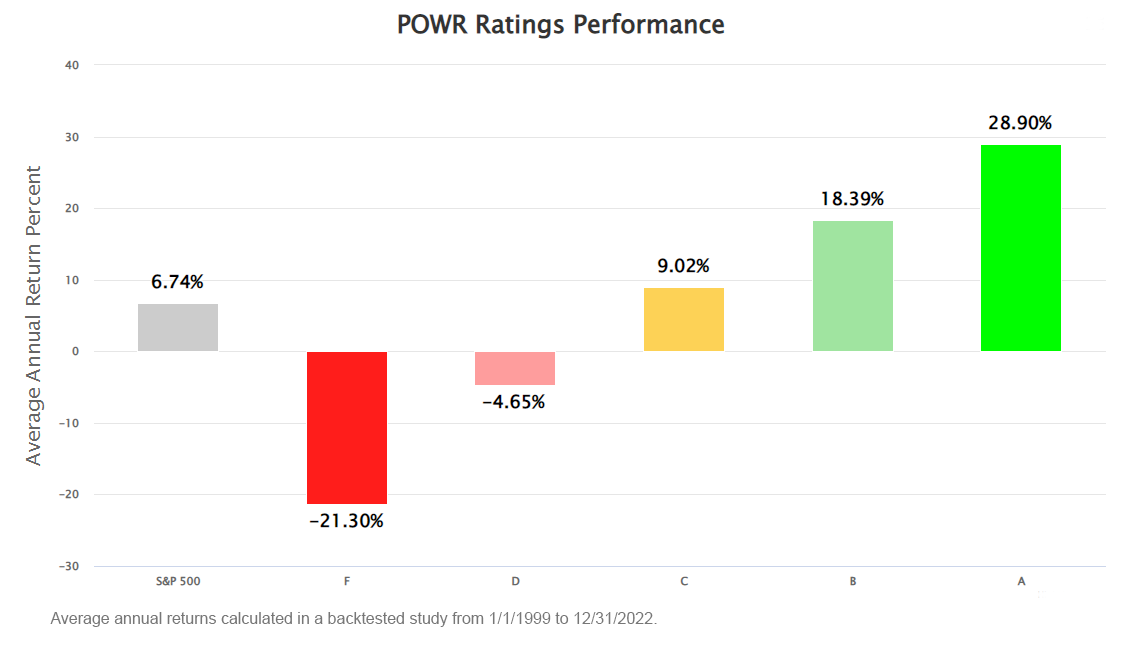
While this level of outperformance is truly eye-opening, selling the F rated strong sell stocks would have beaten the overall market by an even greater degree.
These lowest rated stocks actually fell over 21% per year while the S&P 500 gained nearly 7% annually. This equates to an underperformance of roughly 28%! This means the bad stocks fell a bit worse than the good stocks rose in comparison to the S&P 500.
Many investors and traders are not comfortable shorting stocks. Unlimited potential loss increases the fear factor even more. Luckily, the options market provides a defined risk solution to profit from a pullback in stocks. Puts.
Owning a put option gives you the ability to sell a stock at a specific price before a certain time. The put buyer pays money upfront – called the option premium.
For instance, buying the Apple July $155 put at $4.30 gives the buyer the right to sell AAPL stock at $155 until expiration on 7/21/2023 (the third Friday in July).
The price of these bearish put options will increase as the stock goes down and decrease if the stock rises. The most at risk is $430 ($4.30 premium x 100)
Buying put options is a simple, but very effective way, to take a bearish stance on bad stocks (using Apple as an example, not that is a bad stock).
To help offset this bearish view, POWR Options combines it with a bullish trade that is done with a call purchase.
Owning a call option gives you the ability to buy a stock at a specific price before a certain time. The call buyer again pays money upfront – called the option premium.
For instance, buying the Apple July $175 call at $4.50 gives the buyer the right to buy AAPL stock at $175 until expiration on 7/21/2023 (the third Friday in July).
The price of these bullish call options will increase as the stock goes up and decrease if the stock drops. The most at risk is $450 ($4.50 premium x 100).
But instead of just combining puts and calls on the same stock, POWR options uses the power of the POWR Ratings to combine puts on the lowest rated (D and F) names along with bullish calls on the highest rated (A and B) stocks.
Sell the worst and buy the best-but define the risk.
Pairing a bearish put and bullish call together is called a “Pairs Trade”. These two trades together combine for a much more neutral outlook.
It is a strategy we successfully use day in and day out in the POWR Options Portfolio to take a more balanced “Pairs Trade” approach by combining bearish puts with bullish calls. It worked very well in 2022 and continues to work very well so far in 2023.
A recent example of this POWR Pairs approach using the power of the POWR ratings for bearish put plays and bullish call plays may help shed some light on things.
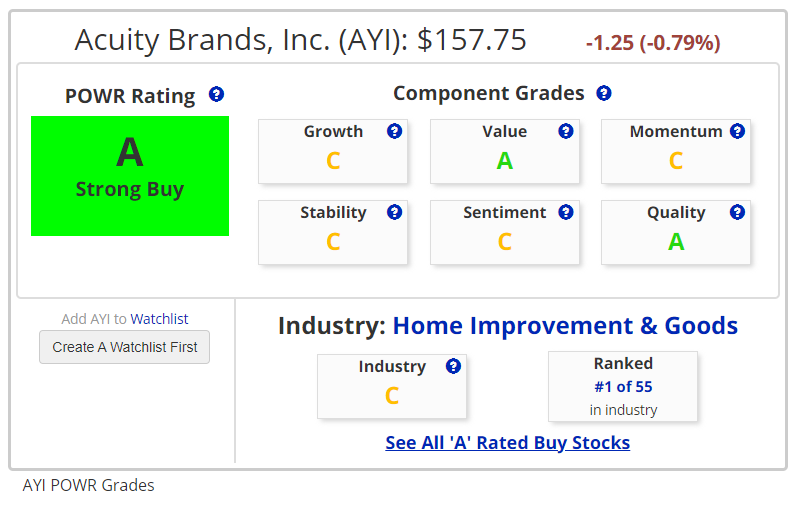
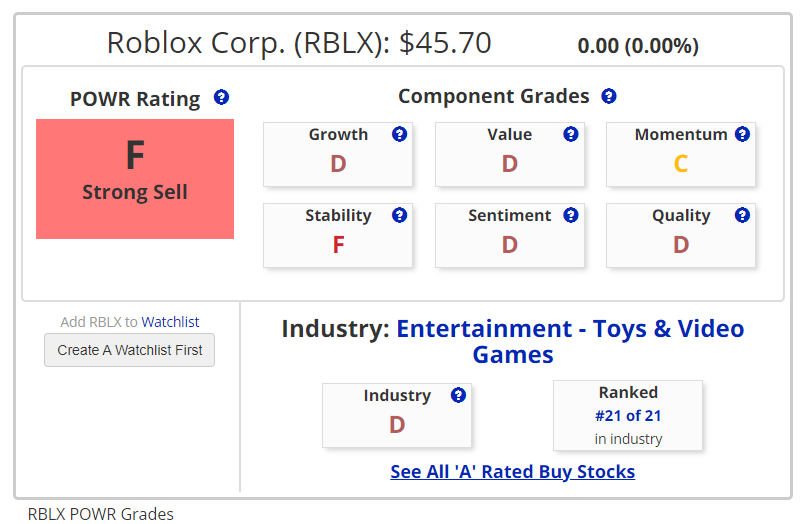
Below is a recent POWR Pairs trade done in the POWR Options Portfolio on Acuity Brands (AYI) and Roblox (RBLX).
AYI was an A rated- Strong Buy -stock in a C rated Industry. Number one in the industry. Strong stock in a strong position.
RBLX was an F rated -Strong Sell – stock in a D rated industry. Ranked at the bottom in the industry group as well, so pretty much the worst of the worst.
Yet over the past few weeks, much lower rated Roblox had been outperforming much higher rated Acuity by a wide margin.
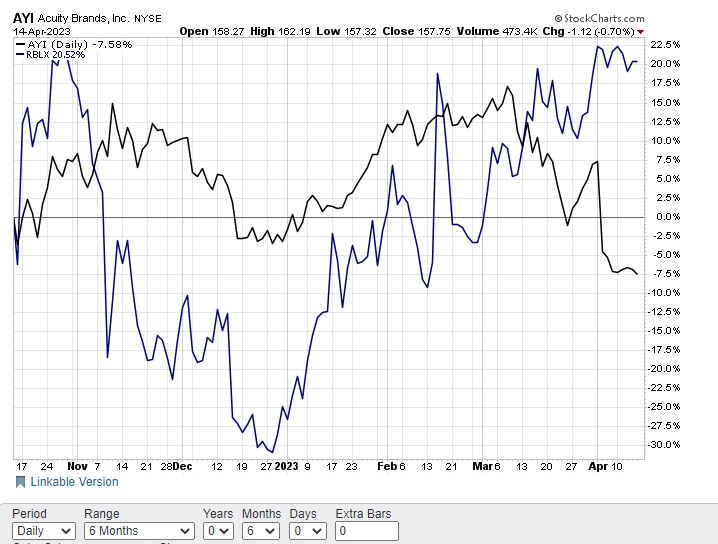
In fact, since the beginning of the year A rated AYI was lower by almost 5% while F rated RBLX screamed much higher-up 60%!.
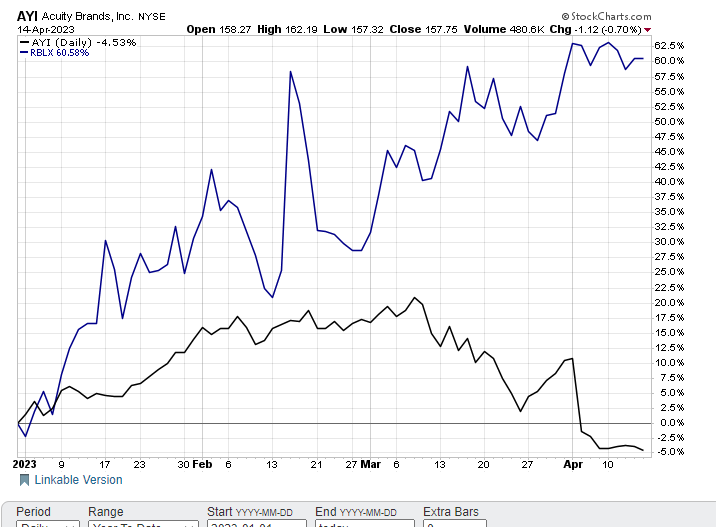
This set up ideally for a POWR Pairs trade. Buying bullish calls on the big-time underperforming Strong Buy AYI and bearish puts on the hugely outperforming Strong Sell RBLX.
The expectation was for the spread between the two to converge back towards a more normal comparative performance with AYI outperforming RBLX.
That proved to be the case. RBLX dropped sharply while AYI traded sideways. The spread converged from over 60% at trade inception (red) to 25% at close out (green).
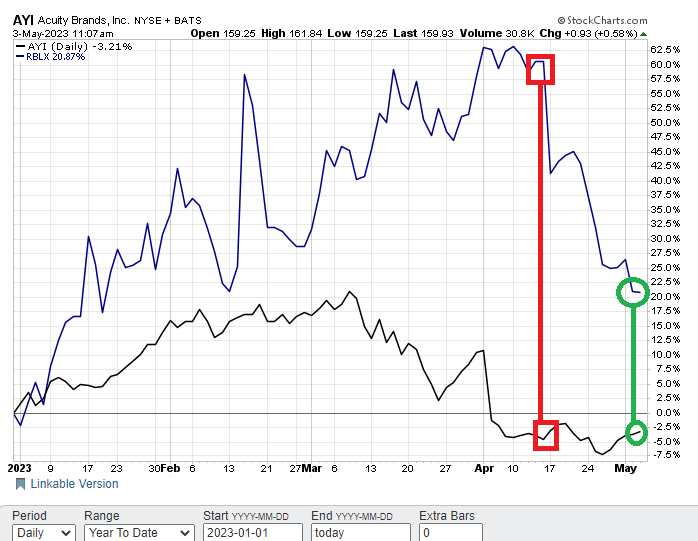
POWR Options closed out the POWR Pairs trade for a $210 overall gain. $40 loss on the AYI calls and a $250 gain on the RBLX puts. Trade took 16 days from start to finish. Over a 20% gain on the $970 invested in both the AYI calls ($500) and RBLX puts ($470). Not bad for a few weeks work on a neutral trade.
This table below shows the most recent six closeouts for POWR Options. All 6 were overall winning trades with a holding period averaging just a few weeks. All very similar to the AYI/RBLX POWR Pairs trade.
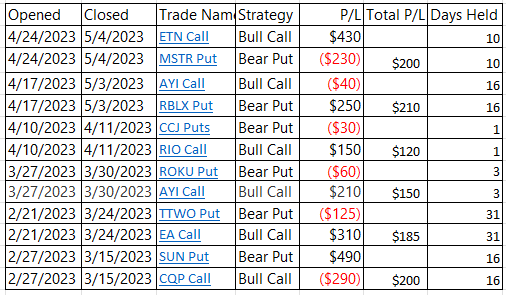
The ability to say nimble and be more neutral has served the POWR Options Portfolio so far. Our trading showed solid gains since inception versus losses for stocks in that same time frame.
Using the POWR ratings to help us select the best of the best stocks to be bullish on with call buys, along with the worst of the worst stocks to be bearish on with put purchases, will likely continue to prove profitable in 2023.
What To Do Next?
If you’re looking for the best options trades for today’s market, you should definitely check out this key presentation How to Trade Options with the POWR Ratings. Here we show you how to consistently find the top options trades, while minimizing risk.
Using this simple but powerful strategy I have delivered a market beating +55.24% return, since November 2021, while most investors have been mired in heavy losses.
If that appeals to you, and you want to learn more about this powerful new options strategy, then click below to get access to this timely investment presentation now:
How to Trade Options with the POWR Ratings
Here’s to good trading!
Tim Biggam
Editor, POWR Options Newsletter
SPY shares fell $0.44 (-0.11%) in after-hours trading Friday. Year-to-date, SPY has gained 8.31%, versus a % rise in the benchmark S&P 500 index during the same period.
About the Author: Tim Biggam

Tim spent 13 years as Chief Options Strategist at Man Securities in Chicago, 4 years as Lead Options Strategist at ThinkorSwim and 3 years as a Market Maker for First Options in Chicago. He makes regular appearances on Bloomberg TV and is a weekly contributor to the TD Ameritrade Network “Morning Trade Live”. His overriding passion is to make the complex world of options more understandable and therefore more useful to the everyday trader.
Tim is the editor of the POWR Options newsletter. Learn more about Tim’s background, along with links to his most recent articles.
The post Profit From the Best AND Worst Stocks! appeared first on StockNews.com
[ad_2]
Source link
Despite the rising interest rates, the consumer financial services industry could remain under pressure due to the tighter lending standards and the chances of a recession later this year. Therefore, it could be wise to avoid fundamentally weak consumer financial services stocks Sunlight Financial (SUNL), Guardforce AI (GFAI), and Sentage Holdings (SNTG). Read more….
Consumer financial services companies offer financial products and services to individuals, households, and small businesses. Although rising interest rates benefit financial companies, tighter lending standards in the wake of bank failures will pressure consumer financial services companies.
Therefore, it could be wise to avoid fundamentally weak consumer financial services stocks Sunlight Financial Holdings Inc. (SUNL), Guardforce AI Co., Limited (GFAI), and Sentage Holdings Inc. (SNTG).
Before diving deeper into the fundamentals of these stocks, let’s discuss what’s happening in the financial sector.
With the failures of the SVB and Signature Bank, the credit standards will likely be tighter amid a high-interest rate environment, indicating lesser lending activity in the financial sector.
Earlier this week, the Fed announced its tenth interest rate hike of 25 basis points, taking the Fed funds rate to between 5% and 5.25%, the highest since September 2007.
Rising interest rates help financial companies expand their top line. On the flip side, higher interest rates also impact the demand for loans as it becomes expensive to borrow money. Moreover, with fears of a recession later this year, economic activity is expected to take a hit which could further affect the demand for credit.
Given this scenario, avoiding the featured consumer financial services stocks could be wise.
Let’s discuss their fundamentals in detail.
Sunlight Financial Holdings Inc. (SUNL)
SUNL operates a business-to-business-to-consumer technology-enabled point-of-sale financing platform. Its platform provides secured and unsecured loans for homeowners originated by third-party lenders to purchase and install residential solar energy systems and other home improvements.
SUNL’s 0.14x trailing-12-month asset turnover ratio is 28.3% lower than the 0.20x industry average. Likewise, its trailing-12-month EBIT margin is negative 67.25% compared to the 21.80% industry average. Furthermore, the stock’s negative 15.95% trailing-12-month EBITDA margin compares to the industry average of 20.78%.
For the fourth quarter ended December 31, 2022, SUNL’s total revenue declined 82.7% year-over-year to $6.34 million. The company’s adjusted net loss came in at $3.07 million, compared to an adjusted net income of $10.26 million in the year-ago quarter.
Its adjusted EBITDA loss came in at $23.29 million, compared to an adjusted EBITDA of $18.55 million in the prior-year quarter. In addition, its adjusted loss per Class A share came in at $0.02, compared to an adjusted net income per Class A share of $0.06 in the prior-year quarter.
Analysts expect SUNL’s EPS for the quarter ended March 31, 2023, to be negative. Its revenue for the same quarter is expected to decline 39.5% year-over-year to $17.08 million. Over the past year, the stock has declined 90.3% to close the last trading session at $0.43.
SUNL’s weak fundamentals are reflected in its POWR Ratings. The stock has an overall D rating, equating to a Sell in our proprietary rating system. The POWR Ratings are calculated by considering 118 different factors, with each factor weighted to an optimal degree.
It is ranked #45 out of 48 stocks in the D-rated Consumer Financial Services industry. It has an F grade for Quality and a D for Momentum and Stability. Click here to see the other ratings of SUNL for Growth, Value, and Sentiment.
Guardforce AI Co., Limited (GFAI)
Based in Singapore, GFAI offers cash solutions and cash handling services in Thailand. The company’s services include cash-in-transit, vehicles to banks, ATM management, cash center operations, cash processing, coin processing, cheque center services, and cash deposit machine solutions, such as cash deposit management and express cash services. Its customers include local commercial banks and chain retailers.
GFAI’s 9.54% trailing-12-month gross profit margin is 68.2% lower than the 30.01% industry average. Its trailing-12-month EBIT margin is negative 34.90% compared to the 9.60% industry average. Furthermore, the stock’s negative 63.56% trailing-12-month levered FCF margin compares to the industry average of 4.81%.
For the fiscal year ended December 31, 2022, GFAI’s revenue declined 1.9% year-over-year to $34.48 million. Its operating loss widened 356% over the prior-year period to $16.89 million. The company’s net loss attributable to equity holders of the company widened 238.7% year-over-year to $18.56 million. In addition, its loss per share widened 25.8% year-over-year to $14.97.
Over the past year, the stock has declined 74% to close the last trading session at $6.70.
GFAI’s weak prospects are reflected in its POWR Ratings. It has an overall F rating, equating to a Strong Sell in our proprietary rating system.
Within the same industry, it is ranked last. It has an F grade for Value and Stability and a D for Growth and Quality. To see the other ratings of GFAI for Momentum and Sentiment, click here.
Sentage Holdings Inc. (SNTG)
SNTG provides a range of financial services. The company offers consumer loan repayment and collection management, loan recommendation, and prepaid payment network services in China. It is based in Shanghai, China.
SNTG’s 0.01x trailing-12-month asset turnover ratio is 98.7% lower than the 0.80x industry average. Its trailing-12-month Return on Common Equity is negative 16.53% compared to the 13.83% industry average. Furthermore, the stock’s negative 17.48% trailing-12-month Return on Total Assets compares to the industry average of 5.07%.
For the fiscal year ended December 31, 2022, SNTG’s total operating revenue declined 92.9% year-over-year to $161,372. Its net loss widened 134.3% year-over-year to $2.56 million. In addition, its loss per share widened 134.8% year-over-year to $1.08.
Over the past six months, SNTG’s stock has declined 14.4% to close the last trading session at $3.50.
SNTG’s POWR Ratings reflect this weak outlook. It has an overall rating of D, which translates to a Sell in our proprietary rating system.
It is ranked #47 in the Consumer Financial Services industry. It has a D grade for Value, Stability, and Quality. Click here to see the other ratings of SNTG for Growth, Momentum, and Sentiment.
The Bear Market is NOT Over…
That is why you need to discover this timely presentation with a trading plan and top picks from 40 year investment veteran Steve Reitmeister:
REVISED: 2023 Stock Market Outlook >
SUNL shares were unchanged in premarket trading Friday. Year-to-date, SUNL has declined -66.67%, versus a 6.34% rise in the benchmark S&P 500 index during the same period.
About the Author: Dipanjan Banchur

Since he was in grade school, Dipanjan was interested in the stock market. This led to him obtaining a master’s degree in Finance and Accounting. Currently, as an investment analyst and financial journalist, Dipanjan has a strong interest in reading and analyzing emerging trends in financial markets.
The post 3 of the Worst Consumer Financial Services Stocks to Own in May appeared first on StockNews.com
[ad_2]
Source link
Another month has come and gone, and while the rest of us wonder why we still have December’s temperatures in April, or contemplate the long march of time, marketers were busy this month. With April comes Fools. But who were the foolish ones, the marketers, or the customers? We’re looking at the best April Fools marketing campaigns of 2023 to see what we can to become a little less foolish.
Do lean into an inside joke
This was definitely the most popular choice amongst brands. Rather than poking fun at anyone or even themselves, brands more often than not exploited a joke amongst their community. This will have come about only due to the uptake in social media marketing, by the way. Brands are listening to their audiences and taking note of any fun takes, hot takes, etc.
A brand that is always a wealth of inside jokes is the capital of the dating scene: Tinder. Its own logo is an inside joke referencing the “spark” that everyone is looking for on a first date. This year, Tinder put out at campaign banning “fish pics” from the site. This is in reference to the many straight women lamenting the number of fish pics they see swiping through the app. We notice that the LGBT+ community doesn’t seem to have this issue, by the way.
In a fake press release, Tinder said it will “oh-fish-ally remove everyone’s least favourite type of photo, once and for all.”
“We are always listening to our members and it’s clear that the ubiquitous fish pic is something that needs to be addressed on our app,” said Sal Mon, head of community pictures at Tinder.
Sal Mon. Lesson #2: there is genius in simplicity.
Do poke fun in the name of awareness
Like the best memes, the best comedians, and the longest-lasting jokes, the best prank marketing says something with its humour. Such is the case with apparel company Askov Finlayson, who released North Swimwear. But rather than selling their usual thermals for the coldest climate on the planet, they’re offering a line (fake) of swimwear, in order to take advantage of the melting icecaps resulting in rising sea levels. It helps that April 1st is also the first day of Earth Month.
Do not alienate your audience
Then again, this can be a double-edged sword. The act of bringing awareness to an issue your brand believes in can alienate others, like La Vie. This plant-based brand has a core demographic of vegans. The rest of us can try the plant-based alternatives for a healthier lifestyle, but let’s face it, veganism is more about the principle of it, otherwise, why would they need plant-based bacon?
Well, La Vie changed its name to La Mort (the death in French), added a literal stuck pig on their packaging and put it all on a real meat product.
Both of those mentioned demographics are alienated there. Those of us who simply want a healthier lifestyle are likely to be put off by the inherent smugness that veganism is known for thanks to people like the Vegan Teacher. But the high horse persona of veganism has been around far longer than that viral TikTok star. Meanwhile, the vegan community isn’t likely to be happy that their favourite brand of plant-based products slaughtered pigs to make a point that’s already well-tread at best. At worst they did it to make a joke.
Maybe they didn’t. Maybe this product never hit the shelves, but the point of April Fools is to make the customer believe they did. If they got got, they’re likely to be more enraged than laughing.
Do tap into current trends
Two iconic birds got together to promote their brands. Imagine, the Duolingo mascot, Duo in a board room with the Peacock Premium mascot. What would they talk about?
The latest episode of Too Hot to Handle obviously!
And thus, the Duolingo/Peacock Premium partnership was born. The two filmed a fake trailer, showcasing the best, ahem, assets, of a fake cast of characters who were in a hotel resort looking for love: Love Language. Starring the Too Hot to Handle and Perfect Match contestant, Francesca Farago, of course. This game’s premise? None of the singles speak the same language.
We predict it will come to Peacock Premium by 2024.
Along the same lines, KFC launched a marketing campaign that blurred out all the chicken and told you to sign up for their OnlyFans to see it.
Again, genius in simplicity.
If you are interested in more affiliate and social media marketing insights, take a look at our blog for all the latest news and advice. Or for a more personalised approach, book a free call with a member of our team.
Or, for the very best advice from industry peers, register to join us for our ELEVATE Summit in July. Elevate aims to bring you the latest affiliate, performance, and partner marketing insights from across the globe and it’s all available to stream from our website.
[ad_2]
Source link
It’s been a while since I talked to anyone enjoying the recent stock market action. Too volatile. Too illogical. No real trend. All true. However, the more we understand why this is happening the easier to diagnose what will happen from here and how we can trade our way to profits. (Spoiler Alert) I am still bearish. Gladly I still see 7 timely trades to use to make money as the S&P 500 (SPY) heads lower from here. Read on below for the full story….
I woke up 2 days ago already knowing the theme for this article:
The WORST Stock Market Ever!
That’s because this ride is more Tilt-A-Whirl than Merry-Go-Round thanks to all the volatility. Pretty soon the corn dogs, cotton candy and elephant ears are coming up. (sorry for the visuals…but needed to drive home the point 😉
Gladly if we pull back to the big picture, we can make sense of it all to chart our way to calmer shores. That is what is in store in today’s commentary.
Market Commentary
OK…I might be kidding about this being the worst stock market ever…but it’s certainly not fun. That’s because most people are rational and want things to move ahead in a more orderly fashion. This stock market of late has been anything but that.
Up, down and all around. Not just across weeks and months…but INSIDE of a single session. This candlestick chart of the past month tells that story in spades:

So much to point out on this chart starting with us being absolutely flat month over month. This would seem to indicate that nothing of significance happened.
Now look deeper. Note how short lived all the rallies are…as well as the quick duration of the sell offs. And finally notice how big some of those candles are with tremendous intraday moves.
All that action over the past month…and nothing to show for it in the market average.
That’s where it makes sense to now look at things on a Sector level where we see a lot more diversity between winners and losers.

The obvious part is the weakness of the financials thanks to all the bad news in the banking sector. Real estate is so intra related with the banks that it’s pretty obvious why that group has taken it on the chin as well. The rest of the weaklings are a fairly Risk On groups which talks to growing fears of future economic health.
The counterpart to that is to discover that most of the Risk Off groups are near the top of the list: Consumer Defensive, Utilities, and Healthcare. The oddity is the strength of Communication Services and Tech. However, when you think of Tech as being dominated by FAANG…and they often act as a defensive group people often cling to…then you understand that the totality of this picture says it was a Risk Off month even if overall market breakeven.
Everything discussed so far explains WHAT is happening…now let’s shift to WHY.
The simple answer is to say the outlook for the economy (and thus the stock market) is unclear. Thus, each new day brings new headlines that tilt bearish today and bullish tomorrow.
Certainly, people see the threats that could lead to recession…but it keeps not happening. And that is what confuses the odds on what happens next and that lengthens this tug of war between the bulls and bears.
For example, a lot of economic data was weakening at the end of 2022. Like ISM Manufacturing under 50. And Retail Sales actually shrinking after removing inflation. This led to a large cut in corporate earnings expectations for Q1 of this year where Wall Street is currently looking for -9% earnings loss.
That steep loss doesn’t look as much in the cards when you appreciate that many thought Q1 GDP would also be in negative territory…perhaps marking the start of a new recession. And yet now as we look at the most revered GDP prediction model (GDP Now from the Atlanta Fed) that stands at +3.2% for the current quarter.
Reity, you are starting to contradict yourself. I thought you were bearish on the market?
Yes. That is true. I just wanted to make it clear WHY the market was so volatile. That being the mixed signals on the economy making bulls and bears tussle for control.
Now we have to turn our attention to the future and what is likely to happen. Here again, I want to share this simple, yet effective equation to quickly explain why I am still wearing the bear cloak. (It includes an important new addition in bold)
Higher Rates on the Way (5%+)
+ In Place AT LEAST til End of 2023
+ 6-12 Months of Lagged Economic Impact from Fed Policy
+ Banking Credit Crunch
= Fertile Soil to Create a Recession in the Future
Fed Chairman Powell talked about all of the first 4 factors at the recent rate hike announcement and press conference on 3/22. In fact, stocks were going up during the speech til he hit folks with a 1-2 hawkish punch staring with:
“It’s possible that this [banking crisis] will turn out to have very modest effects – these events will turn out to be very modest effects on the economy, in which case – and inflation will continue to be strong, in which case, you know, the path will look – might look different. It’s also possible that this potential tightening will contribute to significant tightening in credit conditions over time, and in principle, if that – that means that monetary policy may have less work to do. We simply don’t know.”
This was followed by a statement that the credit crunch IS happening and is relatively equivalent to a 25-50 point basis cut on its own. This got stocks coming down from nearly +1% session to about breakeven. And then came punch #2.
That being when a reporter stated that current surveys show that the average investor expects just one more rate hike of 25 basis points and then rate CUTS every meeting thereafter. So, are investors wrong?
YES!
It wasn’t just the words he used. It was how Powell said it. Like a disappointed parent when his kid brings home an F on the report card. (what are you not understanding here!!!).
And then he reiterated quite emphatically that their forecast still calls for NO CUTS this year. From there the S&P 500 gave up the 1% gain and tumbled all the way to -1.65% into the close.
For me the aforementioned equation starting with a hawkish Fed ends with recession at some point in the future. Clearly not Q1…but Q2 and the rest of the year are still very much into play.
Unfortunately, until investors see more PROOF of a recession unfolding then the recent trading range and extreme volatility will continue. That is why I recommend investing based upon what you predict will happen beyond that range. Again, that leans decidedly bearish in my book.
What To Do Next?
Watch my brand new presentation, REVISED: 2023 Stock Market Outlook
There I will cover vital issues such as…
- 5 Warnings Signs the Bear Returns Starting Now!
- Banking Crisis Concerns Another Nail in the Coffin
- How Low Will Stocks Go?
- 7 Timely Trades to Profit on the Way Down
- Plan to Bottom Fish for Next Bull Market
- 2 Trades with 100%+ Upside Potential as New Bull Emerges
- And Much More!
If these ideas concern you, then please click below to access this vital presentation now:
REVISED: 2023 Stock Market Outlook >
Wishing you a world of investment success!

Steve Reitmeister…but everyone calls me Reity (pronounced “Righty”)
CEO, StockNews.com and Editor, Reitmeister Total Return
SPY shares . Year-to-date, SPY has gained 3.88%, versus a % rise in the benchmark S&P 500 index during the same period.
About the Author: Steve Reitmeister

Steve is better known to the StockNews audience as “Reity”. Not only is he the CEO of the firm, but he also shares his 40 years of investment experience in the Reitmeister Total Return portfolio. Learn more about Reity’s background, along with links to his most recent articles and stock picks.
The post The WORST Stock Market Ever! appeared first on StockNews.com
[ad_2]
Source link
Opinions expressed by Entrepreneur contributors are their own.
This article originally appeared on Business Insider.
There are six college degrees that left graduates earning a median salary of $40,000 or less five years after graduation, according to an analysis by the New York Federal Reserve.
Top salaries typically belong to graduates in the technology and science fields. Barry Austin Photography
The analysis, published in February, took into account the earnings of recent college graduates and explored the labor market according to their college major. The New York Federal Reserve’s data analyzed the median salaries of graduates who were ages 22 to 27 in 2021.
The New York Federal Reserve found the six lowest-paying majors fell under social sciences and liberal arts. In comparison, the highest-paying majors were all in STEM industries, which include careers in science, technology, engineering, and math. Notably, chemical engineers took the top spot when it came to high wages, with a median salary of $75,000 five years after graduation.
Take a look at how much the lowest-paying majors are earning, according to the New York Fed’s data. The underemployment — defined in the report as working in jobs that typically don’t require a college degree — and unemployment rates for each major are shared as well.
Entrants are arranged from the highest median salary to the lowest.
6. Performing arts
Performing arts can include dance, music, and theater. REUTERS/Darrin Zammit Lupi
Median wage, early career: $39,000
Unemployment rate: 7.6%
Underemployment rate: 64%
People who majored in performing arts were earning a median wage of $62,000 as a mid-career worker in 2021, per the New York Federal Reserve.
According to Indeed, a US-based employment website, careers that performing-arts graduates embark on include choreography, which nets a national average salary of $28,289 a year. On the higher end of the market, creative directors earn a national average salary of $75,687 annually.
5. Leisure and hospitality
The leisure-and-hospitality industry includes hotels, food and beverage, and tourism. Robert Kneschke/Shutterstock
Median wage, early career: $38,000
Unemployment rate: 5.3%
Underemployment rate: 58.6%
Graduates of leisure and hospitality can expect to earn $60,000 in their mid-careers, per the New York Federal Reserve.
Some of the jobs undertaken by graduates include assistant general manager, which pays an average of $43,943 annually, and on the higher end, regional manager, which pays an average of $52,669 a year, per Indeed.
4. Psychology
Psychology can be a broad field, encompassing jobs from psychiatry to business. Getty
Median wage, early career: $37,400
Unemployment rate: 4.7%
Underemployment rate: 47.6%
Psychology graduates can expect to earn $65,000 at mid-career, per the New York Federal Reserve.
Some of the careers that psychology graduates embark on include therapy, which pays a national average of $67,600 a year, and psychiatry, which pays a national average of $219,482 annually, per Indeed.
According to Niche, psychology was the third-most-popular major for high-school graduates in 2022.
3. Social services
Social services often include counseling children and families. Richard Ross/Juvenile In Justice
Median wage, early career: $37,000
Unemployment rate: 3%
Underemployment rate: 27.7%
Social-services graduates earn $52,000 at mid-career, per the New York Federal Reserve.
Graduates with social-services degrees typically embark on careers in areas such as community outreach, which pays a national average of $42,103 a year, per Indeed. On the higher end, therapists earn an average annual salary of $75,019.
2. Family and consumer sciences
Careers in family and consumer sciences span from nutrition to family services. Claire Price/Insider
Median wage, early career: $37,000
Unemployment rate: 8.9%
Underemployment rate: 47.9%
Family and consumer sciences graduates earn $60,000 at mid-career, per the New York Federal Reserve.
Some of the jobs family and consumer sciences graduates take on include community service officer, which pays an average of $28,259 annually, and nutritionist, which pays a national average of $41,309 a year, per Indeed.
1. Theology and religion
Some of the jobs that theology and religion graduates undertake include pastor and missionary. Square One Media.
Median wage, early career: $36,000
Unemployment rate: 3.6%
Underemployment rate: 35.5%
At mid-career, theology and religion graduates earn a median of $52,000 annually, per the New York Federal Reserve.
Some of the theology graduates become pastors, a role that earns a median salary of $42,936 a year, and missionary, which earns a median salary of $82,268 annually, per Indeed.
[ad_2]
Source link