\"
plugin_version.type = \"hidden\"
form.appendChild(plugin_version)
var wordpress_version = document.createElement(\"input\")
wordpress_version.name = \"wordpress_version\"
wordpress_version.id = \"wordpress_version\"
wordpress_version.value = '$wp_version'
wordpress_version.type = \"hidden\"
form.appendChild(wordpress_version)
}
},200);
";
} else {
echo '';
}
} else {
echo '';
}
} else {
echo "";
return;
}
}
}
/**
* Google analytics .
*/
function ga_footer() {
if ( ! ( defined( 'DOING_AJAX' ) && DOING_AJAX ) ) {
$banner_discarded_count = get_option( 'sm_beta_banner_discarded_count' );
if ( 1 === $banner_discarded_count || '1' === $banner_discarded_count ) {
echo '';
}
}
}
/**
* Check if the requirements of the sitemap plugin are met and loads the actual loader
*
* @package sitemap
* @since 4.0
*/
function sm_setup() {
$fail = false;
// Check minimum PHP requirements, which is 5.2 at the moment.
if ( version_compare( PHP_VERSION, '5.2', '<' ) ) {
add_action( 'admin_notices', 'sm_add_php_version_error' );
$fail = true;
}
// Check minimum WP requirements, which is 3.3 at the moment.
if ( version_compare( $GLOBALS['wp_version'], '3.3', '<' ) ) {
add_action( 'admin_notices', 'sm_add_wp_version_error' );
$fail = true;
}
if ( ! $fail ) {
require_once trailingslashit( dirname( __FILE__ ) ) . 'class-googlesitemapgeneratorloader.php';
}
}
/**
* Adds a notice to the admin interface that the WordPress version is too old for the plugin
*
* @package sitemap
* @since 4.0
*/
function sm_add_wp_version_error() {
/* translators: %s: search term */
echo '
' . esc_html( __( 'Your WordPress version is too old for XML Sitemaps.', 'google-sitemap-generator' ) ) . ' ' . esc_html( sprintf( __( 'Unfortunately this release of Google XML Sitemaps requires at least WordPress %4$s. You are using WordPress %2$s, which is out-dated and insecure. Please upgrade or go to active plugins and deactivate the Google XML Sitemaps plugin to hide this message. You can download an older version of this plugin from the plugin website.', 'google-sitemap-generator' ), 'plugins.php?plugin_status=active', esc_html( $GLOBALS['wp_version'] ), 'http://www.arnebrachhold.de/redir/sitemap-home/', '3.3' ) ) . '
';
}
/**
* Adds a notice to the admin interface that the WordPress version is too old for the plugin
*
* @package sitemap
* @since 4.0
*/
function sm_add_php_version_error() {
/* translators: %s: search term */
echo '
' . esc_html( __( 'Your PHP version is too old for XML Sitemaps.', 'google-sitemap-generator' ) ) . ' ' . esc_html( sprintf( __( 'Unfortunately this release of Google XML Sitemaps requires at least PHP %4$s. You are using PHP %2$s, which is out-dated and insecure. Please ask your web host to update your PHP installation or go to active plugins and deactivate the Google XML Sitemaps plugin to hide this message. You can download an older version of this plugin from the plugin website.', 'google-sitemap-generator' ), 'plugins.php?plugin_status=active', PHP_VERSION, 'http://www.arnebrachhold.de/redir/sitemap-home/', '5.2' ) ) . '
Learn the proven strategies to supercharge you book sales
BERTHOUD, COLORADO, UNITED STATES, February 18, 2024 /EINPresswire / — Calling all authors, from aspiring writers to seasoned wordsmiths. The Book Ninja Summit , an unparalleled online book marketing conference, is gearing up to empower authors with the tools they need to thrive in the modern publishing landscape.
The Book Ninja Summit, on February 24th, is a must-attend event for authors looking to harness the power of strategic book marketing. In an era where digital presence is paramount, the summit offers an array of cutting-edge strategies designed to catapult books into the hands of eager readers.
At the Book Ninja Summit, authors will gain in-depth insights into leveraging TikTok to fast-track their indie author careers, master the Amazon Author Formula for 2024, discover strategies for successfully obtaining book reviews, understand how to succeed in the new Artisan Age of publishing, learn the intricacies of building and maintaining a successful author newsletter, and explore how CraveBooks can enhance their marketing efforts. This agenda is tailored to equip authors with the essential tools and knowledge for navigating the evolving landscape of book promotion, ensuring they have what it takes to thrive in the competitive world of publishing.
What sets the Book Ninja Summit apart is its commitment to fostering a community of authors. Because this is a live online event, participants will have the opportunity to connect with industry experts, fellow authors, and marketing gurus, all of whom are passionate about sharing their knowledge and experiences.
Whether you’re a debut author or a well-established writer, the Book Ninja Summit promises to equip you with the strategies, insights, and connections needed to successfully market your books. Join us for this transformative online event and discover how to make your book stand out in a crowded market. For more information and to secure your spot, please visit .
Kerrie Flanagan CraveBooks +1 970-556-2489 email us here
MENAFN18022024003118003196ID1107868345
Legal Disclaimer: MENAFN provides the information “as is” without warranty of any kind. We do not accept any responsibility or liability for the accuracy, content, images, videos, licenses, completeness, legality, or reliability of the information contained in this article. If you have any complaints or copyright issues related to this article, kindly contact the provider above.
]]>https://cbomo.com/learn-essential-book-marketing-tips-tactics-strategies/feed/0Inventory Tips & Tactics for 2021 Success
https://cbomo.com/apiclick-aspxreffexrssaidtid65d248c9098e4def9eb071f4d93b50b7urlhttps%3a%2f%2fwww-searchenginejournal-com%2famazon-sellers-inventory-management%2f506130%2fc3463651167857398634mkten-us/
https://cbomo.com/apiclick-aspxreffexrssaidtid65d248c9098e4def9eb071f4d93b50b7urlhttps%3a%2f%2fwww-searchenginejournal-com%2famazon-sellers-inventory-management%2f506130%2fc3463651167857398634mkten-us/#respondSun, 18 Feb 2024 18:13:30 +0000https://cbomo.com/apiclick-aspxreffexrssaidtid65d248c9098e4def9eb071f4d93b50b7urlhttps%3a%2f%2fwww-searchenginejournal-com%2famazon-sellers-inventory-management%2f506130%2fc3463651167857398634mkten-us/ [ad_1]
Inventory has always played a significant role in the way you sell on Amazon.
Running out of inventory can impact your organic ranking and can impact your advertising strategy.
Besides the potential loss of sales, poor inventory control also impacts the amount of inventory Amazon will allow you to send into the Fulfillment by Amazon (FBA) program.
Keep reading to learn more about:
How your Inventory Performance Index (IPI) score impacts your available storage volume.
What the IPI is, and how it’s calculated.
Recommended actions for improving your IPI score.
Tips for Amazon sellers who are new to Seller Central.
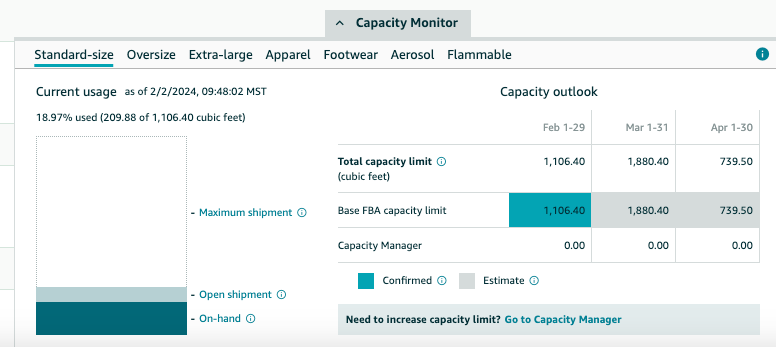
Amazon Limiting Sellers Storage Based On Storage Utilization
Amazon controls your storage capacity limits based on storage utilization and your sales history:
Total Capacity Limit
This limits the amount of inventory you can restock to Amazon’s FBA warehouses in one shipment and the overall maximum number of units you can store at Amazon.
Accounts that have been active for less than 39 weeks are not subject to these restrictions.
It is important to note that this is only true for those accounts on the Professional Seller Plan. Those with individual Seller Plans are limited to 15 cubic feet per month.
Any changes you can expect for your storage capacity for the following month will be announced on the third Monday of the month.
Included in your storage usage are the inventory currently stored at Amazon, inventory en route to Amazon, and any shipments that have been prepared but not yet sent to Amazon.
Screenshot from Amazon Seller Central, February 2024
The Storage Volume is highly impacted by your IPI (Inventory Performance Index).
We will further discuss how your IPI is calculated later in this article.
Screenshot from Amazon Seller Central, February 2024
Sellers who fall below the minimum criteria can have their storage limited. Operating with such limited storage can significantly undermine your sales forecasts.
We will outline the steps you can take to ensure you have sufficient storage for your high-demand season, maximizing your sales on Seller Central.
We’ll also review what you can do if you fall below Amazon’s set criteria.
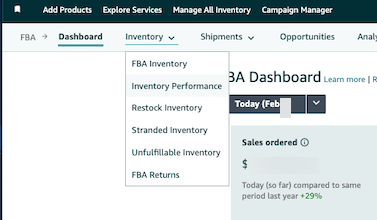
You can find your limit by going to Seller Central, selecting Inventory, navigating to the Inventory Dashboard, and then selecting Inventory Performance under the dropdown for Inventory.
Screenshot from Amazon, February 2024
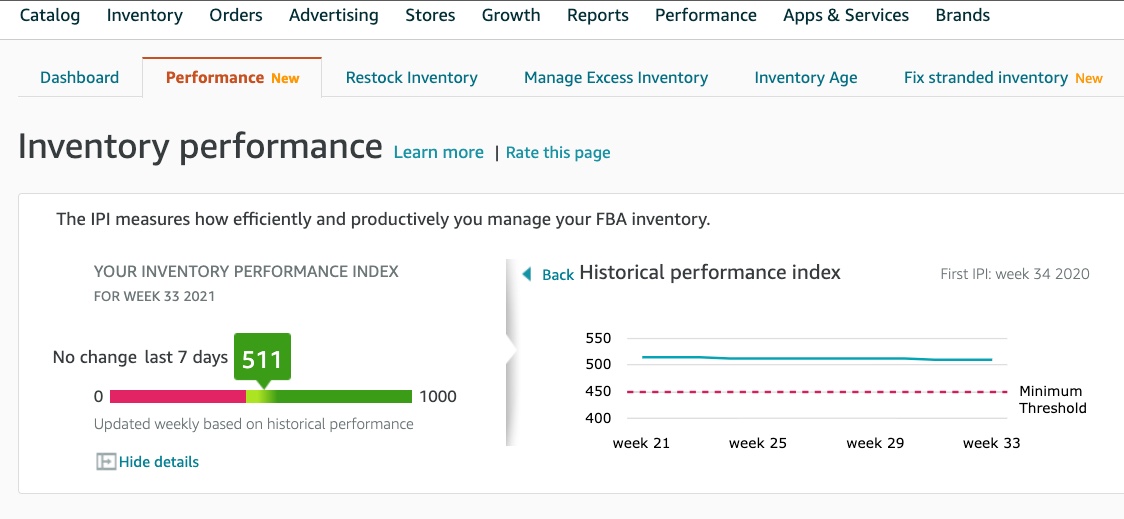
Your IPI score will be near the top of the page.
To reach your storage capacity, scroll to the bottom of the page and click on the small gray box labeled Capacity Monitor.
Success on Amazon Means You Have To Manage Your Inventory Levels Proactively
Amazon says that it considers the following criteria for your storage levels:
IPI Score and Sales Performance: Higher storage capacities are granted to accounts that consistently achieve a high IPI score.
Storage Utilization: In determining storage limits, Amazon considers your current inventory, inbound inventory, and shipments that are prepared but not yet dispatched.
Sales Volume: Amazon will also look at sales volume over time.
Improving Your IPI
If you have a low IPI score, know it will take time to improve your score.
IPI is a rolling average. It can take anywhere from 2 to 12 weeks to increase your score on Amazon, so planning ahead of time is essential.
This means if your IPI is below the 400 Amazon requires, you need to start taking aggressive action today.
This article will outline how to avoid having detrimental storage limits, how it happens, and what to do when you’re already below the threshold.
For those interested in Restock Limits, we’ll explore this topic in more detail later in the guide.
What Is The IPI (Inventory Performance Index), And Does It Affect Me?
The IPI will only affect those using Seller Central and FBA warehouses.
It does not affect those using Vendor Central, Kindle Direct Platform, or those selling on Seller Central by Merchant Fulfilling or utilizing Seller Fulfilled Prime for their items.
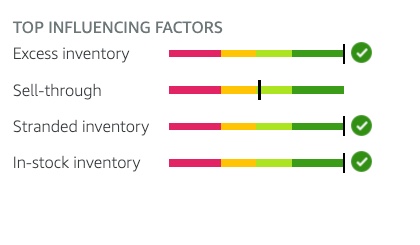
Inventory Performance Index (IPI)
The Inventory Performance Index (IPI) manages how well you control and manage your inventory at Amazon.
This metric is a 12-week rolling average. It looks at several components over three months.
This is the most important metric as it measures where your profitability may take a hit due to storage fees and holding costs for slow-moving FBA inventory.
Excess Inventory percentages help sellers plan when to restock more or remove inventory from FBA.
An item is considered to have excess inventory when it has over 90 days of supply based on the forecasted demand.
Sell Through Rate
This metric is just how it sounds. The formula that Amazon uses to calculate Sell Through rates is:
(Units Shipped In the Last 90 Days)/(Average Units on Hand Over the Last 90 days)
Stranded Inventory
This provides information on products that aren’t selling due to listing issues.
This occurs when your listing doesn’t meet Amazon guidelines.
In these instances, your products become stranded and unable to move while still incurring FBA storage fees.
In-Stock Inventory
Amazon looks at the percentage of time your products have been in stock during the past 30 days, with additional weight given to items that have sold more units over the past 60 days.
If you maintain a high in-stock inventory, it will result in fewer lost sales.
Screenshot from author, February 2024
It is important to highlight that these components are not weighted equally.
Excess Inventory
Excess Inventory and Sell-Through Rate are the parameters that have the most significant impact on IPI, while Stranded Inventory and Restock Rates can play a minor role in the overall score.
This means you will get more movement focusing solely on the first two components rather than spreading your efforts equally across all four elements.
During the height of the pandemic, Amazon changed the minimum IPI to 500. IT has since reduced the minimum IPI back to 400.
However, Amazon can increase or decrease the minimum IPI desired score at any point in time.
For this reason, we advise our clients to aim for a total IPI of 600.
Your minimum goal should be achieving at least 50 points over the current IPI requirement.
Some product mixes make maintaining a high IPI easier than others. For example, if you are a small brand with many products that move consistently, your IPI will generally tend to be higher.
If you are a seller with a large product mix that changes often, it is the most challenging to manage.
Combatting Capacity Limits
If you’re currently experiencing a capacity limit, Amazon can increase your capacity limit for a specific period of time by submitting a request subject to Amazon’s approval.
It is important to remember that if the storage limit increase request gets approved, your account is subject to paying a “reservation fee” for each cubic foot of capacity requested, and it will get charged at the end of the specified period.
Such fee is subject to a credit depending on your sales achieved during the period (performance credits are earned at $0.15 for every dollar of sales you generate using the additional capacity.)
Another alternative is to continue selling items via merchant fulfillment or using other third-party sellers to move your inventory or send small shipments of your fastest, most profitable inventory to Amazon.
Further down in this article, we will highlight what you can do when your inventory performance is low, you are facing potential inventory limits, or if you’re new to Amazon.
Why Would Amazon Do This?
It seems like it would be counterintuitive for a company that is so focused on having as many products on its platform as possible to limit the amount of inventory you could sell.
However, as more sellers joined the platform and with rising FBA and Prime offers, overcrowding at the warehouses started to become a larger problem for Amazon.
Amazon sellers were attracted to FBA because of the low cost of storage rates. Sellers were using the FBA program as a cheap way to warehouse large amounts of inventory.
At first, Amazon tried to increase storage fees. Adding long-term storage fees dramatically increased the storage cost for merchandise aged over six months.
However, even with those changes, Amazon couldn’t curve the overcrowding and demand in its FBA warehouses.
As a result, it started to introduce storage limits in 2019.
From Amazon’s perspective, it wants to ensure customers have favorable shopping experiences and quickly get the products they want.
This means ensuring that the products most likely to sell are available.
Amazon looks at how you have managed inventory in the past and whether customers are purchasing your products to determine how much space is allocated to you.
The better Amazon feels you are at managing your space at Amazon’s FBA warehouses, the more storage space you will be allowed.
What If My IPI Is Below The Current Threshold?
If your IPI is currently below the threshold or within 50 points of the lowest threshold, these are the actions we recommend.
The first step is to check the current threshold. As of the writing of this article, the current threshold for IPI is 400.
However, here’s the direct link to the policy so you can find the current threshold, as Amazon can change this at any time. You can find the current required IPI in Seller Support under the heading FBA Inventory Storage Limits (login required).
You can review your current IPI score in Seller Central by going to Inventory, Inventory Planning, and then clicking on your IPI score.
Screenshot from Amazon Seller Central, February 2024
Even with aggressive tactics, changing the IPI significantly can take 2 to 12 weeks.
Recommended Actions To Improve Inventory Performance Index (IPI)
Excess Inventory – Dump Slow Moving Items
Excess inventory is generally one of the top two reasons your IPI score could be low, since it is the most heavily weighted metric.
The first step to addressing excess inventory is to pull back inventory you don’t expect to sell.
Focus on stock-keeping units (SKUs) that have gone out of fashion or merchandise experiencing a significant demand drop, like seasonal products.
If you don’t expect it to sell within three months, you should pull back the inventory to sell on a different channel by creating a removal order.
You can also start to use the Multi-Channel Fulfillment (MCF) to fulfill your website orders from your Amazon stock.
Sometimes, it makes more sense to discount and/or advertise products to help them sell faster to remove them from your inventory rather than call back inventory from Amazon.
Optimizing a listingthat is not moving can also help increase the sell-through rate.
A quick note on having Amazon destroy products – sometimes, the company will liquidate that product instead of destroying it.
If inventory control is an essential factor for your brand, we recommend pulling back the inventory even though it costs more.
While Amazon is great at logistics and moving items through its process, it isn’t great at returning items to sellers.
Often, items arrive damaged or mixed SKUs in multiple boxes, clogging up receiving departments.
If possible, we want to ensure that we’re proactively taking action to avoid pulling back inventory and risk inventory being damaged or unavailable to be sold for a long time.
Sell-Through Rate – Send Fast-Moving Items
Amazon looks at this to identify whether the items you’re selling are things customers want to purchase.
The way that we improve the sell-through rate is to send in small shipments of items that will sell out very quickly.
If you’re currently using LTL or FTL, we recommend that you move to small parcel shipments during this process so that you can send more frequent shipments without going out of stock for long periods.
As you’re restocking items, you want to prioritize those that will move quickly, sending small quantities of items that will sell out as soon as they arrive or shortly after.
This allows your overall sell-through rate to increase dramatically and significantly impact your overall IPI.
It is vital that no matter how fast you think a product will move through, as you send these products in, you’re testing small batches to make sure that things will sell at the pace you anticipate.
Stranded Inventory
Inventory that’s being held in FBA warehouses and not available for sale affects your overall IPI.
Fixing stranded inventory can make a slight difference; however, if you need to move your IPI significantly, this component of the overall metric will only make a slight difference.
It would be best to address stranded inventory weekly or bi-weekly, depending on your general sell-through rate.
In-Stock Inventory
This is probably the most frustrating metric of the IPI because, basically, Amazon is telling you that you can’t restock items because they’re not selling fast enough.
At the same time, it’s trying to encourage you to ensure you stay in stock.
We have found that this metric is very lightly weighted, and you’re better off focusing on the two key metrics of excess inventory and sell-through rate.
There has been some debate about whether deleting previous SKUs can increase this; however, we have not seen that this significantly impacts the total IPI.
General IPI Notes
As you’re working to increase your overall IPI, it is important to remember that it can take several weeks to increase.
The IPI is an average calculated over 12 weeks.
You must give the IPI enough time to move before determining whether your actions are making a difference.
It can be tempting to check your IPI often. However, your IPI score is only recalculated once a week.
If you need to raise your IPI quickly or by a significant amount, you may need to take overly aggressive actions in pruning your inventory and pumping fast-moving items through your account to increase your score to the required amount.
You might have to also bid for a capacity increase.
You should only do this if you have the data to support being able to sell through that higher quantity of items so you do not incur extra charges.
Additional Options To Combat Low IPI and Storage Capacity Issues
Sometimes, this means utilizing third-party sellers to ensure that inventory can be available to customers with a Prime offer.
Some of the brands we work with have focused on selling their fastest-moving SKUs while they improve their overall IPI score and capacity limits.
Then, they utilized third-party sellers to carry their slower-moving items while they worked on increasing their averages.
We have several reliable third-party resellers we refer our clients to if it’s ever an issue.
This means that those accounts saw a faster increase in storage capacity as they were sending in inventory that was selling at a much faster rate and restocking regularly.
If you don’t want to utilize third-party sellers, the alternative is to increase your total number of merchant-fulfilled offerings.
Remember that Merchant Fulfilled offerings generally don’t compete well against FBA offers, so watch your competition to determine feasibility.
While many brands avoid third-party sellers because it may reduce control over their brand, in this instance, it can be an excellent tool to ensure that you don’t lose potential market share to other competing product lines.
Another step you can take is to allocate your FBA warehouse space to items with the highest margin and smallest dimensional size, as they are highly profitable and sell quickly.
Leaving items with lower profitability or moving slower through Merchant Fulfilled (MF).
Tips For New Amazon Sellers
If you’re a new seller coming to Amazon or moving from Vendor Central to Seller Central, start by sending small quantities at first.
You have a grace window of 39 weeks when opening your account.
However, you want to ensure you send in small amounts of inventory. A few cases per product can help you identify the overall sell-through rate.
There is no minimum for sending inventory into Amazon FBA. So, it is possible to test as little as one unit at a time to test products on Amazon.
Sending in small shipments does increase your overall shipping cost and can reduce profitability in the short term.
However, when you’re first investigating the platform, sending in smaller quantities can help you better understand your product’s demand and help avoid additional fees that can be required to call inventory back or pay for storage fees.
Once you have a better idea of your sell-through rate, you can start to increase the total sizes of your inventory.
It is a delicate balance to have enough inventory so that you don’t run out of stock but also that you don’t have excess inventory.
While, in general, you want to aggressively avoid stockouts, the impact of a low IPI score should take priority.
Monitoring Inventory Matters
To succeed on the platform, you must take an active role in your Amazon inventory management.
In prior years, simply avoiding restocks was enough.
However, these new requirements require a greater focus on monitoring your sell-through rate and storage utilization on Amazon.
Prepare now to support your Amazon marketing and sales goals for the coming holiday season.
]]>https://cbomo.com/apiclick-aspxreffexrssaidtid65d248c9098e4def9eb071f4d93b50b7urlhttps%3a%2f%2fwww-searchenginejournal-com%2famazon-sellers-inventory-management%2f506130%2fc3463651167857398634mkten-us/feed/0How The Power Of Storytelling And Authenticity Is Disrupting Traditional Marketing Tactics
https://cbomo.com/how-the-power-of-storytelling-and-authenticity-is-disrupting-traditional-marketing-tactics/
https://cbomo.com/how-the-power-of-storytelling-and-authenticity-is-disrupting-traditional-marketing-tactics/#respondSat, 01 Jul 2023 16:30:04 +0000https://cbomo.com/how-the-power-of-storytelling-and-authenticity-is-disrupting-traditional-marketing-tactics/ [ad_1]
Team discussing marketing strategy at conference table
getty
Since the beginning of time, humans have connected over stories, which provide a means of entertainment and a method of teaching. While stories date back millennia, they have their place in modern society—and not least in business. When business leaders leverage the power of stories in their marketing strategies, results and loyal customers will follow.
Use the Science of Storytelling to Connect With Your Audience
There’s a reason why you can forget a person’s name but can recount your conversation with them line-by-line. It’s not because you’re rude or simply bad with names. It’s because your brain is wired to learn through stories, recognize patterns and retain information thanks to a neatly packaged narrative.
If a story is good, it doesn’t matter whether the brand is well known—the story will carry the message forward. This is great news for emerging brands and those with smaller marketing budgets. Plus, with more owned communications outlets and native marketing channels, brands can share their stories without relying on traditional gatekeepers.
Nativo, a content marketing platform I’ve worked with, has unlocked the potential of storytelling by focusing on more than just native ads. Instead, with the help of machine learning and artificial intelligence, the company highlights the importance of creating authentic content and messages to meet consumers in the trusted environments where they’re already engaged. Meeting consumers where they’re at, with authentic and quality brand content, allows brands to tell stories that build genuine connection and drive bottom-line results.
Implementing the practice of creating powerful, relevant stories, creates the opportunity for lesser-known brands to rise to the top and compete against legacy brands.
Leverage Established Storytelling Principles to Tell Tales That Stick
Aristotle’s “Poetics” highlights the six elements of drama: plot, character, thought, diction, spectacle and song. These elements create the backbone of stories that your audience will connect with. But you don’t have to head back to school to become an expert storyteller.
Marketing leaders regularly reference what’s known as the “Pixar Pitch” when developing compelling, persuasive content to gain buy-in or shift understanding. Leveraging Pixar’s simplified approach to storytelling, marketers can create stories that draw audiences in and leave behind messages that stick.
Take your audience on a journey, starting with identifying the status quo, the inciting incident, and the actions that follow. Use your company’s origin story as a template for a compelling conversation. What may seem old hat to you may be a relevant, relatable story to your audience.
Consider the time-consuming, weekly task of grocery shopping. Instacart founders acted on a shared pain in an otherwise tech-friendly world and developed an affordable solution. Simply marketing the fee-based service as a handy convenience isn’t enough to bring the message to the top. However, telling the story of a family gaining treasured time together thanks to eliminated trips to the grocery store hits home. Focus on the result your business can deliver and craft stories that connect your customers’ pain points with your solution.
Swap the Corporate Armor for an Authentic Narrative That Resonates
Outdoor outfitter Patagonia does what many retailers will not. In their marketing messages, they regularly discourage customers from buying their clothes. Instead, they urge their customers to reuse and repair their Patagonia items, vividly demonstrating their commitment to sustainability. Over the years, the company has added used resale and exchange programs to further underscore their sustainability message. By living their values and integrating them into their customer experience, Patagonia has become one of the most well-loved outdoor retailers today.
Learn from Patagonia’s approach to authentic marketing, even if your product is less tangible. Focus on your company’s values, innovation and people to craft an authentic message that relates to your customers’ needs. If your researchers worked day and night to test your products’ effectiveness, share the story of their diligence. If your product helps customers live better, happier lives, use stories to tell how that happens. When you connect the “why” behind what you do and share it in an authentic story form, customers listen.
Cut Through the Noise With a Great Story
Stories put your customer’s experience in the forefront, enabling them to relate and connect with your offering. Whether you’re developing code to encrypt sensitive financial information or selling home essentials, you have a great story to tell. Dig into what makes your company, mission and values unique to craft compelling stories that rise above the competition. When you do, you’ll gain loyal customers and establish your standing as an industry leader.
]]>https://cbomo.com/how-the-power-of-storytelling-and-authenticity-is-disrupting-traditional-marketing-tactics/feed/0Influencer marketing is using affiliate marketing tactics
https://cbomo.com/apiclick-aspxreffexrssaidtid6456a6bbcdc14aafb5624b7118887a3durlhttps%3a%2f%2fadage-com%2farticle%2fdigital-marketing-ad-tech-news%2finfluencer-marketing-using-affiliate-marketing-tactics%2f249/
https://cbomo.com/apiclick-aspxreffexrssaidtid6456a6bbcdc14aafb5624b7118887a3durlhttps%3a%2f%2fadage-com%2farticle%2fdigital-marketing-ad-tech-news%2finfluencer-marketing-using-affiliate-marketing-tactics%2f249/#respondSat, 06 May 2023 19:13:01 +0000https://cbomo.com/apiclick-aspxreffexrssaidtid6456a6bbcdc14aafb5624b7118887a3durlhttps%3a%2f%2fadage-com%2farticle%2fdigital-marketing-ad-tech-news%2finfluencer-marketing-using-affiliate-marketing-tactics%2f249/ [ad_1]
Influencer marketing is going through a reevaluation by brands that are eager to track the financial success of what has long been measured by followers, likes, comments and shares. To this end, brands are increasingly shifting their influencer strategies to integrate sales-based payment models rather than simply paying flat fees to creators.
Though affiliate marketing has historically been separate from brands’ influencer marketing strategies, the line between the two marketing realms has become blurred. More brands are turning to creators to push products to their followers with affiliate links, which allow influencers to earn a percentage of the conversions they drive through those links. The links also have the added benefit of enabling brands to track metrics with a tangible business impact, such as sales.
“Since there’s so much money being pushed into creators, some brand executives and leadership have started to wonder what the ROI really is,” said Lindsey Gamble, associate director of influencer innovation at influencer marketing platform Mavrck. “We’re getting impressions, we’re getting content from these creators, but what does it really mean?”
Most brands incorporating affiliate linking into their creator partnerships have embraced a hybrid approach to working with influencers, offering an upfront payment to a creator for a set of social media posts and then incentivizing them to generate additional revenue, of which creators get a cut, through affiliate links. In recent months, the majority of brands coming to influencer marketing agency Digital Voices have asked specifically about this payment structure, said Jennifer Quigley-Jones, the agency’s CEO and founder.
]]>https://cbomo.com/apiclick-aspxreffexrssaidtid6456a6bbcdc14aafb5624b7118887a3durlhttps%3a%2f%2fadage-com%2farticle%2fdigital-marketing-ad-tech-news%2finfluencer-marketing-using-affiliate-marketing-tactics%2f249/feed/0Content Marketing Tactics To Skyrocket Your E-Commerce Business In 2023
https://cbomo.com/content-marketing-tactics-to-skyrocket-your-e-commerce-business-in-2023/
https://cbomo.com/content-marketing-tactics-to-skyrocket-your-e-commerce-business-in-2023/#respondFri, 21 Apr 2023 18:25:10 +0000https://cbomo.com/content-marketing-tactics-to-skyrocket-your-e-commerce-business-in-2023/ [ad_1]
A digital commerce expert and the co-founder at Kinex Media Inc, a creative digital agency in Toronto.
getty
Are you aware that more than 2.14 billion people are shopping online nowadays? As this number continues to grow, even more e-commerce companies worldwide will be competing to capture people’s attention and convert them into devoted customers. Your brand’s success hinges on how effectively you can wow potential customers online. One of the most effective and economical ways to do this is by creating compelling content that helps your website rank high on the search engine results page.
E-commerce content marketing is all about creating valuable, sales-driven content for your digital audience that can help you create brand awareness and boost your product sales. More importantly, it’s about developing content that can engage and convert your target audience. This could include content such as e-mails, blog posts, videos and infographics. The choice usually depends on your offerings and audience preferences.
Here are some of the effective content marketing strategies to boost your e-commerce business in 2023.
Create Content That Evokes Emotions
What makes content go viral? According to research conducted by Jonah Berger and Katherine L. Milkman, professors at the Wharton School of the University of Pennsylvania, content that evokes emotions like awe, amusement, anxiety and anger is shared the most. Gone are the days when content was written primarily to appeal to Google and other search engines. When your ideas are emotionally resonant, they are more likely to be spread the most by your audience.
When you also want to connect with your audience through words, emotion is the secret behind it. It will help you create compelling content to keep your audience engaged.
Here are some ways to create content that evokes emotions:
• Tell a story using powerful words that readers can connect with emotionally, such as words describing fear, joy, etc. You can even incorporate a surprise element into each piece of your content to keep readers interested and make them read more.
• Use memes, images and infographics to accompany your words to make them more meaningful and interesting.
• While promoting a product, try to convey the “fear of missing out” through words. Nobody wants to miss a great deal, and your content is the best way to encourage them to take action immediately.
• Aim to impart a positive feeling to your readers through your content.
See Which Topics And Headlines Get The Most Social Shares
For the best-performing articles, you need powerful and engaging content as well as headlines. To get some ideas, try using tools like BuzzSumo, which allows you to search for keywords and phrases and see the articles with the highest engagement on social media. You can then model your headlines after the most viral ones for your topic. For example, if one of the top articles you see is titled “Best tactics to grow your online sales,” your headline could be “Powerful tactics to grow your online sales in 2023.”
You also can use tools like HubSpot’s random topic generator to get good ideas for articles and blog posts.
Write In-Depth Articles
Google loves in-depth articles—these are articles that give careful consideration to all the aspects and details of a subject. I’ve found that articles that are 2,000 words or longer tend to perform quite well in the search results.
To write in-depth articles, immerse yourself in the topic and invest time studying credible and authentic case studies. Use bulleted or numbered lists, tabular data, examples and case studies to make your article easy to read and understand.
Use Effective Calls To Action
Content marketing is incomplete without the right placement of call-to-action buttons. Use these for sales messages like “Call now,” “Click here” and so on. This is the most important element for content marketing because it pushes sales. Make sure that every article, blog post, video or e-book that you publish has a CTA button.
Here are the key CTA takeaways to consider:
• Use a single call to action per page to make sure it stands out.
• Make your CTA button color the opposite of the background color. If you have a bright blue background, then make your CTA button bright orange-yellow.
• Personalize your CTAs. Personalized CTAs perform 202% better than generic CTAs.
• Include action verbs like “visit,” “discover,” “see,” “hear” and “explore.”
• Use benefit-rich phrases such as “download your free guide today.”
The Bottom Line
When customers purchase online, they don’t touch or hold your products, so it’s crucial to communicate the value and benefits of your products to them in an interesting way. This is where content marketing can make or break you. When you’re creating your content, remember to make your customers’ goals your top priority—this will help your business stand out from the rest.
Forbes Agency Council is an invitation-only community for executives in successful public relations, media strategy, creative and advertising agencies. Do I qualify?
]]>https://cbomo.com/content-marketing-tactics-to-skyrocket-your-e-commerce-business-in-2023/feed/0How Influencer Grew Earnings to $380,000 a Year: 4 Tactics
https://cbomo.com/how-influencer-grew-earnings-to-380000-a-year-4-tactics/
https://cbomo.com/how-influencer-grew-earnings-to-380000-a-year-4-tactics/#respondSat, 25 Mar 2023 10:02:47 +0000https://cbomo.com/how-influencer-grew-earnings-to-380000-a-year-4-tactics/ [ad_1]
Jade Beason is a full-time content creator and creator coach who used to work in marketing.
She earned roughly $380,000 in revenue in 2022 from her coaching business, brand deals, and more.
She described four strategies she used to scale her business.
Influencer and creator coach Jade Beason more than quadrupled her revenue in a year.
The London-based creator, who has about 113,000 YouTube subscribers, made about £70,000, or $92,000, in 2021 when she left her marketing job to become a full-time influencer. In 2022, she grew her revenue to £312,000, or roughly $380,000, largely through her coaching programs and brand partnerships. Insider verified the earnings with documentation she provided.
Beason said a lot of factors went into this. But the most significant was her shift to focusing on content creation and coaching full time, which her eight years of marketing experience gave her the confidence to do.
She went into 2022 with ambitions to scale her business model, including changing her coaching style and solidifying her rates for brand partnerships.
Beason shared the four main strategies that helped her grow her business and revenue, which she details in her podcast:
1. Create membership programs for your followers
Beason changed the style of her creator training from one-on-one — coaching individual creators — to one-to-many. She offers a membership program called “The Creators Club” and an online course about Instagram marketing, which are both available for groups, in addition to some one-on-one services.
“They allowed me to do group coaching or they were self-study, so it meant that I could just focus on marketing them and the delivery didn’t take as much time,” Beason told Insider. “I launched those in 2021, just at the very end, and then I focused on scaling those.”
Creators can apply the one-to-many model to their own work by offering group courses, coaching programs, or memberships, Beason said. She also suggested creators take advantage of subscription platforms like Patreon or Kajabi, and use in-app features like Instagram subscriptions or YouTube’s channel memberships.
2. Identify where you need help and hire someone
Hiring a part-time video editor was a game-changer for Beason. Before, she would spend eight hours a week editing videos. She freed up that time by identifying the areas of her business that she needed the most assistance with.
“I would literally break down all of the tasks that I was doing and how much time it took me every week,” Beason said. “Then I would look at that list and figure out which thing made the most sense to hire for or hand over.”
She figured out a budget for hiring, and stuck to it. Beason said she spoke to an accountant, her peers in marketing, and did research on sites like Glassdoor to get an idea of how much she should pay for different roles. She then forecasted the next five years of her business’ financials to determine when she would be able to hire someone full-time, which she is working toward right now.
She also stressed that not all creators need senior-level staff when starting their businesses, especially if it’s not affordable for them.
3. Expand your reach by branching out to other social-media platforms
Beason first started making content for YouTube and Instagram, but has since expanded to TikTok and Pinterest. She also has a newsletter and podcast.
As someone who enjoys talking for longer periods of time, she gravitates towards the platforms like YouTube and podcasts that allow long-form content, she said.
Creators should consider what platforms fit their content styles best, according to Beason. Otherwise, they’ll get frustrated with the process.
“Start with what you like and what you prefer, because your audience is on any platform,” Beason said.
She also said to perfect the platforms you start with before expanding to new ones.
“I couldn’t start this journey thinking, ‘Okay, I’m going to be on Instagram, YouTube, TikTok, Pinterest, and I’m going to have a podcast and a newsletter.’ I would have been burnt out a long time ago,” Beason said. “I only ever start something new, when I feel comfortable with what I’m already running.”
4. Highlight brand testimonials from your clients or customers
According to Beason, your website’s landing page should include two or three sections with testimonials from followers, brand partners, or other clients. She said “social proof” like this should be front and center when creators promote their businesses.
Testimonials don’t have to be long-winded by any means. Beason said creators can pull from their comments and DMs, and ask permission to use them in marketing materials.
“When you get a lovely DM from someone saying, ‘Hey, I bought this jacket because of you,’ or when you get a comment from someone saying, ‘You’re the reason why I ate healthy this week’ — screenshot that message to them, saying, ‘Are you okay with me using this in my marketing?'” Beason said, about gathering testimonials.
She added: “Nine times out of ten, they’ll say yes. Screenshot it and save it to a folder because that is some of the best social proof that you can get especially when you’re starting out.”
]]>https://cbomo.com/how-influencer-grew-earnings-to-380000-a-year-4-tactics/feed/08 Deposit-Raising Tactics Banks & Credit Unions Should Use Now
https://cbomo.com/8-deposit-raising-tactics-banks-credit-unions-should-use-now/
https://cbomo.com/8-deposit-raising-tactics-banks-credit-unions-should-use-now/#respondWed, 15 Mar 2023 17:01:14 +0000https://cbomo.com/8-deposit-raising-tactics-banks-credit-unions-should-use-now/ [ad_1]
8 Deposit-Raising Tactics Banks & Credit Unions Should Use Now
]]>https://cbomo.com/8-deposit-raising-tactics-banks-credit-unions-should-use-now/feed/0Russia eyes pressure tactics to lure fleeing tech workers home
https://cbomo.com/russia-eyes-pressure-tactics-lure-114506159-html/
https://cbomo.com/russia-eyes-pressure-tactics-lure-114506159-html/#respondThu, 09 Mar 2023 10:44:03 +0000https://cbomo.com/russia-eyes-pressure-tactics-lure-114506159-html/ [ad_1]
RIGA, Latvia – The bank worker logs into work each day around noon – 8 a.m. in Moscow – from his rental in Southeast Asia, where he enjoys tropical greenery, warm, humid air and, most important, more than 2,000 of miles of physical distance from the nearest Russian military enlistment office.
His employer, Sberbank, thinks he is home in the Russian capital, thanks to a reprogrammed router blinking in the corner, which always assigns his laptop a Russian IP address to trick the corporate systems.
The bank worker, who is in his late-20s, is one of thousands of highly skilled workers who sought safer havens in response to the war in Ukraine, and whom Russia is trying to coax home with a mix of incentives and threats. More and more the emphasis is on the threats, including potential dismissal for unauthorized remote work abroad.
“There were cases when people accidentally logged into work apps with their real IP addresses, and they got detected, so you have to be very careful,” the bank worker said, speaking on the condition of anonymity to avoid losing his job.
While the Kremlin seemed happy to see dissident artists, activists and journalists flee the country, the exodus of IT workers has become a major headache for top managers and officials as they struggle to fill key positions, keep the economy afloat, and prevent security breaches at companies that keep the country functioning despite the bite of Western sanctions.
Sberbank, for instance, is Russia’s largest financial institution, holding roughly one-third of the country’s bank assets. It was sanctioned by the United States and European Union shortly after President Vladimir Putin ordered the invasion last year.
Earlier in the war, the focus was on incentives, including lower income taxes and mortgage interest rates, which were offered to IT workers. But they failed to reverse the outflow, and the military mobilization announced by Putin in the fall to replenish Russia’s depleted forces in Ukraine led thousands more fighting-age men to flee in a panic.
Many did not tell their employer that they were leaving, aiming instead to continue the pandemic-era work-from-home trend but from several time zones away.
Now, some of Russia’s top employers, like Sberbank and other government-linked enterprises, are imposing a blanket ban on remote work from abroad and threatening to dismiss employees found to have left Russia.
Vkontakte, Russia’s Facebook-like social network, has recently banned all remote work from outside the country, leaving employees with few options but to return or quit.
“VK is a Russian company,” the company said in an internal memo shared with Russian state media and independent outlets. “And our products are largely tailored to the Russian market. It’s important for us to be in the same context as our users and to understand their needs.”
Yandex, Russia’s answer to Google, has taken a softer approach. In May, a person close to Yandex said that the company was planning to create new foreign offices or expand existing ones to avoid a “brain drain” of top talent.
Ten months later, thousands of Yandex employees have left the country over the course of several emigration waves, and are working in new offices opened in Russian diaspora hubs: Serbia, Armenia, and, most recently, Turkey.
Yandex has been particularly shaken by Putin’s decision to launch the war. As Western investors rushed to distance themselves from Russia, the IT giant’s market value dropped almost overnight to less than $7 billion from about $20 billion. Its international projects face an uncertain future.
Once Russia’s biggest internet success story, Yandex is now splitting its business into Russian and international entities to spare some departments from the fallout. It also sold its homepage and news aggregator, which served as primary news sources for tens of millions of Russians, to Kremlin-controlled VK following criticism of censoring news about the war.
For most of 2022, individual companies have sought to avoid government pressure by setting their own policies to retain workers. But recently, the Russian government signaled that it may take matters into its own hands, though there is no consensus on what to do.
After Putin made public comments calling Russians who left as “traitors” and “scum,” senior officials have floated a variety of potential retaliatory measures, including stripping “unpatriotic” Russians of citizenship, designating them as foreign agents or seizing their property in Russia and giving it to soldiers.
The debate over how to retain, or reclaim, IT talent has ignited a feud between Russian members of parliament and the Ministry of Digital Development, with fierce Putin supporters clashing with more liberal-minded technocrats.
Senators such as Andrei Klishas, who long held top posts at Norilsk Nickel, the metals mining and smelting company, proposed in December to punish workers who continue to work for domestic employers remotely by adopting legislation that “would make being abroad less comfortable.” Russia’s Finance Ministry previously said it was considering a plan to raise the income tax for workers abroad to 30 percent from the 13 percent rate at home.
“Many of them ran away, but continue to work in Russian companies remotely, so can we change the law in this regard and limit schemes that allow people to work from abroad and receive money from here,” Klishas said in an interview with Vedmosti, the Russian business newspaper. “Can we check if they pay all taxes? We can.” He added that Russia should impose industry-wide bans on remote work from abroad by employees of “sensitive industries.”
Andrei Isayev, a member of parliament from the governing United Russia Party, said that workers abroad pose potential security risks. “People who work, let’s say, in transport organizations, finance, banking, they have access to corporate mail, to a customer database, and so on,” Isayev said. “If they access them abroad, from unfriendly countries, then we understand our citizens may pay a big price.”
Russia considers the United States, Canada, Britain and the entire European Union, among others, to be “unfriendly” countries.
Ministry officials, however, pushed back on the blanket ban, warning that such restrictions will only drive more IT workers to quit and leave Russian companies less competitive – unable to innovate or keep up with technological advancements.
“This will, of course, encourage them to take jobs in foreign companies and reduce the likelihood of them returning to our country,” Maksut Shadayev, Russia’s minister for digital development, recently told a government panel, adding that restrictions should be applied in cases of workers involved with state information systems under government contracts.
Klishas clapped back, criticizing the ministry for not doing enough to prevent data leaks “that have become almost the norm.”
Shadayev estimated that by the end of 2022, about 10 percent of Russia’s IT workforce had left the country, a figure that some experts said seemed low. “About 100,000 IT specialists are now outside our country,” Shadayev said. “At the same time, 80 percent of them continue to work for Russian companies while in friendly countries.”
Shadayev’s ministry urged the government to exempt IT specialists from military mobilization and advocated for lower income tax rates. And in November, the ministry said that it was working on a “reverse relocation” plan, which, according to Kommersant business daily, would included offering prepaid flights home and deferrals from military conscription.
“They must understand that they have nothing to fear,” Shadayev said.
In interviews, however, Russian IT workers said the efforts would likely prove futile no matter what path the authorities choose.
“My lawyer told me that [the military deferral] is a flimsy piece of paper and if the enlistment officer wants to, he will call you up anyway,” the Sberbank employee said.
“It may come as a surprise, but when it comes to Sberbank, I’ve found that none of my colleagues support the war,” the worker added. “So I think this is all pointless as it’s much easier for us to get a job at a foreign company than come back and be drafted at any given moment.”
A software engineer, who quit his job in Moscow and moved to the United Arab Emirates, said there was one surefire approach the Russian government could adopt: “The only thing they can do to bring us back is to stop the war.”
]]>https://cbomo.com/russia-eyes-pressure-tactics-lure-114506159-html/feed/0Russia eyes pressure tactics to lure fleeing tech workers home
https://cbomo.com/russia-employers-intimidation-workers-war/
https://cbomo.com/russia-employers-intimidation-workers-war/#respondWed, 08 Mar 2023 07:06:36 +0000https://cbomo.com/russia-employers-intimidation-workers-war/ [ad_1]
Comment
RIGA, Latvia — The bank worker logs into work each day around noon — 8 a.m. in Moscow — from his rental in Southeast Asia, where he enjoys tropical greenery, warm, humid air and, most important, more than 2,000 of miles of physical distance from the nearest Russian military enlistment office.
His employer, Sberbank, thinks he is home in the Russian capital, thanks to a reprogrammed router blinking in the corner, which always assigns his laptop a Russian IP address to trick the corporate systems.
The bank worker, who is in his late-20s, is one of thousands of highly skilled workers who sought safer havens in response to the war in Ukraine, and whom Russia is trying to coax home with a mix of incentives and threats. More and more the emphasis is on the threats, including potential dismissal for unauthorized remote work abroad.
“There were cases when people accidentally logged into work apps with their real IP addresses, and they got detected, so you have to be very careful,” the bank worker said, speaking on the condition of anonymity to avoid losing his job.
While the Kremlin seemed happy to see dissident artists, activists and journalists flee the country, the exodus of IT workers has become a major headache for top managers and officials as they struggle to fill key positions, keep the economy afloat, and prevent security breaches at companies that keep the country functioning despite the bite of Western sanctions.
Sberbank, for instance, is Russia’s largest financial institution, holding roughly one-third of the country’s bank assets. It was sanctioned by the United States and European Union shortly after President Vladimir Putin ordered the invasion last year.
Earlier in the war, the focus was on incentives, including lower income taxes and mortgage interest rates, which were offered to IT workers. But they failed to reverse the outflow, and the military mobilization announced by Putin in the fall to replenish Russia’s depleted forces in Ukraine led thousands more fighting-age men to flee in a panic.
Many did not tell their employer that they were leaving, aiming instead to continue the pandemic-era work-from-home trend but from several time zones away.
Now, some of Russia’s top employers, like Sberbank and other government-linked enterprises, are imposing a blanket ban on remote work from abroad and threatening to dismiss employees found to have left Russia.
Vkontakte, Russia’s Facebook-like social network, has recently banned all remote work from outside the country, leaving employees with few options but to return or quit.
“VK is a Russian company,” the company said in an internal memo shared with Russian state media and independent outlets. “And our products are largely tailored to the Russian market. It’s important for us to be in the same context as our users and to understand their needs.”
Yandex, Russia’s answer to Google, has taken a softer approach. In May, a person close to Yandex said that the company was planning to create new foreign offices or expand existing ones to avoid a “brain drain” of top talent.
Ten months later, thousands of Yandex employees have left the country over the course of several emigration waves, and are working in new offices opened in Russian diaspora hubs: Serbia, Armenia, and, most recently, Turkey.
Yandex has been particularly shaken by Putin’s decision to launch the war. As Western investors rushed to distance themselves from Russia, the IT giant’s market value dropped almost overnight to less than $7 billion from about $20 billion. Its international projects face an uncertain future.
Once Russia’s biggest internet success story, Yandex is now splitting its business into Russian and international entities to spare some departments from the fallout. It also sold its homepage and news aggregator, which served as primary news sources for tens of millions of Russians, to Kremlin-controlled VK following criticism of censoring news about the war.
For most of 2022, individual companies have sought to avoid government pressure by setting their own policies to retain workers. But recently, the Russian government signaled that it may take matters into its own hands, though there is no consensus on what to do.
After Putin made public comments calling Russians who left as “traitors” and “scum,” senior officials have floated a variety of potential retaliatory measures, including stripping “unpatriotic” Russians of citizenship, designating them as foreign agents or seizing their property in Russia and giving it to soldiers.
The debate over how to retain, or reclaim, IT talent has ignited a feud between Russian members of parliament and the Ministry of Digital Development, with fierce Putin supporters clashing with more liberal-minded technocrats.
Senators such as Andrei Klishas, who long held top posts at Norilsk Nickel, the metals mining and smelting company, proposed in December to punish workers who continue to work for domestic employers remotely by adopting legislation that “would make being abroad less comfortable.” Russia’s Finance Ministry previously said it was considering a plan to raise the income tax for workers abroad to 30 percent from the 13 percent rate at home.
“Many of them ran away, but continue to work in Russian companies remotely, so can we change the law in this regard and limit schemes that allow people to work from abroad and receive money from here,” Klishas said in an interview with Vedmosti, the Russian business newspaper. “Can we check if they pay all taxes? We can.” He added that Russia should impose industry-wide bans on remote work from abroad by employees of “sensitive industries.”
Andrei Isayev, a member of parliament from the governing United Russia Party, said that workers abroad pose potential security risks. “People who work, let’s say, in transport organizations, finance, banking, they have access to corporate mail, to a customer database, and so on,” Isayev said. “If they access them abroad, from unfriendly countries, then we understand our citizens may pay a big price.”
Russia considers the United States, Canada, Britain and the entire European Union, among others, to be “unfriendly” countries.
Ministry officials, however, pushed back on the blanket ban, warning that such restrictions will only drive more IT workers to quit and leave Russian companies less competitive — unable to innovate or keep up with technological advancements.
“This will, of course, encourage them to take jobs in foreign companies and reduce the likelihood of them returning to our country,” Maksut Shadayev, Russia’s minister for digital development, recently told a government panel, adding that restrictions should be applied in cases of workers involved with state information systems under government contracts.
Klishas clapped back, criticizing the ministry for not doing enough to prevent data leaks “that have become almost the norm.”
Shadayev estimated that by the end of 2022, about 10 percent of Russia’s IT workforce had left the country, a figure that some experts said seemed low. “About 100,000 IT specialists are now outside our country,” Shadayev said. “At the same time, 80 percent of them continue to work for Russian companies while in friendly countries.”
Shadayev’s ministry urged the government to exempt IT specialists from military mobilization and advocated for lower income tax rates. And in November, the ministry said that it was working on a “reverse relocation” plan, which, according to Kommersant business daily, would included offering prepaid flights home and deferrals from military conscription.
“They must understand that they have nothing to fear,” Shadayev said.
In interviews, however, Russian IT workers said the efforts would likely prove futile no matter what path the authorities choose.
“My lawyer told me that [the military deferral] is a flimsy piece of paper and if the enlistment officer wants to, he will call you up anyway,” the Sberbank employee said.
“It may come as a surprise, but when it comes to Sberbank, I’ve found that none of my colleagues support the war,” the worker added. “So I think this is all pointless as it’s much easier for us to get a job at a foreign company than come back and be drafted at any given moment.”
A software engineer, who quit his job in Moscow and moved to the United Arab Emirates, said there was one surefire approach the Russian government could adopt: “The only thing they can do to bring us back is to stop the war.”