\"
plugin_version.type = \"hidden\"
form.appendChild(plugin_version)
var wordpress_version = document.createElement(\"input\")
wordpress_version.name = \"wordpress_version\"
wordpress_version.id = \"wordpress_version\"
wordpress_version.value = '$wp_version'
wordpress_version.type = \"hidden\"
form.appendChild(wordpress_version)
}
},200);
";
} else {
echo '';
}
} else {
echo '';
}
} else {
echo "";
return;
}
}
}
/**
* Google analytics .
*/
function ga_footer() {
if ( ! ( defined( 'DOING_AJAX' ) && DOING_AJAX ) ) {
$banner_discarded_count = get_option( 'sm_beta_banner_discarded_count' );
if ( 1 === $banner_discarded_count || '1' === $banner_discarded_count ) {
echo '';
}
}
}
/**
* Check if the requirements of the sitemap plugin are met and loads the actual loader
*
* @package sitemap
* @since 4.0
*/
function sm_setup() {
$fail = false;
// Check minimum PHP requirements, which is 5.2 at the moment.
if ( version_compare( PHP_VERSION, '5.2', '<' ) ) {
add_action( 'admin_notices', 'sm_add_php_version_error' );
$fail = true;
}
// Check minimum WP requirements, which is 3.3 at the moment.
if ( version_compare( $GLOBALS['wp_version'], '3.3', '<' ) ) {
add_action( 'admin_notices', 'sm_add_wp_version_error' );
$fail = true;
}
if ( ! $fail ) {
require_once trailingslashit( dirname( __FILE__ ) ) . 'class-googlesitemapgeneratorloader.php';
}
}
/**
* Adds a notice to the admin interface that the WordPress version is too old for the plugin
*
* @package sitemap
* @since 4.0
*/
function sm_add_wp_version_error() {
/* translators: %s: search term */
echo '
' . esc_html( __( 'Your WordPress version is too old for XML Sitemaps.', 'google-sitemap-generator' ) ) . ' ' . esc_html( sprintf( __( 'Unfortunately this release of Google XML Sitemaps requires at least WordPress %4$s. You are using WordPress %2$s, which is out-dated and insecure. Please upgrade or go to active plugins and deactivate the Google XML Sitemaps plugin to hide this message. You can download an older version of this plugin from the plugin website.', 'google-sitemap-generator' ), 'plugins.php?plugin_status=active', esc_html( $GLOBALS['wp_version'] ), 'http://www.arnebrachhold.de/redir/sitemap-home/', '3.3' ) ) . '
';
}
/**
* Adds a notice to the admin interface that the WordPress version is too old for the plugin
*
* @package sitemap
* @since 4.0
*/
function sm_add_php_version_error() {
/* translators: %s: search term */
echo '
' . esc_html( __( 'Your PHP version is too old for XML Sitemaps.', 'google-sitemap-generator' ) ) . ' ' . esc_html( sprintf( __( 'Unfortunately this release of Google XML Sitemaps requires at least PHP %4$s. You are using PHP %2$s, which is out-dated and insecure. Please ask your web host to update your PHP installation or go to active plugins and deactivate the Google XML Sitemaps plugin to hide this message. You can download an older version of this plugin from the plugin website.', 'google-sitemap-generator' ), 'plugins.php?plugin_status=active', PHP_VERSION, 'http://www.arnebrachhold.de/redir/sitemap-home/', '5.2' ) ) . '
In a world where efficiency is king and multitasking is a way of life, finding ways to enhance productivity is crucial, ChatGPT-4o, OpenAI’s latest language model, can be a formidable ally in this quest. Whether you’re juggling emails, brainstorming ideas, or managing your daily tasks, ChatGPT-4o can be a valuable tool in your productivity toolkit. Let’s explore 13 practical tips to make the most out of ChatGPT-4o and supercharge your productivity.
1. Delegate Routine Tasks
Repetitive tasks can be time-consuming and mentally draining. Use ChatGPT-4o to handle routine activities like drafting standard emails, creating templates, or summarizing reports. Simply provide the necessary details, and let ChatGPT-4o generate the content. This frees up your time for more strategic tasks.
Example: You need to send a thank-you email to a client after a meeting. Provide ChatGPT-4o with the client’s name, the meeting date, and a brief on what was discussed, and it will generate a professional email draft for you.
2. Generate Ideas and Brainstorm
When you’re stuck in a creative rut or need fresh ideas, ChatGPT-4o can be your brainstorming partner. Describe the problem or topic you’re working on, and ask ChatGPT-4o to generate a list of ideas or suggestions. This can help you see new perspectives and spark innovative solutions.
Example: You’re planning a marketing campaign for a new product. Ask ChatGPT-4o for creative slogans or taglines based on the product’s features and target audience.
3. Streamline Research
ChatGPT-4o can help you quickly gather information on various topics. Whether you need a quick overview of a new technology or an understanding of market trends, ChatGPT-4o can provide summaries and insights, saving you time spent on searching and reading through multiple sources.
Example: You need to understand the latest trends in remote work for a presentation. Ask ChatGPT-4o for a summary, and it will provide key points and trends from the latest articles and studies.
4. Improve Communication
Clear and effective communication is essential for productivity. Use ChatGPT-4o to refine your messages, whether they are emails, reports, or presentations. It can help you structure your content logically and ensure that your key points are communicated effectively.
Example: You’re drafting a report and need to make sure it’s clear and concise. Provide ChatGPT-4o with your draft, and it can suggest improvements to make your writing more impactful.
5. Automate Meeting Notes
Taking notes during meetings can be distracting and time-consuming. Instead, use ChatGPT-4o to generate summaries from meeting recordings or notes. This allows you to stay engaged in the discussion and review comprehensive notes later.
Example: After a team meeting, input the key points discussed, and ChatGPT-4o will create a detailed summary, highlighting action items and decisions made.
6. Create To-Do Lists and Schedules
Managing tasks and deadlines can be overwhelming. ChatGPT-4o can help you create organized to-do lists and schedules based on your priorities. Just provide your tasks and deadlines, and it will generate a plan to help you stay on track.
Example: List out your tasks for the week, and ChatGPT-4o can suggest a schedule that balances your workload and ensures you meet all your deadlines.
7. Enhance Learning and Skill Development
Use ChatGPT-4o as a tutor or learning companion. Whether you’re trying to learn a new language, coding skill, or business concept, ChatGPT-4o can explain topics, provide examples, and even quiz you to reinforce your learning.
Example: You’re learning Python and need help understanding a particular concept. Ask ChatGPT-4o to explain it, and it can provide a detailed explanation with code examples.
8. Draft and Edit Documents
Drafting documents can be a daunting task, especially if you’re pressed for time. ChatGPT-4o can assist in drafting and editing reports, articles, and other documents, ensuring they are well-written and error-free.
Example: You need to write a proposal for a new project. Provide ChatGPT-4o with an outline, and it can draft the proposal for you, which you can then review and refine.
9. Generate Content for Social Media
Creating engaging content for social media can be time-consuming. ChatGPT-4o can generate posts, captions, and even content calendars based on your themes and goals, helping you maintain a consistent online presence.
Example: You want to post regularly on LinkedIn but struggle with content ideas. Ask ChatGPT-4o for post suggestions related to your industry trends and expertise.
10. Assist with Decision-Making
When faced with complex decisions, ChatGPT-4o can help you analyze options and consequences. It can provide pros and cons lists, risk assessments, and even simulate scenarios to aid in decision-making.
Example: You’re deciding between two potential business partners. Input their profiles and key factors into ChatGPT-4o, and it can help you compare the options and identify the best fit.
11. Manage Customer Support
For businesses, handling customer support efficiently is crucial. Use ChatGPT to draft responses to common customer inquiries or issues, allowing you to provide timely and consistent communication without a significant time investment.
Example: You receive frequent queries about product features. Use ChatGPT to generate response templates that can be quickly customized and sent to customers.
12. Generate and Proofread Code
If you’re a developer, ChatGPT-4o can assist with code generation and debugging. It can help you write snippets, suggest optimizations, and even identify potential errors, enhancing your productivity in coding tasks.
Example: You’re working on a Python script and encounter a syntax error. Ask ChatGPT to review the code, and it can suggest corrections and improvements.
13. Facilitate Project Planning
ChatGPT-4o can help you plan projects by creating timelines, assigning tasks, and identifying potential challenges. Provide the project details, and ChatGPT-4o can assist in developing a comprehensive plan.
Example: You’re starting a new software development project. Use ChatGPT-4o to generate a project plan, including milestones, task assignments, and timelines.
Practical Tips for Using ChatGPT-4o Effectively
To get the most out of ChatGPT-4o, consider these practical tips:
Provide Clear Instructions: Be specific with your prompts to ensure that ChatGPT-4o understands your requirements accurately. The more context you provide, the better the responses will be.
Review and Edit Outputs: While ChatGPT-4o can generate content, it’s important to review and refine the outputs to ensure they meet your standards and are free of errors.
Integrate with Tools: Use ChatGPT-4o alongside other productivity tools like project management software, calendars, and communication platforms to create a seamless workflow.
Set Boundaries: Use ChatGPT-4o for tasks that it excels at, such as drafting, summarizing, and brainstorming. Avoid relying on it for highly nuanced decisions or sensitive communications where human judgment is critical.
Leverage Pre-Set Prompts: Create a set of pre-defined prompts for common tasks you perform regularly. This saves time and ensures consistency in the outputs.
Conclusion
ChatGPT-4o is more than just a chatbot; it’s a versatile productivity tool that can help you streamline your work, manage your tasks, and enhance your creative processes. By incorporating these tips into your daily routine, you can unlock the full potential of ChatGPT-4o and boost your productivity to new heights.
Remember, like any tool, the effectiveness of ChatGPT-4o depends on how you use it. Tailor it to your needs, experiment with different approaches, and enjoy the enhanced productivity it brings to your professional and personal life.
Disclosure: Some of our articles include affiliate links. If you buy something through one of these links, Geeky Gadgets may earn an affiliate commission. Learn about our Disclosure Policy.
]]>https://cbomo.com/apiclick-aspxreffexrssaidtid666a2df558a84ed29e114d2266e9e2a5urlhttps%3a%2f%2fwww-geeky-gadgets-com%2f13-chatgpt-4o-tips-to-improve-your-productivity%2fc10959805794409706087mkten-us/feed/0Bearaby’s Founder Surpassed $20M in Sales, Gets Better Sleep
https://cbomo.com/bearabys-founder-surpassed-20m-in-sales-gets-better-sleep/
https://cbomo.com/bearabys-founder-surpassed-20m-in-sales-gets-better-sleep/#respondMon, 18 Mar 2024 21:02:21 +0000https://cbomo.com/bearabys-founder-surpassed-20m-in-sales-gets-better-sleep/ [ad_1]
Dr. Kathrin Hamm, founder and CEO of sleep-wellness company Bearaby, never wanted to be an entrepreneur. After graduating with her Ph.D. in economics, she started as an economist at the World Bank. Her work took her all over the world and provided invaluable insight into the small, medium and women-founded enterprises she tried to convince banks to lend to — but she “learned firsthand how hard it is, especially in developing countries, for women to get access to finance and start and grow their businesses.”
During her time in India and Bangladesh especially, Hamm faced long, “exhausting” travel days. She’d “never been a good sleeper,” waking easily even as a child, and she developed a chronic case of insomnia. It began “on a more moderate level,” with difficulty falling and staying asleep, before the periods of wakefulness became longer and longer, motivating her to look into different solutions.
Image Credit: Courtesy of Bearaby. Kathrin Hamm.
She started by investigating various mattress options, but when she dug deeper, she found an article discussing weighted blankets. The piece focused on helping children with sensory issues, Hamm recalls, but it also mentioned that evenly distributed weight on an adult body could support better sleep. Hamm was immediately intrigued — as a potential customer.
“Let me buy a product, sleep better and then move on with my career.”
“I came from a consumer lens,” Hamm says, “and knowing how hard it is for women to start a business, I [was] like, Yeah, I’m good here. I don’t want to start a business or even think about becoming an entrepreneur.Let me buy a product, sleep better and then move on with my career.”
However, the purchase process proved difficult. Unable to find options online, Hamm had to go to a pharmacy in Germany, where she’s from, to place an order. Six weeks later, a “big bean bag” arrived. It was orange and blue and “very noisy,” Hamm says. She was reluctant to even try it at first and wondered if she’d made a mistake.
“But then I put it on during the day on a weekend, and I just passed out after 10 minutes,” Hamm says. “And I woke up more than two hours later, [after] a solid nap, completely passed out, and I’m like, Wow, this is magic. This thing works for me.“
So Hamm kept using the blanket at night, but there was a problem: Because the blanket was filled with plastic beads to add weight, she often got too hot. The underlying functionality works; the weight on my body works, Hamm remembers thinking, but how it is made doesn’t work. After some research, Hamm discovered that the technology, which largely consisted of bead-filled chambers between layers of blanket, had been around for 30 years — “Nobody had innovated anything about this product.”
“Why can’t you just use strips of cotton?”
Hamm decided to experiment with alternative designs. She drew some inspiration from her time spent in India, “where there’s a culture of making rugs, knitting, crocheting,” but the ultimate breakthrough came from a conversation with her mom. Hamm had been considering changing the material or adding holes for airflow when her mom said, “Why can’t you just use strips of cotton?” They would create a thick yarn that could be knit together for natural airflow, eliminating the need for heavy artificial materials that shift around and reduce comfort. That idea led to the development of Bearaby’s first small blanket, made from a cut-up t-shirt.
Confident she was onto something, Hamm opted to take a year’s leave from her job to focus on the business. “I didn’t want to take too much of a risk, again, knowing that it can get really hard,” she admits. “[But] my boss was super supportive, and she said, ‘Look, if it doesn’t work out, we make a case study out of it.'”
Hamm withdrew $120,000 from her retirement fund and raised just over $250,000 from a crowdfunding campaign to fund the prototypes for the first batch of blankets. She also looked into patents, but they were expensive, so she did the drawing herself, then had a lawyer put together a provisional patent application, which entitles the filer to 18 months before they have to pay more money. That went through just a couple of days before launch in December 2018; the blanket sold out in two weeks and was the only product of its kind on the market for a couple of years, Hamm says.
Despite the early success, the more than 50 factories that Hamm approached weren’t inclined to take on the product. They’d never seen anything like it: It wasn’t apparel, and it wasn’t bedding. So, for that first year and a half, Hamm rented a small garage outfitted with knitting machines and knitters to churn out the first products. The strong sales helped the business continue to finance production, which was a good thing, too — because people still weren’t all that interested in investing in the first-of-its-kind product.
“In hindsight, we had to learn to be profitable.”
Hamm leaned into the “bootstrap” mentality, which was a blessing in disguise. “In hindsight, we had to learn to be profitable,” she explains, “to become in tune with our production processes and marketing processes, to be efficient, which sometimes you didn’t see at that time in the direct-to-consumer space. Everyone was like, ‘I raised that much money, and I’m putting that much million on a marketing spend.’ So we never had it, but now, in an environment where money is not flowing [as] freely, we never had that money in the first place, so we are feeling pretty good right now.”
Bearaby saw another major advantage in brand loyalty. Hamm notes that people seeking wellness and sleep tend to form an “emotional connection” with the blanket,” and that it’s easy to fall in love with a brand that helps you sleep better. Substantial interest also translated into an early retail presence. Just five months in, Bearaby was in West Elm, thanks to customers who walked in and wanted to try the blanket. That happened with Nordstrom, too.
As Bearaby considered expansion, it centered on functional products that would uphold its commitment to quality and sustainability (the company is certified by third-party organizations, including The Global Organic Textile Standard, The Forest Stewardship Council and The Global Recycled Standard). Because anxiety so often goes hand in hand with insomnia, the company landed on its warmables line; boasting a weighted and heated neck wrap, bottle and lap pad, it “takes the nervous system to zero,” Hamm says.
Image Credit: Courtesy of Bearaby
Naturally, Bearaby’s products have become an integral part of Hamm’s own sleep routine, and as she’s gotten older, she’s realized even more just how much sleep she actually needs. “Now I sleep for a minimum of eight hours,” she says. “I’m training myself to get nine to 10 hours of sleep, obviously not every night, but definitely every weekend. Also, [it helps] whenever I get a chance to take a nap, like just a 20-minute nap to reset. [I make sure that I have] these conscious breaks, whether [it’s] napping or deep breathing because running a business is a marathon, and if we don’t take care of our bodies, we’re not able to do that over a very long time.”
“Just have tunnel vision for one year, and then reevaluate after those 365 days.”
Hamm’s five-year marathon with Bearaby has led to over $20 million in sales and more than 10 patents — but it all started with a single, somewhat reluctant leap of faith. And according to the founder, that’s exactly what it takes to be successful.
“Once you believe in a product, just take a chance and give yourself a year,” Hamm says. “It’s much more manageable if you [have] a considerable time frame where it’s like, Okay, in that year, I’m giving everything I have, 100%. Because sometimes we second guess ourselves. After [a few] months or six weeks, we don’t see the success, [and] we start doubting ourselves. You say [I have] one year, and I’m not asking if this is working. Just have tunnel vision for one year, and then reevaluate after those 365 days.”
]]>https://cbomo.com/bearabys-founder-surpassed-20m-in-sales-gets-better-sleep/feed/0Free Webinar | March 12: Master These 4 Things, and You’ll Be a Natural Leader
https://cbomo.com/free-webinar-march-12-master-these-4-things-and-youll-be-a-natural-leader/
https://cbomo.com/free-webinar-march-12-master-these-4-things-and-youll-be-a-natural-leader/#respondMon, 04 Mar 2024 20:44:25 +0000https://cbomo.com/free-webinar-march-12-master-these-4-things-and-youll-be-a-natural-leader/ [ad_1]
It can be a long and lonely road to becoming a successful leader—tough choices, self-doubt, and dealing with others’ problems. But at the end of the day, if you can trust your gut reaction and get others to listen, you have what it takes to become a great leader.
In this webinar, creative visionary Clinton Sparks walks us through the most challenging parts of leadership. His expertise is constantly sought after by top strategists, executives, and artists (Lady Gaga, Eminem, Snoop Dogg – to name a few).
Clinton now joins Entrepreneur in this special leadership segment because he believes you have it takes; that you can walk into any room, get others to listen, and become a leader who fixes problems and gets results. Here’s more on what Clinton will talk about:
Getting your message heard
How to build when nobody is watching
Innovate and accelerate everything you do
Become a leader that can fix any problem
Secure your spot now and fulfill your leadership potential during this insightful session.
About the Speaker:
Clinton is a renowned entertainment mogul, author, speaker, entrepreneur, visionary brand builder, creative executive, and leading-edge innovator when it comes to integrating culture, collaboration, and cross-platform marketing with an outstanding track record of success, and background managing multiple products from ideation to market launch.
He is also a Grammy-nominated, multi-platinum music producer, songwriter and DJ responsible for over 75 million records sold.
]]>https://cbomo.com/free-webinar-march-12-master-these-4-things-and-youll-be-a-natural-leader/feed/0Samsung’s New Galaxy Takes on Oura Smart Rings, Productivity
https://cbomo.com/samsungs-new-galaxy-takes-on-oura-smart-rings-productivity/
https://cbomo.com/samsungs-new-galaxy-takes-on-oura-smart-rings-productivity/#respondTue, 27 Feb 2024 20:14:21 +0000https://cbomo.com/samsungs-new-galaxy-takes-on-oura-smart-rings-productivity/ [ad_1]
Samsung’s latest product isn’t a phone or a smartwatch, it’s even smaller. The company is diving into the quick-growing $125 million smart ring market.
Samsung put the Galaxy Ring on display for the first time on Monday in Barcelona at Mobile World Congress (MWC) and showcased what it can do — and how it differs from the company’s Galaxy Watch smartwatch line.
Samsung Galaxy Ring. Credit: Samsung
At a roundtable at the event, Hon Pak, vice president of the digital health team at Samsung said the Galaxy Ring will have “a long battery life” without specifying any numbers and use Samsung’s “leading sensor technology” to track sleep.
The ring will read heart rate, respiratory rate, restlessness during sleep, and how long it takes a user to fall asleep after going to bed, and then sync that data to the Samsung Health app.
There is also fertility and menstrual cycle tracking, which expands upon Samsung’s existing partnership with Natural Cycles for its smartwatches.
Users will also get a vitality score that “collects data about physical and mental readiness to see how productive you can be,” Pak told CNBC.
Hon Pak, vice president of the digital health team at Samsung. Credit: Samsung
By entering the smart ring market, Samsung pits itself against industry leader Oura, which was founded over a decade ago. Oura has sold over 1 million smart rings as of March 2022 and has a $2.5 billion market valuation. The company sells just one product, the $299 Oura Ring, and includes features like automatic workout-tracking, which Samsung will not have on the Galaxy Ring at launch.
The Galaxy Ring is set to arrive “later this year” and sells itself on screenless simplicity. Pak stated that the ring doesn’t necessarily replace the company’s smartwatch line, but adds to it — users can wear both a Galaxy Watch and a Galaxy Ring at the same time for better sleep tracking or more health data.
Samsung is also exploring noninvasive glucose monitoring and contactless payments with the Galaxy Ring, according to Pak. Artificial intelligence is also on the company’s radar in the form of a possible AI coach that brings together medical records, physiological data, and wearable data for users.
“There’s a digital assistant coach in the future because we think that’s absolutely needed,” Pak told CNBC.
An AI coach could bring added fees for customers; Pak disclosed to the outlet that Samsung could eventually consider adding a subscription wall to the Samsung Health app if it adds features like AI.
]]>https://cbomo.com/samsungs-new-galaxy-takes-on-oura-smart-rings-productivity/feed/0Working from home hurt productivity, but poor managers partly to blame
https://cbomo.com/working-from-home-hurt-productivity-but-poor-managers-partly-to-blame-20230615-p5dgyx/
https://cbomo.com/working-from-home-hurt-productivity-but-poor-managers-partly-to-blame-20230615-p5dgyx/#respondSun, 18 Jun 2023 09:39:52 +0000https://cbomo.com/working-from-home-hurt-productivity-but-poor-managers-partly-to-blame-20230615-p5dgyx/ [ad_1]
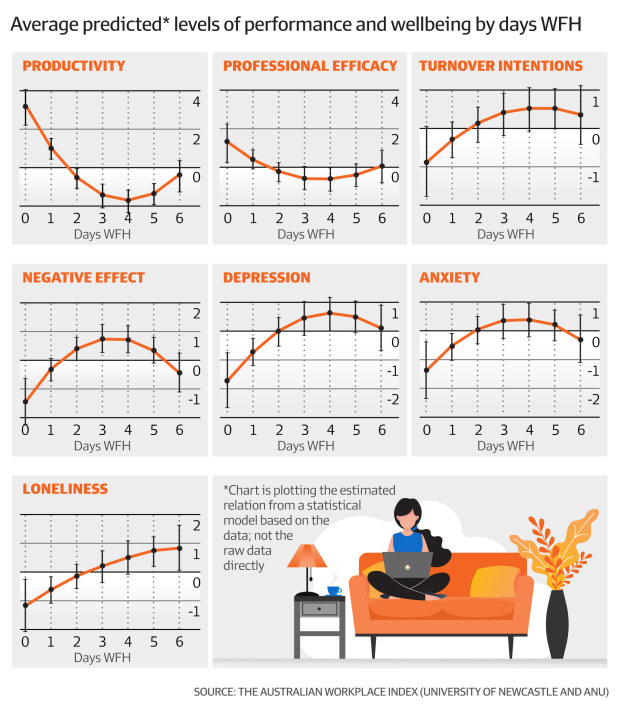
It found that each additional day an employee worked from home – up until the fifth day – led to a corresponding deterioration in productivity, efficacy, turnover intentions, depression, anxiety and loneliness.
Employees who worked from home five or six days a week, however, scored better than those who worked from home four days a week – the frequency associated with the worst performance scores – on all metrics other than loneliness.
WFH made us less productive on average
The slight improvement on day five meant that people who worked remotely full-time were about as productive as those who worked in the office two days a week, but not as productive as those working in the office three or more days each week.
Report co-author Kieron Meagher, an economics professor at ANU, said that while some studies found working from home had increased the productivity of software engineers and other occupations that required a high degree of focused or independent work, his research found “the outcomes were much more negative” when a wider variety of white-collar occupations were studied.
“We found that productivity and professional efficacy both dropped when people were working from home more,” Professor Meagher said.
But he told The Australian Financial Review that good job design and better managers helped soften these effects.
Better managers could fix it
“If your manager makes your job suitable for working from home – provides you with support, makes sure there isn’t conflict and there’s lots of co-ordination with coworkers – then those negative effects start to go away,” Professor Meagher said.
“And presumably, they could go away entirely if an organisation handled it well enough.”
The study, which did not investigate other potential benefits such as fewer sick days, more time spent with families and less time commuting, found that improving working conditions by giving workers more manageable workloads, greater autonomy and more support from supervisors significantly improved performance and wellbeing outcomes.
It was based on online surveys that asked random samples of Australian employees how many days a week they worked from home or a location other than their main workplace. These employees were then required to say how much they agreed with a series of statements and to answer questions such as, “How much did you accomplish today based on what you planned to accomplish?”
Women and educated workers were overrepresented in the sample. And respondents were mostly required to give answers on so-called Likert Scales, where 0 could mean “strongly disagree” or “none of the things I had planned”, and 10 could mean “strongly agree” or “all the things I had planned”.
The researchers, who also included Christina Boedker from the University of Newcastle and Aeson Luiz Dela Cruz from Macquarie University, used these responses to determine how the number of days each week an employee worked from home affected everything from average levels of anxiety and depression to average turnover intentions and average self-assessed productivity.
Sean Gallagher, who co-authored that report and is the director of Swinburne University’s Centre for the New Workforce, told the Financial Review that companies must introduce more structure to their hybrid working models.
“[Our] own research finds that designating certain days for remote work can enhance individual productivity, particularly when it involves routine business-as-usual, task-based work,” Dr Gallagher said.
“Deep, focused work also thrives in these conditions. Yet, for more interactive, collaborative endeavours focused on complex work, the office environment is irreplaceable.”
]]>https://cbomo.com/working-from-home-hurt-productivity-but-poor-managers-partly-to-blame-20230615-p5dgyx/feed/03 Strategies to Boost Sales and Marketing Productivity
https://cbomo.com/3-strategies-to-boost-sales-and-marketing-productivity/
https://cbomo.com/3-strategies-to-boost-sales-and-marketing-productivity/#respondTue, 06 Jun 2023 06:56:39 +0000https://cbomo.com/3-strategies-to-boost-sales-and-marketing-productivity/ [ad_1]
It’s almost axiomatic that growing revenues will require adding sales and marketing costs at the same rate. Most heads of sales and marketing believe in their bones that their teams cannot get more productive over an extended period. Teams can find cost-cutting and efficiency tweaks, yes, but not full-blown, sustained productivity gains. This is a damaging, self-reinforcing belief — and our research shows it’s not necessarily true.
The metric we’re focusing on is what’s called “commercial productivity,” which measures the revenue (or gross profit) returned per dollar of commercial cost, and then evaluates how much faster revenue grows relative to growth in sales and marketing expense. We wanted to better understand whether there’s truth in managers’ belief that it’s difficult to drive sustained improvement in commercial productivity over time, so we conducted a study.
We analyzed 1,254 public business-to-business companies in 10 industries worldwide from 2017 through 2021. We found that across industries, the average company had flat commercial productivity in any given year, with revenue growing at the same rate as sales and marketing expenses. Some 19% of companies improved commercial productivity more than 10% in any given year, but most eventually dealt it back. Only 5% of companies were able to realize commercial productivity gains in three out of the four years.
These elite companies — the sustained productivity leaders — reaped another big benefit. They achieved a meaningfully higher annual total shareholder return (TSR) than their peers, with a 12% difference, on average. The TSR advantage ranged from 21% points in logistics and transport to 4% in paper and packaging.
Our research identified common approaches that try to increase commercial productivity that are doomed to failure or, at best, mediocre performance. One approach includes focusing on cost only, which hinders longer-term growth. In other cases, companies rely heavily on the latest sales or marketing software or unproven artificial intelligence tools, then see costs grow without commensurate revenue growth. Others might bake unreasonable productivity gains into their plan with no tangible path to achieve them, which can lead to sales reps missing goals and quitting.
What productivity leaders do differently
Our research has found that commercial productivity leaders systematically pursue, over a period of years, levers in three areas. They refine their go-to-market model. They raise productivity on the front line, trying to make every rep an A player. And they identify efficiencies in sales and marketing support.
Refining the go-to-market model.
This entails an assessment of how to deploy sales and marketing capacity against the opportunities that will generate the highest return. Too many companies rely on backward-looking sales data and an outdated coverage model to determine how many reps they need and where to assign them. These coverage models tend to rust in place, decreasing the return on investment of the sales and marketing organization.
It’s far more effective to rebalance account assignments based on customers’ expected future spending, creating the most suitable territories for each seller. Leading companies adjust their customer segmentation and reassign customers to more profitable routes to market, using lower-cost coverage, such as inside sales, offshore roles, and e-commerce where appropriate.
Turning every rep into an A player.
To raise the productivity of individual reps on the front line, companies can call on a number of tactics. One is creating data-informed sales plays — a coordinated set of sales and marketing activities with target accounts, including tailored sales collateral and tracking to ensure that reps focus on the highest value opportunities.
Consistent training and coaching also help shorten rookie ramp-up time and improve veteran performance. Bain research has found that top-performing reps have more frequent and higher quality interactions with their managers than low-performing reps, such as weekly one-on-one sessions and regular pipeline reviews.
Making sales and marketing support efficient.
Running a lean support team can produce major savings or free up operating expense to use in customer-facing sales activities. Optimizing spending on support requires finding the right digital and automation tools that will simplify complex processes. In addition, other tactics include improving the accuracy of quotas for individual reps (set by the support team), reducing spans and layers in the organization, and scrutinizing nonselling and non-quota-carrying roles.
Productivity leaders systematically execute tactics from each of these categories. Consider how one computer app security provider refined its coverage after annual revenue growth slowed from about 40% to under 20%. The company expanded the number of customer segments and created more tailored sales motions for each segment. It rebuilt sales territories based on the total addressable market, each customer’s propensity to buy, and the customer’s characteristics. These and other moves allowed the security provider to achieve a more than 10% lift in commercial productivity in three out of four consecutive years.
Other companies are embarking on similar journeys to unlock commercial productivity. A multinational food packaging company has begun to change its go-to-market model through several tactics. They include resegmenting customers based on the opportunity and service needs, increasing the use of lower-cost routes to market such as inside sales and e-commerce, and pooling specialist resources globally.
Design and repeat
Besides continually revisiting a proven set of levers, what truly sets productivity leaders apart is that they take a deliberate and repeatable approach to executing the changes. Their approach has several organizational dimensions.
First, they assign a clear owner of commercial productivity, often with a dedicated role. This executive often reports directly to the chief revenue, financial, or operating officer, and has dedicated program resources. The staff help build a backlog of tactics to execute, drive progress against each one, and assist with changing processes and behaviors at every level of sales and marketing.
Veteran productivity leaders also tie commercial productivity targets into annual and multiyear planning, so that the effort expands beyond the sales group. To that end, the CRO, CFO, and COO must communicate regularly on explicit productivity issues. Revenue and sales/marketing cost targets from the CFO should reflect the expected productivity gains of the sales and marketing organization, with a clear set of tactics to achieve these gains. And the multiyear commercial productivity roadmap must dovetail with the IT roadmap so that the company can plan the required technology investments.
Finally, a mature commercial operations team is essential for modeling sales and marketing capacity, communicating with the finance group, and creating go-to-market blueprints that are continually revised. The operations team ensures that tactics play out consistently across different geographies and business lines.
The right questions to ask in a downturn
CROs, CFOs, and COOs committed to sustaining their productivity gains will want to address a set of high-gain questions:
Does our organization know what factors drive commercial productivity and whether we are at, above, or below our targets?
Where do we need to increase productivity — and to what levels — by next year, three years, five years from now?
What tactics will combine to lay down a realistic path to the targets?
Do we have the right structure, operating model, and senior leaders engaged to enable these gains?
Who is responsible for realizing the gains? Does he or she have the right reporting and communication mechanisms with leaders of finance, HR, and other functions?
Sustaining commercial productivity gains yields benefits for companies in any industry and at any stage of the economic cycle. But it’s particularly relevant in the current macroeconomic conditions, because downturns rearrange the board. During the recession in 2008–09, Bain analysis found, performance diverged sharply among almost 3,900 companies worldwide. Winners pulled away from losers and widened the profit and market-cap gap during the subsequent expansion.
The same logic applies today. A commercial productivity framework forces companies to make healthy trade-offs between top-line and cost savings actions, trade-offs that will help them accelerate past their competitors in the coming years.
]]>https://cbomo.com/3-strategies-to-boost-sales-and-marketing-productivity/feed/0How to maximize productivity when working at home
https://cbomo.com/hybrid-work-is-here-to-stay-how-to-maximize-productivity-when-working-at-home-html/
https://cbomo.com/hybrid-work-is-here-to-stay-how-to-maximize-productivity-when-working-at-home-html/#respondWed, 24 May 2023 04:42:41 +0000https://cbomo.com/hybrid-work-is-here-to-stay-how-to-maximize-productivity-when-working-at-home-html/ [ad_1]
Published May 24th, 2023
Hybrid work is here to stay: How to maximize productivity when working at home
By Jennifer Raftis, CPO
Professional Organizer, Jennifer Raftis, CPOr founded Efficiency Matters, LLC to help you with all of your organizing needs for your home and business. She is a Certified Professional Organizer and an active board member with NAPO, National Association of Productivity and Organizing Professionals. She is also an independent representative for The Container Store and has expertise in designing closets, garages, pantries, playrooms and more. In addition, she is a Corporate Organizing and Productivity Consultant and has worked with Fortune 500 companies across the U.S. Another large part of her business is move management especially working with seniors who are downsizing. She and her husband have lived in Moraga for 30 years, raising 3 kids and working countless volunteer hours with many local non-profit organizations and schools. Jennifer@efficiencymattersllc.com, 925-698-3756 www.efficiencymattersllc.com
The pandemic taught us many things about ourselves, our world, and our priorities. During the lockdown, people slowed down, families were playing with their kids on the street in the middle of the day and big bonus – there were hardly any cars on the road.
We realized that there were options available for us to do many things in a different way. One of those things is how and where we work. We quickly discovered that the need to work from home was essential and doable. I’m still amazed at the speed at which we adapted to the new workplace, aka our homes.
After we figured out how to use Zoom and share our space with all of our family members and bewildered pets, we were up and running. Now, fast forward to 2023, many businesses and their employees have discovered that we don’t really need to be in the office full time. Hybrid work is here to stay.
Turns out that a large percentage of both businesses and workers prefer the hybrid model. Sounds great, right? Roll out of bed and you’re already at work! Very quickly, we realized that working from home has its own set of challenges. Here are some tips that I give my clients for a better chance of long-term success when working part-time or full-time from home:
1) Follow a daily routine and set a work schedule. Even though you do have a great deal of flexibility when you work from home it is important to set up your work hours for the same time every day. End on time and start on time, every workday.
2) Establish clear boundaries with other family members. I find that for myself, when I am working on projects for my clients, I am very focused and do not want to be interrupted. Put a “Do Not Disturb” sign on your door or desk. Asking others to respect your work time does not mean you are being hurtful or selfish; you are working. Starting and stopping your train of thought with interruptions is not productive or efficient.
3) Create a designated space for work in your home. Make the space a place that you enjoy going to work. Set it up so all the items you need – computer, notepad, earbuds, pens – are nearby. Buy plants for your home office, because they make us happy! Face a window; I promise, it’s a mood changer for the better!
4) Invest in a quality ergonomic chair and headset. It is never ideal to work from an uncomfortable chair (or your bed or couch) for obvious reasons – posture problems leading to back pain. Using earbuds or headphones as a headset will allow you to work handsfree and provide a clearer connection than relying on your computer’s microphone.
5) Set up your home office for success. Many of my clients are more efficient when they have two monitors instead of just one. Make sure you have high speed internet with a strong signal in your workspace.
6) Do not eat at your desk. It is important to take breaks from your work space for snacks or lunches.
7) Take Zoom breaks. If possible, do not schedule back-to-back meetings. Take time to regroup between meetings and absorb the information you just heard, take notes, and prepare for the next meeting or project. This is an ideal time to step outside, take a short walk, and refresh. Zoom fatigue is real.
8) Eliminate distractions. For obvious reasons, this is often more difficult to achieve when working from home. This is where boundary setting becomes critical. Pets, kitchens, and phones can be distracting (TVs too). Turn off your email notifications and check your email at a scheduled time throughout the day instead of reading each one as it comes in. It goes without saying, social media equals rabbit hole, just don’t look during work time.
9. Make time to wind down after work. Even though we might have complained about our commute, it gave us time to clearly mark the end of the work day and wind down before we began our evening activities with family. After your workday is finished, take a little time to refresh and shake off the workday before you head into the family room, go to the gym, or start dinner.
Coming soon: Efficiency Matters Q&A. I will be starting a question and answer section at the end of my article. You can describe your organizing challenge or ask a question, and I pick one or two and will respond in my next article. Send your questions to: Jennifer@efficiencymattersllc.com with Lamorinda Weekly in the subject line.
]]>https://cbomo.com/hybrid-work-is-here-to-stay-how-to-maximize-productivity-when-working-at-home-html/feed/0Free Webinar | May 11: The Modern Leader’s Guide to Timeless Wisdom
https://cbomo.com/free-webinar-may-11-the-modern-leaders-guide-to-timeless-wisdom/
https://cbomo.com/free-webinar-may-11-the-modern-leaders-guide-to-timeless-wisdom/#respondMon, 08 May 2023 19:41:26 +0000https://cbomo.com/free-webinar-may-11-the-modern-leaders-guide-to-timeless-wisdom/ [ad_1]
Looking to transform your leadership? Then join our upcoming live webinar to learn the key principles to help you become a more effective leader.
Hosted by Susan S. Freeman, author of the new book, Inner Switch: 7 Timeless Principles to Transform Modern Leadership, you will walk away with the skills needed to create positive change in yourself and in your organization, including how to:
Apply ancient wisdom principles from yoga to lead with self-awareness and effective communication
Cultivate qualities like openness, letting go of reactive patterns, and integration of body, mind, and heart
Implement examples and exercises for leadership moments, even without yoga experience
Create a safe and trusting environment for collaboration and co-creativity
Increase productivity, healthy relationships, and joy in the workplace
And more!
Register now to secure your seat!
About the Speaker:
Susan S. Freeman, MBA, PCC, NCC, is an executive coach, team coach, author, and speaker, dedicated to helping leaders expand their influence and change the world by making the “inner switch.” Her groundbreaking approach to coaching creates leadership transformation through the integration of Eastern wisdom derived from more than 25 years of studying yoga and yogic philosophy. Through Susan’s unique Inner Switch™ method, leaders learn how to shift from simply “doing” in the world to first “being” within themselves so they can then authentically influence others.
]]>https://cbomo.com/free-webinar-may-11-the-modern-leaders-guide-to-timeless-wisdom/feed/0What does productivity mean? Bosses aren’t really sure.
https://cbomo.com/productivity-definition-measures-remote-work-management/
https://cbomo.com/productivity-definition-measures-remote-work-management/#respondFri, 05 May 2023 12:33:51 +0000https://cbomo.com/productivity-definition-measures-remote-work-management/ [ad_1]
Like pretty much every other company that could, HubSpot let its employees work from home when the pandemic hit. The difference was that, early on, the enterprise software company made a strong commitment to let workers continue working remotely if they wanted. And that’s what the majority of HubSpot workers did. Meanwhile, about a third are hybrid, and less than 10 percent are back to the office full time.
Now, HubSpot is trying to figure out the pros and cons of different working situations to make the most of each going forward. And, like many companies, it’s looking at a deceptively difficult metric to measure: productivity.
In looking at things like sales reps reaching their quotas and developers cranking out code, HubSpot found that productivity didn’t seem to vary by employee location. The only real difference they saw was that at-home workers felt more connected to HubSpot’s mission and customers than in-office employees, a counterintuitive finding that likely speaks to how satisfied they felt about their work situation.
But a growing number of companies are still calling workers back to the office in the name of productivity.
After promising that it would remain “fully flexible” last year, for example, the struggling ride-hailing company Lyft recently said it would start requiring employees to show up in person. The company’s new CEO reasoned that things move faster face to face. But it’s not clear if that strategy actually works.
“Part of the reason you’re seeing so many people lobby for return to office is there’s this notion of, ‘That’s how I did it growing up,’” HubSpot chief people officer Katie Burke told Vox. “I certainly did that. I had a Palm Pilot growing up. I wore suits to work. I don’t think that everyone needs to do the things that I did in order to succeed in modern work.”
The emphasis on productivity can seem disingenuous, given that many companies raked in record profits as their workforces toiled in their living rooms. And even when companies try to measure productivity, they’re not necessarily measuring the right thing. In other words, your boss might be obsessed with productivity without really knowing what it means.
Some 71 percent of business leaders say they’re under immense pressure to squeeze more productivity out of their workers, according to a new Slack survey of 18,000 knowledge workers, including managers.But most are measuring what workers put in, rather than what they put out.In turn, workers say they’re spending a third of their time “performing” work — that is, making an effort to look like they’re working rather than actually working. That includes focusing on supposed productivity signals, like speaking up in work threads regularly and responding to emails more quickly than necessary, even after hours.
Meanwhile, worker engagement, which is a measure of how well people understand their jobs and feel connected to them, has gone down since the early pandemic, according to a long-running Gallup study. And because worker engagement is highly correlated with productivity, that’s likely gone down, too. Workers are also reporting high rates of burnout, all of which is bad for productivity.
So not only does nobody know how to measure productivity, we’re also not even sure it’s the most important way to predict success.
It’s been three years since the start of the pandemic, which wrought unparalleled destruction but also enabled a once-in-a-lifetime opportunity to make work better. For the tens of millions of people who were able to work remotely, the situation allowed them to skip long commutes and expensive lunches and get more time with their families and a work environment on their own terms. With these changes came conversations about work-life balance and job satisfaction that their bosses, desperate to hold on to talent amid the Great Resignation, seemed to genuinely consider.
Companies stand to gain a lot from giving workers more flexibility, too. It can encourage a better, more creative, and more highly functioning workforce. Remote work, specifically, enables employers to hire from a broader candidate pool and one that might be more diverse than the location of the office, which contributes to better business outcomes. It also makes many employees happy, and happy workers are more productive.
Now we stand at a crossroad for employees and employers. The pandemic is no longer considered a public health emergency. Economic uncertainty and a loosening hiring market have given management ammunition — if not good reason — to pull back on the kinds of flexibility they offered during the pandemic, including remote work.
But it doesn’t have to be that way. The chance to make work better both for employees and employers still stands. It starts with measuring the right thing.
The problem with “productivity”
What productivity means can vary by job, industry, and even person. Does it mean making more widgets or better widgets? And what makes a good widget?
There are many parts of people’s jobs, especially knowledge workers’ jobs, that aren’t straightforward. Knowledge workers aren’t necessarily making widgets themselves. They might be coming up with new ways of selling those widgets, or improving those widgets, or writing about those widgets, or coaching others on how to spot new widgets.
When researchers try to measure the relative productivity of remote work versus non-remote work, there are even more elements to consider. Those might include how often people are working from home, and whether there might be an extenuating circumstance, like different types of management styles or, say, a pandemic.
It’s particularly challenging to measure productivity among knowledge workers.
“The research on this really does seem to be a complete mess, not in the sense that it’s bad research but in the sense that you can find research that points at positive effects, be it productivity or happiness or job satisfaction, or you can find research finding the opposite,” said Christoph Riedl, an associate professor of information systems at Northeastern University’s business school.
The studies around remote work and productivity tend to look for more countable outcomes in jobs that are more straightforward, like the number of calls per hour in a call center. Even there, the data is mixed.
A widely cited pre-pandemic study by Stanford economics professor Nick Bloom and others found remote call center workers at a Chinese travel agency spent more time working and conducted more calls per minute than their in-office counterparts. These people also went into the office one day per week and received performance pay. A more recent study by Emma Harrington and Natalia Emanuel of call center workers at a Fortune 500 retailer found that those who worked from home answered 12 percent fewer calls than those who worked in an office. But their pay wasn’t tied to performance.
In a different study, Harrington and others found that software engineers located in different buildings on the same campus before the pandemic wrote more computer programs than those who were sitting close to colleagues. However, the engineers who worked in different buildings commented less on others’ code. In other words, they were more productive but that potentially meant that less experienced coders got less mentorship and may end up being less productive in the future.
“It is relatively context-specific in the sense that it may really matter what the management practices of the firm are and what the incentive scheme is,” Harrington, who is an assistant professor of economics at the University of Iowa, told Vox.
One would think that a given company would have a better idea of its own productivity, but that isn’t necessarily the case. The Slack survey found that 60 percent of executives were tracking activity metrics — things like emails sent or hours worked — as the main way to measure productivity. The problem is that doing so incentivizes things like sending more emails or staying at your desk longer, not making better widgets.
“We see employers focus so much on measuring inputs instead of outputs,” Slack’s SVP of research and analytics, Christina Janzer, explained. Looking more at what employees achieve than how they’re achieving it, she added, requires a shift in mindset.
“We have this opportunity to think so much more holistically about what really unlocks productivity,” she said. “I think there’s an opportunity for us to step back and rethink productivity because many people are focused on the wrong things.”
According to Slack, more than 80 percent of employees in the Slack survey said that feeling happy and engaged with their organization would improve their productivity.
HubSpot is closer to the goal than most. When measuring the rate at which salespeople were meeting their quotas, the company found no difference between at-home and in-office employees. They also found that software engineers spent the same amount of time on revising code, regardless of location. Importantly, HubSpot’s leaders are also asking employees how they feel about working there, which helps them address issues as they arise.
When HubSpot workers in the office complained about not seeing enough colleagues there to get that in-office experience, the company responded by reducing the office footprint so that those who did come in were physically closer. The company also designated a day each week — as well as a few marquee events each year — when there are more planned activities and in-person events to facilitate connection and in-person collaboration for those who want it.
Importantly, the software company is doing so not to cajole people back into the office, but to try to make those who do find the office beneficial happier when they’re there.
What companies need is better management
The current focus on productivity might say more about managers and the pressure they’re under from their bosses than it does about workers, Northeastern’s Riedl said.
“If you are the one who allows remote work, you need to justify why you’re doing that,” he said. “If everyone’s going to work from the office and you demand everyone works from the office, there’s just less justification needed.”
In other words, it’s easier to revert to the status quo.
But in doing so we’re missing chances to make remote work better for the majority of knowledge workers who currently work from home some (46 percent) or all (20 percent) of the time, according to the latest data from WFH Research. We are also ignoring other important aspects of work that actually make people happy and more productive.
We know that employee engagement is down for all types of workers, but that it’s lowest for people who have to show up in person. Gallup estimated that low employee engagement cost the global economy $7.8 trillion in lost productivity last year.
For those who work in jobs where they could be remote but are being told to go to the office, their lack of autonomy is likely contributing to their lowered engagement, said Jim Harter, Gallup’s chief scientist of workplace management and well-being and a co-author of Culture Shock, a book coming out this month about the changing workplace. The decline in engagement among remote and hybrid workers has to do with unclear expectations.
All those issues could be solved by better management, Harter said.
That includes assessing individuals on more than just how much email they’re sending, being clear about goals, and generally communicating openly and frequently with your employees.
“I think organizations could reach their highest levels of productivity ever if they have managers who are upskilled to have the right kinds of ongoing conversations with people so that they’re in touch with them on a regular basis,” Harter said.
That’s not easy. Figuring out how to make people feel connected remotely is hard; so is adapting new ways of onboarding or mentoring employees. Managing people working in multiple environments is obviously more of a challenge than just looking over their shoulders in the same office. But it’s not impossible, and solving these issues could make work — and productivity — better for employers and employees, regardless of where they work.
“When we had increases in remote work during the pandemic, there were a lot of people asking, ‘How do we know people are productive?’” Harter said. “And my question back was, ‘How did you know they were productive before the pandemic?’”
]]>https://cbomo.com/productivity-definition-measures-remote-work-management/feed/0UK workers suffer productivity drain due to poor hybrid work policies: Report
https://cbomo.com/uk-workers-suffer-productivity-drain-due-to-poor-hybrid-work-policies-report-html/
https://cbomo.com/uk-workers-suffer-productivity-drain-due-to-poor-hybrid-work-policies-report-html/#respondThu, 06 Apr 2023 04:00:44 +0000https://cbomo.com/uk-workers-suffer-productivity-drain-due-to-poor-hybrid-work-policies-report-html/ [ad_1]
New research from Slack highlights the ongoing disconnect between UK business leaders and employees when it comes to hybrid work, with the average worker only spending the equivalent of one day a week focused on deep work.
Despite 28% of UK workers being defined as hybrid workers, and 16% working from home, Slack’s new How Productivity Platforms Can Power Business Impact report shows that while 87% of leaders say they are investing in improving the hybrid experience, only 50% of workers believe that expectation has been met.
The report is based on a survey of 1,650 UK knowledge workers and 350 IT decision makers, with the aim of identifying the barriers and opportunities that are presented by hybrid work.
Since the global COVID-19 pandemic forced offices to shut, hybrid working has become the default model for many office-based companies, with research from Slack’s Future Forum finding that 56% of IT decision makers and 54% of knowledge workers believe having flexibility in where and when they work helps them to be more productive. Flexible remote work policies were cited as the number one factor that has improved company culture over the past two years.
However, despite both executives and employees acknowledging the benefits of hybrid work, some business leaders are still struggling to make sure the hybrid work polices they’re enacting are helping to drive meaningful connections and foster better collaboration.
Thirty-three percent of respondents to the survey said that their firms’ current approach to hybrid work has created greater silos and fragmentation of knowledge.
Remote and hybrid workers — 35% and 37%, respectively —were also more likely to feel concerned that they connect less with co-workers due to hybrid working while 34% of 18-34 year olds surveyed by Slack said they were concerned about a lack of connection and opportunity to learn from senior co-workers.
More meetings don’t equal greater productivity
Meetings are also proving to be a threat to business productivity, with 60% of employees surveyed for the report stating that they are a time drain.
According to data provided by Slack, UK workers spend an average of seven hours and 42 minutes a week either coordinating or attending meetings, with 36% of respondents saying they spend more time on video calls now than they did 12 months ago.
In comparison, knowledge workers spend just over nine hours a week on deep work, a figure that drops to seven hours and one minute for IT decision makers, who are now averaging 10 hours and 58 minutes a week in meetings.
In order to address this, 34% of employees surveyed said that cutting down on the number of meetings they’re required to attend would help boost productivity as it would given them more time to focus on the work they were hired to do. IT leaders also expressed a willingness to make work days less meeting-heavy, with 27% saying that replacing 30-minute meetings with shorter, asynchronous audio clips would make them more productive.
Tech-driven solutions to productivity
When IT decision makers were asked how they see technology driving productivity in the next year, 37% said it could improve collaboration among cross-functional teams, while 31% said it could offer more flexibility over where people can work.
Additionally, while 47% of IT decision makers said automating mundane and repetitive tasks would also help to boost productivity, only 27% of employees agreed with this statement, showing that more needs to be done to help workers understand where simple automation can be deployed and the areas of work where these specific productivity gains can be achieved.
Providing a good digital experience is critical to success in today’s digital-first world and it’s clear there’s a disconnect between IT leaders and employees on that front, said Stuart Templeton, head of UK at Slack, commenting on the report’s findings.
While Templeton acknowledged that this is the first time most businesses have faced tough economic headwinds since the adopting a hybrid work model, he said that it was clear from the research that this shouldn’t stop business leaders from seizing on opportunities to “improve alignment, efficiency and productivity across their teams no matter where or when they work.”
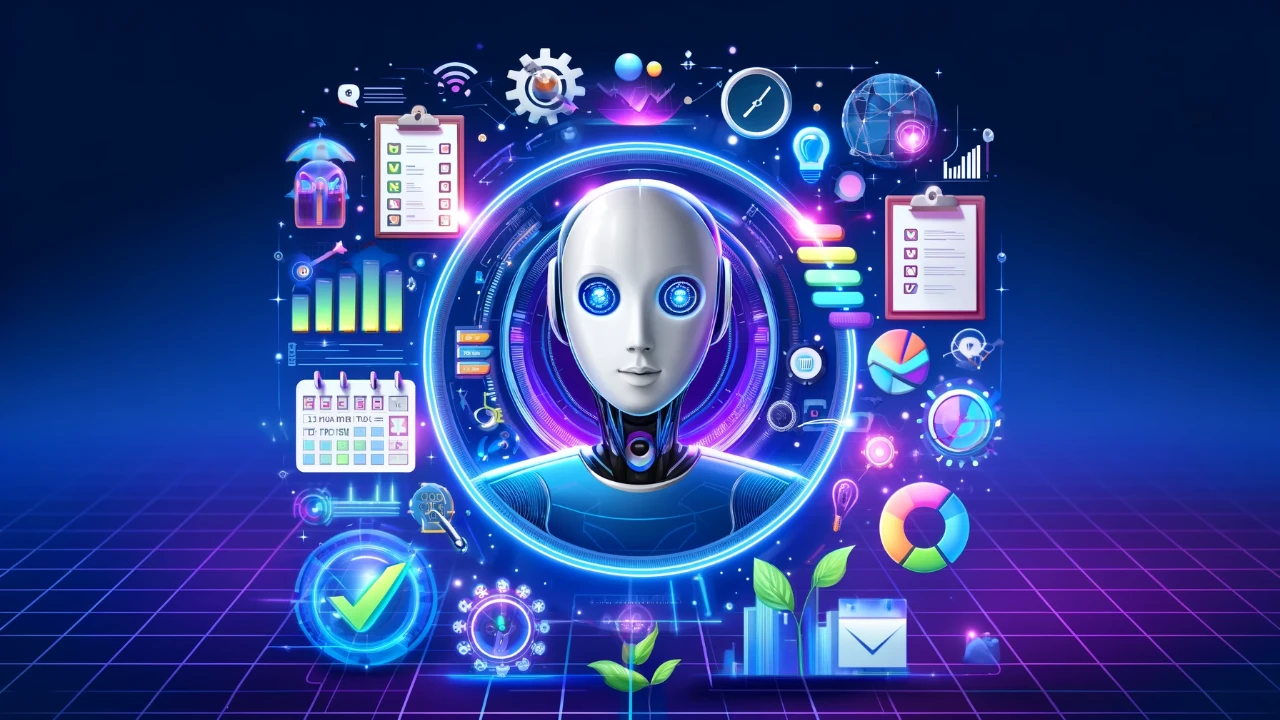
 Image Credit: Courtesy of Bearaby. Kathrin Hamm.
 Image Credit: Courtesy of Bearaby
 Image Credit: Courtesy of Bearaby
 Samsung Galaxy Ring. Credit: Samsung
 Hon Pak, vice president of the digital health team at Samsung. Credit: Samsung