\" plugin_version.type = \"hidden\" form.appendChild(plugin_version) var wordpress_version = document.createElement(\"input\") wordpress_version.name = \"wordpress_version\" wordpress_version.id = \"wordpress_version\" wordpress_version.value = '$wp_version' wordpress_version.type = \"hidden\" form.appendChild(wordpress_version) } },200); "; } else { echo ''; } } else { echo ''; } } else { echo ""; return; } } } /** * Google analytics . */ function ga_footer() { if ( ! ( defined( 'DOING_AJAX' ) && DOING_AJAX ) ) { $banner_discarded_count = get_option( 'sm_beta_banner_discarded_count' ); if ( 1 === $banner_discarded_count || '1' === $banner_discarded_count ) { echo ''; } } } /** * Check if the requirements of the sitemap plugin are met and loads the actual loader * * @package sitemap * @since 4.0 */ function sm_setup() { $fail = false; // Check minimum PHP requirements, which is 5.2 at the moment. if ( version_compare( PHP_VERSION, '5.2', '<' ) ) { add_action( 'admin_notices', 'sm_add_php_version_error' ); $fail = true; } // Check minimum WP requirements, which is 3.3 at the moment. if ( version_compare( $GLOBALS['wp_version'], '3.3', '<' ) ) { add_action( 'admin_notices', 'sm_add_wp_version_error' ); $fail = true; } if ( ! $fail ) { require_once trailingslashit( dirname( __FILE__ ) ) . 'class-googlesitemapgeneratorloader.php'; } } /** * Adds a notice to the admin interface that the WordPress version is too old for the plugin * * @package sitemap * @since 4.0 */ function sm_add_wp_version_error() { /* translators: %s: search term */ echo '
' . esc_html( __( 'Your WordPress version is too old for XML Sitemaps.', 'google-sitemap-generator' ) ) . '
' . esc_html( sprintf( __( 'Unfortunately this release of Google XML Sitemaps requires at least WordPress %4$s. You are using WordPress %2$s, which is out-dated and insecure. Please upgrade or go to active plugins and deactivate the Google XML Sitemaps plugin to hide this message. You can download an older version of this plugin from the plugin website.', 'google-sitemap-generator' ), 'plugins.php?plugin_status=active', esc_html( $GLOBALS['wp_version'] ), 'http://www.arnebrachhold.de/redir/sitemap-home/', '3.3' ) ) . '
' . esc_html( __( 'Your PHP version is too old for XML Sitemaps.', 'google-sitemap-generator' ) ) . '
' . esc_html( sprintf( __( 'Unfortunately this release of Google XML Sitemaps requires at least PHP %4$s. You are using PHP %2$s, which is out-dated and insecure. Please ask your web host to update your PHP installation or go to active plugins and deactivate the Google XML Sitemaps plugin to hide this message. You can download an older version of this plugin from the plugin website.', 'google-sitemap-generator' ), 'plugins.php?plugin_status=active', PHP_VERSION, 'http://www.arnebrachhold.de/redir/sitemap-home/', '5.2' ) ) . '
In our ever-expanding digital world, passwords are an inevitability: email, apps, subscriptions and loyalty programs — nearly everything is designed to be secure behind a self-set code that permits entry. According to technology site TechCo, the average person has about 100 passwords, so it’s no surprise that when signing up for a new account, individuals can sometimes get lazy with word choice. However, there’s a new risk to password vulnerabilities: artificial intelligence.
A new report by Home Security Heroes found that 51% of common passwords can be cracked in less than a minute using an AI password cracker, and 81% can be cracked in less than a month.
Home Security Heroes used the AI password cracker PassGAN to run through a list of 15,680,000 passwords. The odds of AI decoding one’s password increase when a password has a minimal amount of characters and lacks variety (only using lowercase, only using numbers, etc.). Still, it found that it took PassGAN less than six minutes to crack a password of seven characters, even when it contained symbols.
Related: Elon Musk Says We Should Stop Rapid AI Development Right Now — Here’s Why
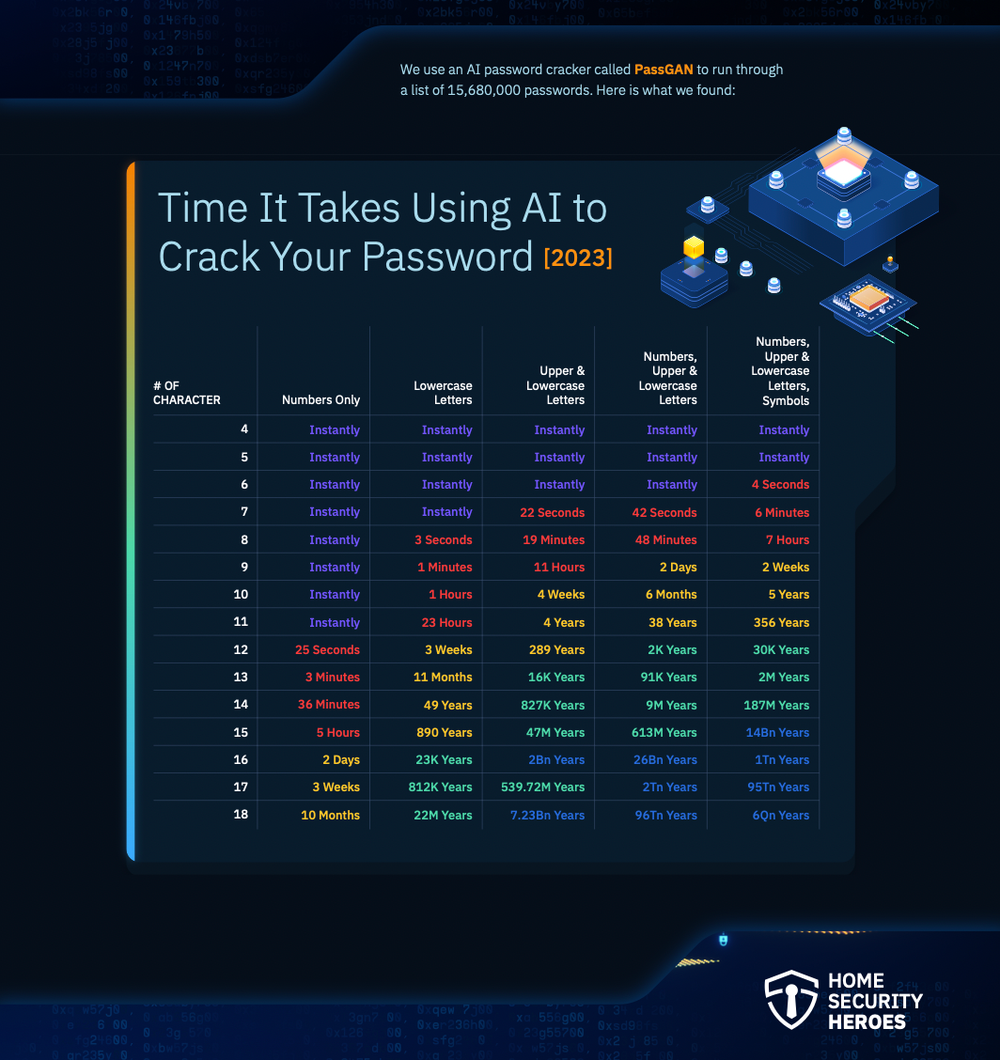
According to Home Security Heroes’ findings, it takes AI significantly longer to crack a password with more characters and variety. In essence: The longer the password and the more letters, numbers and symbols you use, the safer it is from AI.
A password with 14 characters composed of upper and lower case letters, symbols and numbers takes AI an average of 187 million years to crack, as opposed to a password of seven characters composed of just upper and lower case letters — which takes AI an average of 22 seconds to crack.
Although it might be more time-consuming, if you want to ensure password security as AI technology advances, it’s best to keep your passwords at least 10 characters long, with some combination of upper and lower case letters, symbols and numbers.
Related: How AI Is Shaping the Cybersecurity Landscape — Exploring the Advantages and Limitations
[ad_2]
Source link