Fort Worth has trash in its sights, and would like you get with the program — the composting program, that is.
Recognizing that the city’s landfill was filling up with materials that could go elsewhere, Fort Worth has been seeking ways to divert materials that could be re-used, recycled, mulched, or composted.
In 2019, the city launched its innovative
Residential Food Waste Composting Program, in which residents separate food scraps and bring them to drop-off points across Fort Worth.
Food scraps might seem like a messy annoyance when you take out the garbage, but it’s a bigger problem for the environment than it is for your nose. The methane gas from decomposing food in landfills contributes to greenhouse gas emissions. It also contributes to air, water, and traffic and transport pollution because the food scraps have to be hauled away by garbage trucks.
Composting takes those scraps and transforms them into organic matter that can be put back into the ground as a rich soil nutrient.
Back in 2014, an audit of the Fort Worth landfill revealed that 35 percent of contents could have been composted instead. This knowledge led city staffers to come up with an innovative solution, with a design based on a similar program in Minneapolis, to encourage and support residential composting.
In addition to local funding from the Texas Commission on Environmental Quality, the program is supported by the U.S. Department of Agriculture.
Fort Worth currently has a total of 2,466 subscribers, who’ve donated a total of 144,201 pounds of food waste, keeping nutrient-rich food scraps and organic waste out of landfills.
Avery Pesek, a senior environmental planner with the city, and coordinator for Keep Fort Worth Beautiful, hopes to get that number close to 3,000 in 2024.
“We’ve found that the biggest barrier to entry in the program is people knowing about it,” Pesek says. “We are trying to get the word out about how easy and effective composting is to help Fort Worth.”
Fort Worth’s program was the first of its kind in North Texas; Plano launched a similar residential composting in 2023. (Houston began a composting program in 2021. San Antonio was a pioneer when it began a composting program in 2011, and Austin has been composting since 2013.)
Fort Worth subscribers pay a one-time $20 fee and are given a Composting Starter Kit, which includes a 5-gallon bucket with a lid, a smaller kitchen countertop pail that closes securely, and education materials.
“Two things I run into is a concern about odor and a concern about difficulty, but because it is a locking, closing bucket, there really isn’t a smell,” Pesek says.
Once the bucket is full, residents can drop off the scraps at one of 21 collection sites, such as Fort Worth community centers, churches, and parks. Most offer 24-hour access points to make dropping off as convenient as possible.
After dumping their compost, participants rinse their bucket at home and start again.
“If your reference is backyard composting, you might think this is going to be more difficult than it is,” Pesek says. “You can put things into our buckets that you can’t put in a backyard compost.”
For example, animal products. Most backyard composters add plant materials only, but the Fort Worth program takes any food scraps or leftovers, including cooked meats, bones, eggshells, baked goods, tea bags, coffee filters, nuts, fruits, and vegetables, including peels and pits.
“The composting program was designed with the residential subscriber in mind, and we wanted to make sure we could accept products like cooked meat, dairy, egg shells, that traditional backyard composting is not able to handle,” Pesek says.
They’re working with Cowboy Compost, the Fort Worth waste management company founded by former FWSO maestro Miguel Harth-Bedoya that specializes in “zero-waste” through composting in restaurants, workplaces, sporting events, and private homes. (They also sell their own bagged compost.) Cowboy Compost transforms the scraps into material that can be used in gardens, landscaping, and construction projects.
Unacceptable items include raw meats, grease or oil, chewing gum, Styrofoam, plastic bags, diapers, microwave popcorn bags, frozen food packaging, and pet waste or cat litter. Additionally, any products that are recyclable or labeled biodegradable are also unacceptable for compost.
Pesek says the program has consistently had a low level of contamination – less than 1 percent.
“The people who are opting into the program are a really passionate group,” she says. “We’ve been shocked at how good they are at following the requirements.”
According to the latest census, there are approximately 326,648 households in Fort Worth, making the current subscriber tally of 2,466 households less than 1 percent.
But for now, Pesek has her eye on the 3,000 subscriber benchmark. One composter at a time.
[ad_2]
Source link
CLARKSBURG, W.Va. (WBOY) — Working while taking care of a family can be tough deal for women, and unfortunately, West Virginia is not the best place for these hard workers, according to one study.
A recent study from WalletHub compared all 50 states and the District of Columbia across 17 key metrics to find out which were the best and worst places to be a working mom in 2023.
According to their findings, West Virginia is the 47th worst state to be a working mom. In the category of “Professional Opportunities,” it ranked the worst. The study also found that West Virginia has the 5th highest “Gender Pay Gap.”
Best and Worst States for Working Moms
| Overall Rank | State | Total Score | Child Care | Professional Opportunities | Work-Life Balance |
|---|---|---|---|---|---|
| 1 | Massachusetts | 66.20 | 2 | 11 | 1 |
| 2 | Rhode Island | 65.05 | 10 | 2 | 2 |
| 3 | Connecticut | 61.06 | 5 | 5 | 5 |
| 47 | West Virginia | 32.31 | 47 | 51 | 32 |
| 48 | Mississippi | 32.17 | 44 | 44 | 49 |
| 49 | Alabama | 31.04 | 46 | 47 | 43 |
| 50 | South Carolina | 30.20 | 48 | 45 | 45 |
| 51 | Louisiana | 29.14 | 50 | 50 | 38 |
To achieve their rankings, WalletHub used 17 weighted metrics across three key dimensions: Child Care, Professional Opportunities and Work-Life Balance.
“Each metric was graded on a 100-point scale, with a score of 100 representing the most favorable conditions for working moms,” WalletHub said.
The weighted average of all metrics, stated below, was then used to calculate each state’s overall score and rank-order.
Child Care – Total Points: 40
- Day-Care Quality: Double Weight (~10.00 Points)
- Child-Care Costs: Full Weight (~5.00 Points)
Note: This metric was adjusted for the median women’s salary. - Pediatricians per Capita: Full Weight (~5.00 Points)
- School-System Quality: Double Weight (~10.00 Points)
Note: This metric is based on WalletHub’s “States with the Best & Worst School Systems” ranking. - Share of Nationally Accredited Child Care Centers: Full Weight (~5.00 Points)
- Number of Childcare Workers per Total Number of Children: Full Weight (~5.00 Points)
Note: Childcare workers attend to the basic needs of children, such as dressing, bathing, feeding, and overseeing play. They may help younger children prepare for kindergarten or assist older children with homework.
Professional Opportunities – Total Points: 30
- Gender Pay Gap: Double Weight (~6.67 Points)
Note: This metric measures women’s earnings as a percentage of men’s. - Ratio of Female Executives to Male Executives: Full Weight (~3.33 Points)
- Median Women’s Salary: Full Weight (~3.33 Points)
Note: This metric was adjusted for the cost of living. - Share of Working Women Living with Economic Security: Full Weight (~3.33 Points)
Note: This metric is based on the Basic Economic Security Tables (BEST) Index, which measures how much income working adults of different family types need to be economically secure. Economic security means having “enough income to meet…basic monthly expenses—such as housing, food, transportation and child care expenses—and save for emergencies and retirement.” - Share of Families in Poverty: Full Weight (~3.33 Points)
Note: “Families” include single mothers with children aged 0 to 17. - Female Unemployment Rate: Full Weight (~3.33 Points)
- Gender-Representation Gap in Different Economic Sectors: Full Weight (~3.33 Points)
Note: This metric measures the absolute difference between the share of female employees and male employees. - WalletHub “Best States for Working from Home” Ranking: Full Weight (~3.33 Points)
Note: This metric is based on WalletHub’s “Best States for Working from Home” ranking.
Work-Life Balance – Total Points: 30
- Parental-Leave Policy Score: Double Weight (~15.00 Points)
Note: This metric is based on the report card from Expecting Better: A State-by-State Analysis of Laws That Help Expecting and New Parents. - Average Length of a Woman’s Work Week (in Hours): Full Weight (~7.50 Points)
- Women’s Average Commute Time (in Minutes): Full Weight (~7.50 Points)
[ad_2]
Source link
I’m sure you’ve heard the expression – “money is in the list.”
And it’s true. Email marketing has a tremendous ROI, and we’ve got multiple case studies that prove it.
What’s also true is that there isn’t just one way to make money with email marketing. There are many. And I’m about to share them with you.
Whether you’re an affiliate marketer, coach, or an all-around marketer, you’ll want to stick around. As these seven tactics are about to turn your email marketing program into a growing revenue source.
Table Of Contents
How to make money with email list: 7 actionable ways
Before going over the ways you can make money with email, I want to make a disclaimer.
Even though email marketing boasts an impressive ROI of 3,800%, it is a long-term game. Building an engaged email audience takes time and effort, and that’s only a part of the equation.
So if you ever hear someone making promises that you’ll generate an extra $5k in income from email just after 30 days of work, simply ignore them.
With that out of the way, let me take you through the key ways of making money with email marketing.
1. Use affiliate marketing and promote other people’s products or services
One of the first associations people make about making money online comes down to joining a lucrative affiliate program.
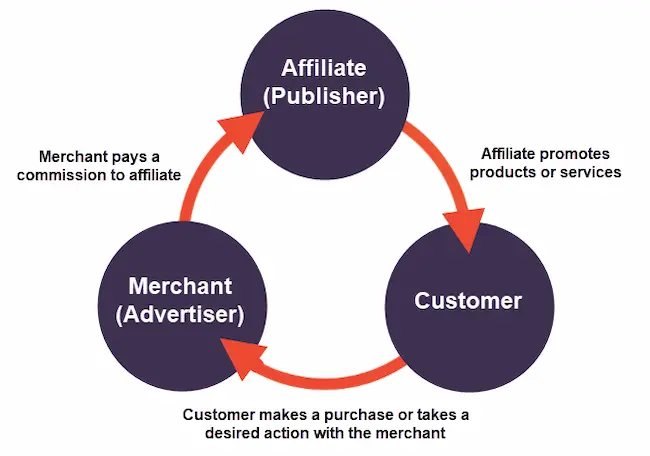
The dynamics are pretty straightforward — you select a brand that has a program for affiliates, sign up for it, and start promoting its product or services to your email subscribers. For every purchase that comes from your affiliate link, you receive a commission.
Let’s say you’re a personal finance blogger and online coach. The most fundamental way for you to capitalize on your position as a financial expert is to tap into the affiliate products offered by FinTech software such as eToro, Binance, or Robinhood:

Another option in this niche is to partner with banks offering an enticing commission for offering their products. There are plenty of them out there — for example, American Express pays up to $200 per sale.

How does affiliate marketing work?
Before we get into the technical side of this marketing channel, let’s say it out loud — the key to success is to promote products or services that meet both fundamental requirements:
- They are trustworthy enough that you can sign your own name to them — don’t get tempted by a high commission and spreading the word about a scammy product. If you lose your credibility as a solopreneur, you lose your business.
- You have knowledge and experience about a specific niche, so you can leverage your street credit to promote products connected to your expertise.
Speaking of the second aspect — Michał Szafrański, one of the most famous Polish financial bloggers, got on the media’s front pages when he earned 70,000 PLN (currently over $16K) on one blog article which was connected to one bank’s affiliate program! Super crazy! And it wouldn’t be possible if it wasn’t for his personal brand and huge credibility.
That said, let’s look at the technical part:
- You select your merchants that offer enticing affiliate products that match your business scope. (If you’re still looking, check out our curated lists of best email marketing affiliate programs and best affiliate marketing programs)
- Sign in to the merchant’s program and get a unique affiliate link.
- You start to promote the product among your audience. As this article is solely about email marketing, you’re leveraging email subscribers.
- Both merchants and affiliates can monitor the performance of those email campaigns by tracking impressions, clicks, and sales.
- You get paid for every objective based on the commission — a conversion, a lead, a sale, and an app install.
Affiliate products are a proven way to generate income, and if you handle it well, it can be super easy (injecting an affiliate link in your email content) and profitable.
For instance, GetResponse’s affiliate program offers 33 percent recurring commission — what a great way to secure a passive income!
👉 Learn more with our affiliate marketing for beginners guide.
2. Include sponsored content or advertising in your emails
Another way to make money with email marketing is to introduce sponsored content and advertising into your email campaigns.
Those commercial tactics are an excellent fit for email marketers that have been on the scene for a while and managed to grow their mailing lists to a number of at least 2,500 subscribers.
Naturally, the bigger and more engaged your email list is, the better. Only this way you will become an attractive asset for potential advertisers.
There’s another reason why hundreds of folks on your email list won’t be enough, but thousands will make a difference. And it’s called CPM (Cost per thousand impressions) — a unit that will help you and your advertiser to set the prices for a banner displayed in your newsletters.
How about solo ads?
A solo ad works like this — advertisers go to email list owners and purchase a placement in their email. Simply put, a brand buys a dedicated email and taps into the existing email audience of that owner.
Even though solo ads don’t have the best reputation from the advertiser’s point of view, it can be a different story when you run a thriving online business and have the capability of providing solo ads service to advertisers.
To make it work, make sure that:
- sponsored emails you send to your subscribers align with your audience’s interests
- you don’t follow spammy practices, and your email list is 100% legit
- you don’t overuse solo ads and trigger your email subscribers to opt out of your mailing list.
Check out this detailed guide about solo ads and think if that’s a good idea for your online business.
Monetize your newsletter with sponsored content
Brands are on the lookout for getting the word out about their products through channels other than paid social media ads and Google Display Network.
That’s why, once your newsletters become a powerful medium, several brands that will find your audience has an overlap with their buyer persona will be open for a partnership with you.

There are three main ways of sponsoring your newsletter:
- Selling classified ads — smaller ads sprinkled all over your newsletter.
- Dedicated emails — one email = one sponsored content
- Sponsored emails — which means a more prominent ad placement in your newsletter
Once you decide which format you will implement, it’s time to think about your pricing. You can set up a flat fee, like $500, for an ad placement. Or, you can opt for a CPM (CPM = Cost of an ad in email send / Number of email subscribers) x 1,000) model.
From there, it’s time to reach out to potential buyers with your sponsored weekly newsletter offer or sign up for marketplaces like Paved, Swapstack, Whosponsorsstuff, or Sponsorgap.
The other option is to pitch your email recipients with your sponsored offer if you know that decision-makers already subscribe to you (which you can check in an email marketing platform like GetResponse). Here’s how Erin Balsa from Haus of Bold does it:

3. Create a tripwire offer
OK, another method to generate more money through email marketing is tripwire offers. And while the name of that technique is not the most fortunate in the world, it’s pretty standard among email marketers out there.
Implementing a tripwire means offering your new subscribers a low-priced product or service. The entry threshold is set low (as the tripwire), increasing the chances of getting more people to purchase.
“OK, it costs only $5, no biggie” — and they’re in! OK, it doesn’t have to be that cheap. Let’s say you’re an online life coach, and you’re offering a bargain deal of $30 for the first online strategy session. As long as you deliver quality after closing that sale, you open an avenue to pitch your more expensive services.
In practice, it can mean creating a landing page with a curated offer and sending an upsell email after finalizing the first deal.

4. Sell your own product or service
OK, affiliate marketing and advertising can help you earn money. In some cases, those results can be impressive.
But, regardless of how high the affiliate commission is, it’s still a percentage. If you’re lucky, you get 20, 30, or 40% of conversions or sales.
By selling your own products or services, you can make money on a scale that will drive your online business forward substantially.
You own it — the 100% goes into your pocket without sharing that with a sponsorship marketplace or a merchant.
How can you pull this off?
At your service
Let’s start with offering a service. If you’re a consultant, an online coach, or a freelance marketer, you can market your services to your email subscribers. Your email list is your potential customers.
As long as you provide them value for free through your email marketing program, at some stage, they will naturally go down the sales funnel and be more prone to try your offer.
Create your own product
Another one is a digital product. It can be a paid ebook or a package of coaching sessions. The rule of thumb would be the same as with your services.
Your product needs to solve pains and generate gains for your target audience. It has to be relevant to them!
We’re in the middle of an AI revolution. And for you, as a content creator, it’s a massive opportunity because, with ChatGPT4, you can now develop applications, Chrome extensions, mobile games, and other digital products without an army of software developers and designers!
And how to know if your audience will be ready to purchase your product?
Use newsletters and autoresponders to survey your subscribers and get their opinion first. The best way to market any product is to learn what your buyers need.

5. Create a paid newsletter
This part might be tricky. Especially if you have just started growing your email list. You can say: “I’m struggling to have people opt into my email list for free, so how am I supposed to get them to pay me for it?”
And you’re absolutely right. It’s a real challenge at the early growth stage. It will take some time, but by providing high-end value to your readers, you will reach the moment to:
- Transform your free email sequence into a paid newsletter
- Create a premium version of your regular newsletter with exclusive content you won’t share anywhere else.
Before you go full-scale, try to test the waters first. Voice of customer data is essential here. Email marketing gives you a natural opportunity to gather feedback from your email subscribers. Ask them:
- Would they pay you if you introduced a paid newsletter
- What type of content would be worth paying for (in their opinion)
- How much would they pay you

Looking for inspiration? There are several thriving paid newsletters out there, each of them dedicated to a specific niche:
- Stratechery Plus – a premium version of the Stratechery newsletter about tech and business,
- STAT+ – in-depth coverage on biopharma, health tech, and science,
- The Browser – with quality, curated stories.
6. Create a paid course
Earlier, I mentioned crafting a digital product to make money with email marketing. Creating a paid online course is one of the most popular and profitable digital products used by solopreneurs.
Sharing tips and tricks and leading thoughts through a free or paid newsletter is one thing. Teaching your subscribers interested in your expertise, new skills, and workflows is another.
To create a paid course, you’ll need to get back to the drawing board and list your audience’s pain points. From then, make a step-by-step process to overcome those challenges.
Once you have the idea for your online course, you need to:
- Break down the structure into lessons, videos, worksheets, and quizzes
- Create a landing page with the signup form
- Optimize your landing page for specific keywords
- Run a successful email marketing campaign backed up by paid social ads to drive traffic to your page.
How to sell an online course
Do you enjoy creating educational courses and want to turn your knowledge into a profitable business? Follow these simple steps and start selling your first online course today!
Sell your online course with a conversion funnel
Over the past few years, the booming popularity of e-learning platforms like Udemy or Coursera has translated into proven ways to make money online for thousands of coaches and trainers.
But the entire process of managing a digital course can scare many people away. The good news is — that there is a way to manage it from top to bottom through GetResponse’s conversion funnel.

- First, behind every successful product campaign, there is website traffic. And the fastest way to trigger that is through paid advertising campaigns. The great part about it is that you don’t have to jump from one ad manager to another. You can orchestrate your paid ads from our conversion funnel’s first stage.
- The next stage in the conversion funnel is converting your website visitors into leads. If your landing page has some gated content, creating a sign-up form will do the trick. If, on the other hand, your landing page is a blog post, then coming up with an exit popup is the tool that can persuade people to leave you their emails.
- People who got interested enough signed up for your email list – yay! At this funnel stage, it’s time for email marketing to work its magic! Starting with a welcome email, you can craft your entire email campaign to nurture your leads with valuable content and to build a ground for pitching them with paid courses through an upsell email.
- After nurturing your leads with email automation, it’s time to show them how much more profit they can gain by signing up for your paid course. Create content on your website with your course outline, structure, and benefits. With the right message, you can convert your subscribers into paid customers.
- It might not always be the case for you as a course creator, but the conversion funnel allows you to upsell your trainees with premium time-limited offers.
- And the most enjoyable part of your digital business journey is connecting to your chosen payment system and observing how much money you earn on sharing your know-how and skills with your email subscribers!
How can you customize your funnel
But the best part of conversion funnels for teaching and training online is that you can build that architecture of actions and stages the way you want!
Examples? Of course!
Check this video where Ian Cleary, Founder of Razor Social, breaks down the process of building their funnel for selling an online course.
Their approach was a bit different:
- They started with a landing page
- Where they collected sign-ups with a form and an exit pop-up
- From where they reached out to their new subscribers with an autoresponder
- Sending people to the sales page.
- Which was connected to the payment method (Stripe)
- With a confirmation page after that
- And, of course, the final metric at the bottom of the funnel – how much money they earned.
Another interesting case comes from Alex Terrier. This jazz musician was widely successful in selling his online music course with the conversion funnel. Only during the first 30 days of his campaign he managed to land:
- 1350 unique landing page visitors
- 253 new subscribers
- 502 unique sales page visitors
His secret sauce? Offering free and high-quality content to hook aspiring musicians.
7. Run paid webinars
And there comes our last email monetization method — running webinars. Conducting online events can serve multiple purposes.
For instance, free webinars are a perfect way to generate leads and nurture existing email subscribers with additional helpful content.
Webinar tools such as polls and surveys, chat, and Q&A enable you to interact with your audience and know them better. This knowledge can help you refine your messaging when you are all set to create content — for a blog post or an ebook.
But paid webinars are a different story. It’s not about capturing leads. Running webinars with an entry fee means selling advanced knowledge and insights to people who want to upgrade their skill sets or learn something super valuable that is not available for free elsewhere.
How much money can you make with paid online conferences and training sessions? Here are some examples from the State of Online Events 2022:
- Conference for coaching experts: creating partnerships: 881 tickets sold, 20,602 EUR earned
- Training for psychotherapists and psychologists (32 events): 7103 tickets sold, 686 808 EUR earned
- Webinar to improve the therapists’ skills: 580 tickets sold, 12,309 EUR earned
Impressed? No wonder! Let’s sneak a peek at how to run paid webinars!
How to run a paid webinar
Follow this step-by-step workflow:
- Create content for your online events: a script, a slide deck, and other media such as videos, quizzes, and surveys.
- Invite a co-host if necessary.
- Create a webinar with a meaningful name, date, and duration.
- Set up your price for an entrance ticket.
- Enable the automatic recording to repurpose your live event as an on-demand webinar that will make money long after you wave “goodbye” to your attendees.
- Send invitations to your subscribers.
- Promote the event on your social media – organically and with paid ads.
- Run the event and keep your audience engaged.
- Follow up with your attendees with additional content and possibly cross-selling your other digital products.
Pro tip: You can orchestrate everything in GetResponse – your webinar, an email campaign, and paid ads on Facebook or Instagram.
Start making money with email marketing!
Even without a big marketing team or a dedicated email specialist, email marketing has a wide array of options to make money — from promoting affiliate products, through running a paid newsletter, to implementing advertising in your emails.
Another strategy is to pitch your services to your subscribers and sell products, such as ebooks, templates, workflows, training sessions, online courses, and paid webinars.
The critical point is consistently delivering high-quality and value for your target audience. Once you look after this part, you can experiment with different ways to make money.
And finally, to start implementing your revenue-generating program, you need a solid email service provider!
And GetResponse is the one that will help you keep everything under one roof! Try all the features for free for the next 30 days.
[ad_2]
Source link
When it comes to working at specific establishments and in certain industries, it’s not unusual for managers to ask prospective employees to have qualifications or experience that relate directly to their business.
But one restaurant in Palm Springs, California is going viral for having an extensive list of expected dos and don’ts for servers looking to join the team — and it’s not for the faint of heart.
The ad, which was originally posted by the Tonga Hut in Palm Springs on Craigslist, started garnering attention after one TikToker posted a video upon finding the ad in a clip that’s been viewed thousands of times.
“This is the most insane ad for a server in a restaurant that I’ve ever seen and it just made my day,” the TikToker named Abbey says.
@.desertrat DONT GET LOCKED IN YOUR OWN HOUSE OR YOU WILL BE FIRED!!! #craigslist #craigslistspecial #serverlife #nobodywantstowork ♬ original sound – abbbbbey
The advertisement starts off relatively normal, requiring that those looking to apply be sober on the job, be comfortable in a fast-paced environment, have experience in the restaurant industry, be willing to work late hours, and have a reliable means of transportation as public transportation options end at 9:40 p.m.
Seems fair, right?
That’s until the TikToker breezes on to the second part of the ad where the hiring manager (who names herself as Claudia) goes into just about every possible worst-case scenario before listing her extraneous bullet points as to why someone should not apply for the position.
 A screenshot of the job listing that was posted via Craigslist.
Standout reasons to skip this job application include: having a cell phone that is constantly dying without being charged, having to call out sick constantly because your grandma has poisoned you with her ham, taking weekends off if your roller derby team makes it to the finals, getting headaches from going to too many garage sales, having a house without windows to crawl out of in case you accidentally lock yourself inside, and being prone to accidentally booking flights to Las Vegas.
The job posting then closes out by maintaining that the restaurant is a “team-oriented environment” and that those with big egos, introversion, and bad attitudes shouldn’t apply.
Viewers had a field day in the comment section, noting that whoever wrote the posting clearly has seen it all when it comes to the restaurant industry.
“It sounds like that employer has heard every single one of those excuses and has a bit of trauma,” one user joked.
Others added that since the listing says that people who “have no sense of humor or can’t handle skillful sarcasm” shouldn’t apply, it’s clear the post was meant to be sarcastic in nature.
Tonga Hut did not immediately respond to Entrepreneur‘s request for comment to clarify.
[ad_2]
Source link