With car insurance rates soaring in recent years, drivers are looking for ways to save on their premiums. Many insurers offer safe driving discounts that incorporate telematics programs, also known as usage-based insurance (UBI), to record and evaluate your habits behind the wheel.
If the data shows you’ve been a responsible motorist, you could see your rate drop by as much as 40%.
While the discounts are appealing, some companies will raise your premiums if the results show you’re not considered a safe driver. Additionally, privacy advocates worry about where all that information could wind up.
“It comes down to consent,” said Hayley Tsukayama, associate director of legislative activism at the Electronic Frontier Foundation, a digital privacy nonprofit. “People get upset when their data is used in ways they don’t expect. Maybe you are willing to make some of those trade-offs — it’s all about clear communication.”
If you’re thinking about a safe driving discount — or you’ve already signed up for one — find out how they work, how much you could save and what the risks are.
Compare offers to find the best auto insurance
How do safe driving apps work?
Discounts for good driving are nothing new: Insurance companies often lower rates for drivers who take a defensive driving class or who haven’t had an accident in several years. But the advent of wireless technology has meant insurers can now collect, transmit and evaluate day-to-day driving behavior in real-time.
Signing up for a safe driving discount usually means installing a plug-in device or downloading an app on your mobile phone. (Some insurers offer either option or use data from both.)
Tracker: These widgets, known as telematics devices, are usually plugged into a port beneath the steering wheel and use your car’s sensors and diagnostic systems to track your performance.
Smartphone app: Instead of onboard diagnostics, data about your driving speed, hard braking and other behaviors is captured by your phone’s internal GPS and sensors. The apps typically analyze movements — like how your phone rotates when you enter your vehicle — to determine if you’re driving.
The system tracks metrics relating to your performance behind the wheel. The specifics vary, but they typically include:
- Time of day
- Mileage
- Location and route
- Speed
- Acceleration, braking and turning
- Phone usage while driving
Since each insurer collects, analyzes and weighs data differently, there is no one approach to getting the most out of a UBI plan. According to Progressive, limiting hard braking and acceleration, avoiding handheld phone activity and not driving between midnight and 4 a.m. will help you optimize its Snapshot program.
Which insurance companies have safe driving apps?
These are some of the top insurers offering discounts if you allow them to monitor your driving habits. Each state has different rules about how data can be used, however, and some restrict or prohibit UBI programs.
Allstate: Up to 25% off with Drivewise
American Family: Up to 20% off with DriveMyWay
Farmers: Up to 35% off with Signal
Geico: Up to 25% off with DriveEasy
Nationwide: Up to 40% off with SmartRide
Progressive: Customers who earn a discount with Snapshot save an average of $231 a year
State Farm: Up to 30% off with Drive Safe & Save
Travelers: Up to 30% off with IntelliDrive
USAA: Up to 30% off with SafePilot
Can a safe driving app make my rate go up?
Will my driving data be sold?
Depending on your insurer, telematics information can be shared or used for other purposes, including marketing. In addition, a company that doesn’t share or sell your data may still be required by law to comply with a subpoena, court order or law enforcement request.
It can be difficult to decipher an insurer’s privacy policy to know exactly what is being done with your information.
“Unfortunately, it does require a little work — they don’t make it easy,” said Tsukayama. “Obviously, the insurance companies are incentivized to get people to sign up for these programs. So, [those agreements] are not always easy to decipher.”
Nationwide, State Farm and USAA told CNBC Select that driving data is not shared or sold with third parties.
Nationwide Auto Insurance
-
Cost
The best way to estimate your costs is to request a quote
-
App available
-
Policy highlights
Nationwide offers near-nationwide availability and personalized services, such as On Your Side® Review, a free annual insurance evaluation to ensure you are adequately protected and are taking advantage of any discounts available to you.
State Farm Auto Insurance
-
Cost
The best way to estimate your costs is to request a quote
-
App available
-
Policy highlights
State farm is one of the largest auto insurers based on market share and has an excellent reputation for customer satisfaction. It offers 13 discounts, including ones for safe driving and young drivers.
Farmers Auto Insurance directed CNBC Select to its privacy notice, which indicates customer data from its Signal app may be shared with third parties, including “companies that perform marketing services on our behalf or to other financial institutions with which we have joint marketing agreements.”
Farmers Auto Insurance
-
Cost
The best way to estimate your costs is to request a quote
-
App available
-
Policy highlights
Farmers sells car insurance in every state except Alaska, Delaware, Hawaii, Maine, New Hampshire, Rhode Island, Vermont, Washington, D.C., and West Virginia and offers a whopping 22 discounts.
According to Progressive’s privacy statement, personally identifiable data from its Snapshot app may be shared with other companies “to service your insurance policy, detect or prevent fraud, perform research, market our or our affiliates’ products and services to you or as required or permitted by law.” (Users can limit some of the marketing of Progressive and affiliate products and services, however.)
Progressive Auto Insurance
-
Cost
The best way to estimate your costs is to request a quote
-
App available
-
Policy highlights
Progressive offers a number of lines of insurance to allow for bundling, and convenient tools to help you keep your coverage in your budget.
“Make sure you’re comfortable if your insurer is reserving the right to sell your information to data brokers,” Tsukayama said. “Maybe you’re willing to make some of those trade-offs. It’s all about clear communication.”
How accurate are safe driving apps?
While your car’s or phone’s sensors can detect driving behavior, they’re not infallible: They may register you were the driver when you were in the passenger seat or detect distracted driving when you’re not even behind the wheel.
Only 38% of customers who use safe-driving apps say the data collected is always accurate, according to J.D. Power. Most programs allow users to request corrections, but the process is time-consuming and the options are limited. Travelers Insurance, for example, gives Intellidrive users 10 days to update that they were a passenger, not a driver, on a given trip.
Travelers Auto Insurance
-
Cost
The best way to estimate your costs is to request a quote
-
App available
-
Policy highlights
Travelers auto insurance policies are affordable and backed by the sixth largest company for car insurance by market share according to the NAIC. The company also offers a number of discounts to customers, including discounts for bundling, owning a hybrid or electric car, and good student discounts.
How do I sign up for a safe driving discount?
In most cases, policyholders need to enroll in the safe driving discount within the first few weeks of their policy going into effect. The insurer then tracks their driving for the duration of their term (usually six or 12 months) and then applies any discount at the next policy renewal.
In some cases, you may need to complete a certain number of trips within that time frame to qualify.
The full discount usually isn’t available until you renew, but most companies offer a smaller discount just for signing up: Nationwide, for example, takes 10% off your rate when you enroll in its SmartRide program. At renewal, the overall discount can increase to as much as 40%.
| Insurer | Program | Discount |
|---|---|---|
| Allstate | Drivewise | Up to 25% off |
| American Family | DriveMyWay | Up to 20% off |
| Farmers | Signal | Up to 35% off |
| Geico | DriveEasy | Up to 25% off |
| Nationwide | SmartRide | Up to 40% off |
| Progressive* | Snapshot | Average of $231 a year for drivers who save |
| State Farm | Drive Safe & Save | Up to 30% off |
| Travelers | Intellidrive | Up to 30% off |
| USAA | SafePilot | Up to 30% off |
Source: Discount information from insurers. Progressive did not disclose a percentage discount
Are safe driving apps worth it?
If you’re a responsible motorist, safe driver apps are a great way to lower your rates. But, depending on your insurer, you could risk a rate increase.
You also need to decide if it’s worth your insurance company having access to that much data.
“If there are reasons that you might want to keep that information more [private], you might say, ‘Oh no, this is not for me,'” Tsukayama said. “The top thing is knowing what you’re getting into. Try to understand what they collect and use that to evaluate how comfortable you are with it.”
Whatever you decide, Tsukayam said, it should be an informed decision.
“At the end of the day, it’s your information,” she said. “It’s not theirs. They may be collecting it and holding it, but it’s about you.”
Safe driving discount pros and cons
Pros
- Lower rates.
- Improved driving habits
Cons
- Your rates could increase.
- Your data may be sold.
More ways to save on car insurance
CreditWise® from Capital One
Information about CreditWise has been collected independently by Select and has not been reviewed or provided by Capital One prior to publication.
-
Cost
-
Credit bureaus monitored
-
Credit scoring model used
-
Dark web scan
-
Identity insurance
FAQs
How much can I save with a safe driving discount?
The exact discount depends on your insurance company, your policy and where you live. Nationwide cited a maximum discount of 40%, the highest among the companies we reviewed.
What are the risks of signing up for a safe driver discount?
Depending on the insurer, your rates could increase or your information could be shared with marketing companies and other third parties.
How does a safe driving app know who is driving?
Safe driving apps use your phone sensors to analyze movements and behaviors — like how your phone rotates when you enter your vehicle — to determine if you are the driver. Mislabeling of trips can happen but users can submit corrections.
Subscribe to the CNBC Select Newsletter!
Money matters — so make the most of it. Get expert tips, strategies, news and everything else you need to maximize your money, right to your inbox. Sign up here.
Meet our experts
At CNBC Select, we work with experts who have specialized knowledge and authority based on relevant training and experience. For this story, we interviewed Hayley Tsukayama, associate director of legislative activism at the Electronic Frontier Foundation.
Why trust CNBC Select?
At CNBC Select, our mission is to provide our readers with high-quality service journalism and comprehensive consumer advice so they can make informed decisions with their money. Every car insurance article is based on rigorous reporting by our team of expert writers and editors with extensive knowledge of insurance products. While CNBC Select earns a commission from affiliate partners on many offers and links, we create all our content without input from our commercial team or any outside third parties, and we pride ourselves on our journalistic standards and ethics.
Catch up on CNBC Select’s in-depth coverage of credit cards, banking and money, and follow us on TikTok, Facebook, Instagram and Twitter to stay up to date.
Editorial Note: Opinions, analyses, reviews or recommendations expressed in this article are those of the Select editorial staff’s alone, and have not been reviewed, approved or otherwise endorsed by any third party.
[ad_2]
Source link
Morsa Images | Digitalvision | Getty Images
Workers and companies see benefits of remote work
In 2019, about 5% of full-time work was done from home. The share ballooned to more than 60% in April and May 2020, in the early days of the Covid-19 pandemic, said Nicholas Bloom, an economist at Stanford University who has researched remote work for two decades.
That’s the equivalent to almost 40 years of pre-pandemic growth virtually overnight, his research shows.
The share of remote work has steadily declined (to about 27% today) but is likely to stabilize around 25% — a fivefold increase relative to 2019, Bloom said.
“That’s huge,” he said. “It’s almost impossible to find anything in economics that changes at such speed, that goes up by 500%.”
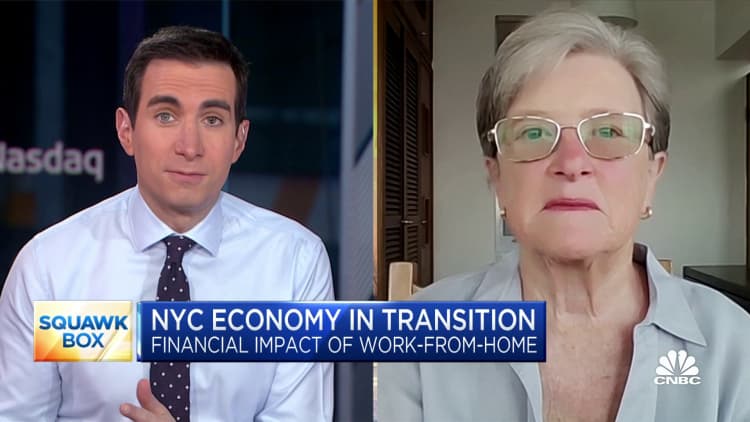
Initially, remote work was seen as a necessary measure to contain the spread of the virus. Technological advances — such as videoconferencing and high-speed internet — made the arrangement possible for many workers.
Both employees and companies subsequently discovered benefits beyond an immediate health impact, economists said.
Employees most enjoy having a reduced commute, spending less time getting ready for work and a having a flexible schedule that more easily allows for doctor visits and picking up kids from school, Bloom said.
Some workers have shown they’re reluctant to relinquish those perks. Companies such as Amazon and Starbucks, for example, recently faced a backlash from employees after announcing stricter return-to-office policies.
Employers enjoy higher employee retention and can recruit from a broader pool of applicants, said Julia Pollak, chief economist at ZipRecruiter. They can save money on office space, by recruiting from lower-cost areas of the country or by raising wages at a slower pace due to workers’ perceived value of the work-at-home benefit, she said.
It’s almost impossible to find anything in economics that changes at such speed.
Nicholas Bloom
economist at Stanford University
For example, job seekers polled by ZipRecruiter say they’d be prepared to take a 14% pay cut to work remotely, on average. The figure skews higher — to about 20% — for parents with young children.
Twitter recently shut its Seattle offices as a cost-cutting measure and told employees to work from home, a reversal from an earlier position that employees work at least 40 hours a week in the office.
“The benefits for employers are pretty substantial,” Pollak said.
Hybrid work model is a ‘win-win’
Momo Productions | Digitalvision | Getty Images
Most companies have turned to a “hybrid” model, with a work week split between maybe two days from home and three in the office, economists said.
That arrangement has yielded a slight boost in average worker productivity, Bloom said. For one, the average person saves 70 minutes a day commuting; roughly 30 minutes of that time savings is spent working more, he said.
“Hybrid is pretty much a win-win,” Bloom said.
About 39% of new hires have jobs with a hybrid work arrangement, while 18% of new jobs are fully remote, according to ZipRecruiter. Both shares are up relative to their pre-pandemic levels (28% and 12%, respectively).
“It’s still an evolving trend, but the movement is very much toward increased remote work,” Pollak said.
Of course, not all workers have the option to work remotely. About 37% of jobs in the U.S. can plausibly be done entirely at home, according to a 2020 study by Jonathan Dingel and Brent Neiman, economists at the University of Chicago.
There are large variations by occupation and geography. For example, jobs in retail, transportation, hospitality and food services are far less likely than those in technology, finance, and professional and business services to offer work-from-home arrangements.
Remote work may endure even in a recession
Not everyone agrees that the benefits of working from home outweigh costs.
Evidence suggests employee mentoring, innovation and company culture may suffer if jobs are fully remote, Bloom said. Workers cite face-to-face collaboration, socializing and better work-life balance as top benefits of in-office work, his research finds.
Companies that are fully remote often have in-person gatherings or retreats as a way to build company culture, Bloom said.

Workers have enjoyed a high degree of bargaining power due to a hot labor market characterized by low unemployment and ample job openings. If the economy cools and their bargaining power dissipates, it’s unclear whether some employers would introduce stricter work-from-home policies, economists said.
For one, employers may see remote work as a useful way to trim labor costs in the face of recession, Bunker said. The more likely scenario is on the margin: perhaps three or four days in the office instead of one or two, he said.
The technology sector is a useful indicator, he said. Tech job postings have fallen this year amid industry struggles, but the share of Indeed job ads offering a remote work benefit has remained constant, Bunker said.
“It’s been quite sticky in the face of hiring pullbacks,” he said.
[ad_2]
Source link