This article originally appeared on Business Insider.
A billionaire philanthropist is backing a $20 million plan to release Tokitae the orca from her small enclosure in the Miami Seaquarium.
The plan would involve loading the 8,000-pound killer whale on a plane, flying her across the US, and releasing her in a bay near Seattle.
“She’s healthy, I’ve got the money, let’s move her,” Indianapolis Colts CEO Jim Irsay told “The Pat McAfee Show” last month.
Friends of Toki, the activist group leading the move with financial backing from Irsay, told Euronews that the animal could be moved within 18 to 24 months.
Killer whale on a plane
The plan, which is in collaboration with the owner of the Miami Seaquarium, The Dolphin Company, would see the 21-foot-long killer whale loaded onto a harness and enclosed in a glass tank at the Miami Seaquarium, according to The Times of London.
That tank would be loaded onto a truck to the Miami airport, where it would be transferred onto a large cargo plane such as a C-130 Hercules, the newspaper said.
The orca would then be flown with her carers across the US on a 2,700-mile journey to the Seattle Airport, where Tokitae would be taken by truck to the Salish Sea, per the Times.
The report said that more than $500,000 had already been spent on Tokitae’s “life support systems” for the trip, including filters for her pool water.
Tokitae, who is not strong enough to swim long distances or hunt on her own, would be transferred to a 15-acre netted area near the San Juan islands.
Tokitae has been living in the world’s smallest orca enclosure. File photo/Miami Herald/Tribune News Service via Getty Images via BI
Tokitae has been living in the world’s smallest orca enclosure
Tokitae, also known as Lolita, has been performing for 53 years. She was captured from Penn Cove, Washington, when she was four.
The killer whale has been living in the world’s smallest orca tank, which measures 80 feet by 35 feet. She’s the second oldest orca living in captivity.
According to a 2022 report, Tokitae’s health was rapidly declining. Her health has since improved, thanks in part to efforts to updates to her living conditions. In the midst of activist pressure, notably from the Lummi Nation, an indigenous group that considers her a family member and calls her Sk’aliCh’elh-tenaut, the Miami Seaquarium agreed to stop the orca’s live shows last year.
Orcas are intensely social animals that form strong bonds with their mothers. The hope is that Tokitae could be reunited with her mother, who is thought to be alive and swimming near where the netted enclosure would be.
Lii, a Pacific white-sided dolphin who has been sharing Tokitae’s enclosure in the Miami Seaquarium, might be relocated with Tokitae to keep her company.
[ad_2]
Source link
Happy hour? Wine not.
But before you plop down your hard-earned money on a savory bottle of red or a bottle of white, you might want to understand better why wines are priced the way they are. Contrary to popular belief, it’s not just because they taste better — or because they’re older than your grandpa.
We asked Brianne Engles, the head winemaker at Chamisal Vineyards in San Luis Obispo, California, to shed some light on this mysterious topic. Chamisal specializes in handcrafted Chardonnay and Pinot Noir, grown on an 82-acre estate in the Edna Valley AVA. Their offerings range from $35 for their estate-grown wines to $100 for their luxury icon wines. Engles says cost boils down to three key factors — farming, oak, and quality.

Brianne Engles of Chamisal Vineyards
Farming
Harvesting grapes at a vineyard can be costly, including planting, irrigation, and labor. At boutique wineries like Chamisal, individual “blocks” or a designated group of premium vines in a vineyard require more TLC.
“Our highest producing, highest quality blocks tend to have lower yields,” explains Engles. “When you have lower yields, your cost of farming is higher.”
This is because low-yield grapes result in lower production, leading to more scarcity of product. All the pruning, canopy management, and harvesting at Chamisal are performed by hand and follow Organic farming practices, which require multiple vineyards passes throughout the growing season. These labor-intensive elements contribute to the increased cost of farming.
Oak
Oak aging is a popular practice among winemakers because it adds complexity and smoothness to the wine. Chamisal wine is aged in oak barrels imported from France. In the barrel, the wine is exposed to oxygen, which helps to soften the tannins and develop the flavors. The oak barrels also impart unique flavors to the wine, which consumers might say smells like vanilla or baking spices.
The oak barrels at Chamisal are used judiciously to allow for the transfer of oxygen into the wine, elevating the unique character of each grape variety and vineyard site’s soil.
But oak aging is a complex and time-consuming process. “New oak is expensive. So if you have a higher percentage of new French oak, it can lead to a more expensive wine,” says Engles.
Time is also a factor. Some wines are typically aged for 12 to 18 months in oak barrels. This practice takes space and money to ensure that a bottle of wine is appropriately nurtured.
Quality
The quality of the grapes coming out of specific blocks is also a factor in the cost of the wine. But when winemakers measure quality, they’re not just focusing on the taste. At Chamisal, they evaluate the wine that comes out of each block in the cellar and do an extensive evaluation.
“We smell it, sip it, give it grades,” explains Engles. “Winemakers are not just sitting there writing flowery descriptors. We’re determining does it have intensity, are the tannins in balance, does it have enough fruit, does it have all the guts and pieces that make a very high quality.”
All these factors make the perfect bottle of wine harder to achieve, and scarcity causes the price to go up.
Would you like some Chardonnay with that crustacean?
Chamisal is hosting its 15th annual Lobsterfest on July 21 and 22nd. Lucky gourmands are treated to long tables piled with steamed lobster, corn, artichoke, sausages, and, of course, lots of wine.
Prices range from $215 for club members to $265 for the general public.
For reservations, visit their site.
[ad_2]
Source link
The unveiling of BMW‘s 2024 5 Series is causing some side eye.
Entering its eighth generation, the BMW 5 Series offers a revolutionary new feature that allows drivers to change lanes just by looking into its side view mirrors.
With Active Lane Change Assist, an optional part of the Highway Assistant Level 2 driver assistance suite, your car can automatically change lanes for you. Here’s how it works:
- The system first prompts you that a lane change is suggested. This might be because you’re approaching a slower car or because your lane is ending, and you need to merge.
- With Active Lane Change Assist, the driver simply looks at the side view mirror, and the car will change lanes — as long as it’s safe.
Other vehicles, such as GM‘s SuperCruise system, have an automated lane change option, but they require you to accept the prompt using the turn signal stalk physically. BMW takes that step out of the process, letting your eyes do the steering.
Related: BMW’s New i Vision Dee Concept Car Can Change Colors Without Going to the Body Shop
Some concern
Not everyone is a fan of this new feature. MotorTrend, for example, questioned the safety of eye-controlled steering.
“We’d be lying if we weren’t slightly concerned,” the auto magazine wrote. “The reality is that it’s not an arduous process to move your hand a few inches and touch the stalk, and there’s a lot less potential for the car to misinterpret the action. We’ll have to try this system out once the car is available for review to see for ourselves.”
First electric 5-Series
The eye-controlled lane change system wasn’t the only major news to come out of BMW this week. The German automaker also announced the debut of two all-electric 5 Series models.
The i5 eDrive40, with 335 horsepower, has an EPA range of about 300 miles per charge. The sticker price starts at $67,795.

On the higher end is the 5 M60 xDrive, a two-motor, 590-horsepower machine. You’ll have to shell out at least $85,095 for this one.

[ad_2]
Source link
A few years ago, a hardware designer named Kyle Buzzard watched a viral video of a seagull that had stolen a GoPro and taken photos of itself looking into the camera.
“That started wonder and the questions, how can we do that and automate it?” recalls Buzzard, who incidentally has the perfect name for his avian interests.
Buzzard and his associates envisioned an AI-powered smart bird feeder that could identify and snap photos of 1000 species of birds that might visit your backyard.
But there were two immediate hurdles they had to overcome.
“First, to try and get up close and personal high-quality images of birds without disturbing them,” explains Buzzard. “Second, to be able to recognize the species easily. Both are very challenging to do and have the bird remain in place long enough. How many times have you reached for your camera or bird book only for the feathered friend to have flown off?”
Buzzard’s design pedigree helped them accomplish their goals.
Bird Buddy launched its first Kickstarter in November 2020, raising $5 million, which according to the company, put them in the top 1% of all Kickstarter campaigns and was the most-funded campaign in Kickstarter’s gadget category.
The result was an ingenious bird feeder that is sort of PokemonGo meets the Ring.

How it works: A feathered friend flies to the feeder, and an AI-powered camera notifies you, identifies the species, takes photos, and organizes them into a collection.
Related: People Keep Licking a Rare Toad in U.S. National Parks. The Reason Is a Real Trip.
Nature calls
Buzzard hopes the device helps people connect back to nature. “Unfortunately, many of us have developed a passive relationship with the natural world,” he says. With technology capturing most of our attention, we fail to look up and see the beauty surrounding us. He hopes Bird Buddy can help solve that by putting the natural world in the palm of your hands.

“We wanted to allow nature to have its chance in our digital lives,” Buzzard says.

For a fun look at the best photos captured by Bird Buddy users, check out the my bird buddy portal.
[ad_2]
Source link
A Minneapolis startup company wants to become a leader in the emerging carbon capture and storage market.
Carba, co-founded by a University of Minnesota chemical engineering professor and a former student, has developed a portable reactor that converts plant waste into a charcoal-like substance called biochar. That material can then be buried to seal carbon in place for generations.
The company’s backers believe it could prove to be an inexpensive and energy-efficient method to remove carbon dioxide from the atmosphere — something the latest Intergovernmental Panel on Climate Change report, released Monday, says will be necessary for preventing the most devastating effects of climate change.
“There’s a huge negative emissions problem, and nobody has the technology to scale without using a ton of energy or capital,” said Andrew Jones, Carba’s founder and CEO. “We believe we have cracked that nut.”

Andrew Jones, Carba’s founder and CEO. Credit: Carba, Inc. / Courtesy
Related: 6 Meaningful Ways to Reduce Your Company’s Carbon Footprint
Capturing carbon into solid form
Trees and plants are the world’s biggest carbon sink. Through photosynthesis, they store carbon dioxide throughout their lives, but after they die, they decay and release that carbon back into the atmosphere.
Carba’s technology offers a way to lock that into a solid form instead. The company promises to consume a fraction of the energy of other technologies, such as direct air capture methods. In addition, those technologies demand either centralized plants or investments of hundreds of millions of dollars per site.
Carba’s answer: let trees and plants do the work of pulling carbon from the atmosphere, and then lock that biomass into a stable form before it can decay. Jones believes biochar should be buried to remove any chance of carbon release.
“If we harvest all the biomass waste out there and convert it to something more stable, like a char, then bury it underground, we’re reversing the coal mining process,” Jones said. “We can take 1 trillion tons of CO2 that we’ve dug up and put into the air, suck it into the trees and the plants, take their waste product, bury it underground, and store it indefinitely.”

Credit: Carba, Inc. / Courtesy
Partnership with Waste Management
The company was recently named a finalist for an incubator program by Minnesota clean energy accelerator Grid Catalyst. It is partnering with trash and recycling giant Waste Management to deploy its first reactor at a Twin Cities waste facility.
Waste Management said in a prepared statement that it seeks to reduce its carbon emissions by 42% by 2032 and sees biochar as a potential solution. Wood waste at its suburban facility currently either becomes compost or is burned for energy.
The company is “excited to partner with Carba on this sustainability research project that has the potential to demonstrate tangible scientific progress towards climate solutions.”
Jones said biochar offers co-benefits for Waste Management. It helps contain environmentally destructive elements such as the fluoridated forever chemicals (widely known as PFAS), mercury, methane and odors. “That’s a benefit to the whole community,” he said.
Grid Catalyst founder and president Nina Axelson said Carba merges energy innovation and clean energy ecosystems. “I feel like Carba sits exactly between those two because it’s carbon capture technology, but there’s a very big energy efficiency component to their technology,” she said.
Jones met co-founder Paul Dauenhauer in 2005 while he was a chemistry undergraduate at the University of Minnesota. Dauenhauer holds an endowed chair, runs his own research lab, and has won many awards, including a MacArthur Foundation “genius grant” in 2020. The serial entrepreneur has spun off his research into three startup businesses involving biomass.
The two previously co-founded Activated Research Company, which provides chemical analysis for greenhouse gases, biofuels, sustainable aviation fuels, jet fuels and pyrolysis products.
Inexpensive and scalable
An inexpensive, scalable technology like Carba is the key to combating carbon emissions, Dauenhauer said. The energy consumption is a fraction of what direct air capture would consume. “I think a lot of people may be good at chemistry or physics and they understand how to sequester carbon but don’t know how to do it cheaply,” he said. “You have to cut every cent out of the processing and logistical sequence of getting that carbon underground. And that’s where we excel.”
The North American market alone creates a billion tons of biomass annually, which means the company shouldn’t be limited by supply chain shortages. Carba’s technology is also feedstock agnostic, so it can use whatever waste materials are cheaply available.
The mobile reactors can move to different dropoff sites to reduce miles traveled by truckers hauling biomass. The size of a wood chipper, the reactors heat plant waste in an oxygen-less environment to a temperature around that of a commercial pizza oven in a process known as torrefaction.
Initially, Carba considered building a biomass plant before deciding that would take too long, cost too much, and require years of studies and permitting, Jones said. However, that remains the problem of carbon capture facilities at coal or other fossil fuel plants — the cost can top $1 billion and the infrastructure takes years to build.
Several other companies are pursuing similar approaches to carbon capture. CDR.fyi, a community-driven initiative to monitor the carbon removal market, wrote in a Medium post that biochar delivered 87% of the carbon removed from the market last year. Of the 10 most active companies, nine targeted biochar for carbon removal.
Jones and Dauenhauer wrote a peer-reviewed article for ACS Engineering that reported that torrified carbon requires just a small energy input compared to direct carbon capture.
Carba believes the bioreactor will cost less than $200 to break down a ton of biomass. Through selling credits on the evolving carbon removal market Carba should more than pay for the bioreactor’s production costs and generate profits, Jones said.
Carba plans to build and own the reactors, with revenue coming from the sale of carbon removal credits in voluntary markets. The markets reward producers with more money for permanence, defined as carbon storage for at least 100 years.
The global carbon removal market is expected to grow from nearly $2 billion in 2020 to $7 billion by 2028, Fortune Business Insights predicts. CDR.fyi reports 593,000 tons of carbon were purchased last year, a 533% increase over 2021.
Last year Stripe, Alphabet, Shopify, Meta, McKinsey Sustainability and a handful of other companies announced they would invest $925 million in carbon removal companies. More than 3,000 companies have committed to being net zero in the future, a goal that will likely lead to buying carbon dioxide removal credits from Puro.Earth, Carbonfuture or other marketplaces.
Jones identified travel, bank and technology sectors as leaders in the carbon dioxide removal market, with even oil and gas companies expressing interest.
Brendan Jordan, vice president of the Great Plains Institute, said carbon removal technology and markets would become increasingly crucial to reducing global greenhouse gases. The International Energy Agency and the Intergovernmental Panel on Climate Change predict the world will “overshoot carbon budgets, and that’s why there is so much interest in carbon removal strategies,” he said.
[ad_2]
Source link
Many may be familiar with Cocaine Bear, the comedy thriller based on the true story of a black bear found dead near a duffle bag loaded with $2 million worth of cocaine.
But have you heard about Cocaine Cat?
There’s no movie yet— but thankfully, his story has a happy ending.
Earlier this year, a 35-pound African serval — named Amiry — escaped from a car that police had pulled over for a traffic stop in Cincinnati.
The freaked-out feline ran up a tree. During the rescue by local animal control, Amiry broke his slender leg.

Photo by: Cincinnati Animal CARE/Facebook
He was admitted to Cincinnati Animal CARE, where the medical team tested him for narcotics. The hospital explained on Facebook that this “has become standard procedure for ‘exotic’ animals after we seized custody of Neo, a capuchin monkey who tested positive for methamphetamine in early 2022.”
They soon discovered that Amiry was strung out on cocaine.
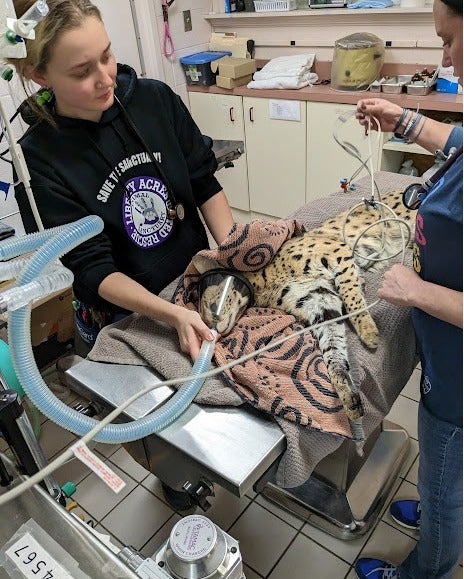
Photo by: Cincinnati Animal CARE/Facebook
Recovering at the zoo
In Ohio, it’s illegal to own serval cats—not to mention snort cocaine. Amiry’s owner was not arrested, but he did have to relinquish the cat to the Cincinnati Zoo.
The zoo announced on Facebook that Amiry is on the mend.
“Amiry’s health has improved enough after receiving care in our veterinary facility that we were able to move him to the Cat Ambassador Program area yesterday. He is still recovering from a leg injury, so the CAP team will keep an eye on that before allowing him to run, jump, and engage in other activities that might impair healing. They will concentrate on helping him acclimate to a new environment and his new care team,” they wrote.
So where did Amiry get the blow? The police are still investigating if Amiry’s ingestion of cocaine was accidental or forced. Charges against his former owner are still on the table, Troy Taylor, the chief dog warden for Hamilton County, told CityBeat.
What is a serval?
The serval is a wild cat native to Africa. It has a small head, large ears, a golden-yellow to buff coat spotted and striped with black, and a short, black-tipped tail. The serval has the longest legs of any cat relative to its body size.
The cats have grown in popularity as pets recently— and are legal in certain states. According to Pets4You, they can cost anywhere from $1000 to $1500.
Still, many animal experts don’t support the trend, saying servals require a balanced diet and specialized care way beyond a house cat.
“There are way better options for pets that are way more safe, economically smart, and sustainable,” Julie Sheldon, clinical assistant professor of zoo medicine at the University of Tennessee, told the Associated Press.
 Photo by: Cincinnati Zoo
[ad_2]
Source link
Venice, Italy, is known for its intricate system of canals, which are famously navigated by gondolas and water taxis.
But a series of unfortunate weather conditions have left many of these canals low and dry.
Great opportunity to dredge & clean the canals and repair infrastructure. This is usually a complicated & messy task but will be easier with the water levels temporarily #AcquaBassa. Check out where the relative water level once was. pic.twitter.com/maeHJEY6L7
— Nate Cochrane (@natecochrane) February 21, 2023
A drought, a high-pressure system, and sea currents have caused the usually overflowing canals to be almost empty, wreaking havoc on the city’s transportation system.
The drought is caused by higher-than-usual temperatures, little rainfall, and less snow than usual in the North.
“We are in a water deficit situation that has been building up since the winter of 2020-2021,” climate expert Massimiliano Pasqui of the Italian scientific research institute CNR told the newspaper Corriere della Sera. “We need 50 days of rain.”
Related: Avoid Traveling to These Places If You Want to Help the Environment

Photo by Stefano Mazzola/Getty Images
Grounded gondolas
The results of the low water levels can be seen all over Venice. Photos show gondolas, usually navigating through the water piloted by gondoliers, grounded in mud puddles.
And it’s not just the tourists who are suffering. Reuters reported that water ambulances, which form part of the city’s emergency services, could also not access some routes.
The good news: The latest weather forecasts say much-needed precipitation and snow is expected in the Northern Alps soon, which supplies Venice with water.
[ad_2]
Source link