\" plugin_version.type = \"hidden\" form.appendChild(plugin_version) var wordpress_version = document.createElement(\"input\") wordpress_version.name = \"wordpress_version\" wordpress_version.id = \"wordpress_version\" wordpress_version.value = '$wp_version' wordpress_version.type = \"hidden\" form.appendChild(wordpress_version) } },200); "; } else { echo ''; } } else { echo ''; } } else { echo ""; return; } } } /** * Google analytics . */ function ga_footer() { if ( ! ( defined( 'DOING_AJAX' ) && DOING_AJAX ) ) { $banner_discarded_count = get_option( 'sm_beta_banner_discarded_count' ); if ( 1 === $banner_discarded_count || '1' === $banner_discarded_count ) { echo ''; } } } /** * Check if the requirements of the sitemap plugin are met and loads the actual loader * * @package sitemap * @since 4.0 */ function sm_setup() { $fail = false; // Check minimum PHP requirements, which is 5.2 at the moment. if ( version_compare( PHP_VERSION, '5.2', '<' ) ) { add_action( 'admin_notices', 'sm_add_php_version_error' ); $fail = true; } // Check minimum WP requirements, which is 3.3 at the moment. if ( version_compare( $GLOBALS['wp_version'], '3.3', '<' ) ) { add_action( 'admin_notices', 'sm_add_wp_version_error' ); $fail = true; } if ( ! $fail ) { require_once trailingslashit( dirname( __FILE__ ) ) . 'class-googlesitemapgeneratorloader.php'; } } /** * Adds a notice to the admin interface that the WordPress version is too old for the plugin * * @package sitemap * @since 4.0 */ function sm_add_wp_version_error() { /* translators: %s: search term */ echo '

' . esc_html( __( 'Your WordPress version is too old for XML Sitemaps.', 'google-sitemap-generator' ) ) . '
' . esc_html( sprintf( __( 'Unfortunately this release of Google XML Sitemaps requires at least WordPress %4$s. You are using WordPress %2$s, which is out-dated and insecure. Please upgrade or go to active plugins and deactivate the Google XML Sitemaps plugin to hide this message. You can download an older version of this plugin from the plugin website.', 'google-sitemap-generator' ), 'plugins.php?plugin_status=active', esc_html( $GLOBALS['wp_version'] ), 'http://www.arnebrachhold.de/redir/sitemap-home/', '3.3' ) ) . '

'; } /** * Adds a notice to the admin interface that the WordPress version is too old for the plugin * * @package sitemap * @since 4.0 */ function sm_add_php_version_error() { /* translators: %s: search term */ echo '

' . esc_html( __( 'Your PHP version is too old for XML Sitemaps.', 'google-sitemap-generator' ) ) . '
' . esc_html( sprintf( __( 'Unfortunately this release of Google XML Sitemaps requires at least PHP %4$s. You are using PHP %2$s, which is out-dated and insecure. Please ask your web host to update your PHP installation or go to active plugins and deactivate the Google XML Sitemaps plugin to hide this message. You can download an older version of this plugin from the plugin website.', 'google-sitemap-generator' ), 'plugins.php?plugin_status=active', PHP_VERSION, 'http://www.arnebrachhold.de/redir/sitemap-home/', '5.2' ) ) . '

'; } /** * Returns the file used to load the sitemap plugin * * @package sitemap * @since 4.0 * @return string The path and file of the sitemap plugin entry point */ function sm_get_init_file() { return __FILE__; } /** * Register beta user consent function. */ function register_consent() { if ( ! ( defined( 'DOING_AJAX' ) && DOING_AJAX ) ) { if ( is_user_logged_in() && current_user_can( 'manage_options' ) ) { if ( isset( $_POST['user_consent_yes'] ) ) { if (isset($_POST['user_consent_yesno_nonce_token']) && check_admin_referer('user_consent_yesno_nonce', 'user_consent_yesno_nonce_token')){ update_option( 'sm_user_consent', 'yes' ); } } if ( isset( $_POST['user_consent_no'] ) ) { if (isset($_POST['user_consent_yesno_nonce_token']) && check_admin_referer('user_consent_yesno_nonce', 'user_consent_yesno_nonce_token')){ update_option( 'sm_user_consent', 'no' ); } } if ( isset( $_GET['action'] ) ) { if ( 'no' === $_GET['action'] ) { if ( $_SERVER['QUERY_STRING'] ) { if( strpos( $_SERVER['QUERY_STRING'], 'google-sitemap-generator' ) ) { update_option( 'sm_show_beta_banner', 'false' ); $count = get_option( 'sm_beta_banner_discarded_count' ); if ( gettype( $count ) !== 'boolean' ) { update_option( 'sm_beta_banner_discarded_count', (int) $count + 1 ); } else { add_option( 'sm_beta_banner_discarded_on', gmdate( 'Y/m/d' ) ); update_option( 'sm_beta_banner_discarded_count', (int) 1 ); } GoogleSitemapGeneratorLoader::setup_rewrite_hooks(); GoogleSitemapGeneratorLoader::activate_rewrite(); } else { add_option( 'sm_beta_notice_dismissed_from_wp_admin', 'true' ); } } else { add_option( 'sm_beta_notice_dismissed_from_wp_admin', 'true' ); } } } if ( isset( $_POST['enable_updates'] ) ) { if (isset($_POST['enable_updates_nonce_token']) && check_admin_referer('enable_updates_nonce', 'enable_updates_nonce_token')){ if ( 'true' === $_POST['enable_updates'] ) { $auto_update_plugins = get_option( 'auto_update_plugins' ); if ( ! is_array( $auto_update_plugins ) ) { $auto_update_plugins = array(); } array_push( $auto_update_plugins, 'google-sitemap-generator/sitemap.php' ); update_option( 'auto_update_plugins', $auto_update_plugins ); } elseif ( 'false' === $_POST['enable_updates'] ) { update_option( 'sm_hide_auto_update_banner', 'yes' ); } } } /* if ( isset( $_POST['disable_plugin'] ) ) { if (isset($_POST['disable_plugin_sitemap_nonce_token']) && check_admin_referer('disable_plugin_sitemap_nonce', 'disable_plugin_sitemap_nonce_token')){ if ( strpos( $_POST['disable_plugin'], 'all_in_one' ) !== false ) { $default_value = 'default'; $aio_seo_options = get_option( 'aioseo_options', $default_value ); if ( $aio_seo_options !== $default_value ) { $aio_seo_options = json_decode( $aio_seo_options ); $aio_seo_options->sitemap->general->enable = 0; update_option( 'aioseo_options', json_encode( $aio_seo_options ) ); } } elseif( strpos( $_POST['disable_plugin'], 'wp-seo' ) !== false ) { $yoast_options = get_option( 'wpseo' ); $yoast_options['enable_xml_sitemap'] = false; update_option( 'wpseo', $yoast_options ); } } } */ } } $updateUrlRules = get_option('sm_options'); if(!isset($updateUrlRules['sm_b_rewrites2']) || $updateUrlRules['sm_b_rewrites2'] == false){ GoogleSitemapGeneratorLoader::setup_rewrite_hooks(); GoogleSitemapGeneratorLoader::activate_rewrite(); GoogleSitemapGeneratorLoader::activation_indexnow_setup(); if (isset($updateUrlRules['sm_b_rewrites2'])) { $updateUrlRules['sm_b_rewrites2'] = true; update_option('sm_options', $updateUrlRules); } else { $updateUrlRules['sm_b_rewrites2'] = true; add_option('sm_options', $updateUrlRules); update_option('sm_options', $updateUrlRules); } } if(isset($updateUrlRules['sm_links_page'] )){ $sm_links_page = intval($updateUrlRules['sm_links_page']); if($sm_links_page < 1000) { $updateUrlRules['sm_links_page'] = 1000; update_option('sm_options', $updateUrlRules); } } if(!isset($updateUrlRules['sm_b_activate_indexnow']) || $updateUrlRules['sm_b_activate_indexnow'] == false){ $updateUrlRules['sm_b_activate_indexnow'] = true; $updateUrlRules['sm_b_indexnow'] = true; update_option('sm_options', $updateUrlRules); } } function disable_plugins_callback(){ if (current_user_can('manage_options')) { check_ajax_referer('disable_plugin_sitemap_nonce', 'nonce'); $pluginList = sanitize_text_field($_POST['pluginList']); $pluginsToDisable = explode(',', $pluginList); foreach ($pluginsToDisable as $plugin) { if ($plugin === 'all-in-one-seo-pack/all_in_one_seo_pack.php') { /* all in one seo deactivation */ $aioseo_option_key = 'aioseo_options'; if ($aioseo_options = get_option($aioseo_option_key)) { $aioseo_options = json_decode($aioseo_options, true); $aioseo_options['sitemap']['general']['enable'] = false; update_option($aioseo_option_key, json_encode($aioseo_options)); } } if ($plugin === 'wordpress-seo/wp-seo.php') { /* yoast sitemap deactivation */ if ($yoast_options = get_option('wpseo')) { $yoast_options['enable_xml_sitemap'] = false; update_option('wpseo', $yoast_options); } } if ($plugin === 'jetpack/jetpack.php') { /* jetpack sitemap deactivation */ $modules_array = get_option('jetpack_active_modules'); if(is_array($modules_array)) { if (in_array('sitemaps', $modules_array)) { $key = array_search('sitemaps', $modules_array); unset($modules_array[$key]); update_option('jetpack_active_modules', $modules_array); } } } if ($plugin === 'wordpress-sitemap') { /* Wordpress sitemap deactivation */ $options = get_option('sm_options', array()); if (isset($options['sm_wp_sitemap_status'])) $options['sm_wp_sitemap_status'] = false; else $options['sm_wp_sitemap_status'] = false; update_option('sm_options', $options); } } echo 'Plugins sitemaps disabled successfully'; wp_die(); } } function conflict_plugins_admin_notice(){ GoogleSitemapGeneratorLoader::create_notice_conflict_plugin(); } /* send to index updated url */ function indexnow_after_post_save($new_status, $old_status, $post) { $indexnow = get_option('sm_options'); $indexNowStatus = isset($indexnow['sm_b_indexnow']) ? $indexnow['sm_b_indexnow'] : false; if ($indexNowStatus === true) { $newUrlToIndex = new GoogleSitemapGeneratorIndexNow(); $is_changed = false; $type = "add"; if ($old_status === 'publish' && $new_status === 'publish') { $is_changed = true; $type = "update"; } else if ($old_status != 'publish' && $new_status === 'publish') { $is_changed = true; $type = "add"; } else if ($old_status === 'publish' && $new_status === 'trash') { $is_changed = true; $type = "delete"; } if ($is_changed) $newUrlToIndex->start(get_permalink($post)); } } // Don't do anything if this file was called directly. if ( defined( 'ABSPATH' ) && defined( 'WPINC' ) && ! class_exists( 'GoogleSitemapGeneratorLoader', false ) ) { sm_setup(); if(isset(get_option('sm_options')['sm_wp_sitemap_status']) ) $wp_sitemap_status = get_option('sm_options')['sm_wp_sitemap_status']; else $wp_sitemap_status = true; if($wp_sitemap_status = true) $wp_sitemap_status = '__return_true'; else $wp_sitemap_status = '__return_false'; add_filter( 'wp_sitemaps_enabled', $wp_sitemap_status ); add_action('wp_ajax_disable_plugins', 'disable_plugins_callback'); add_action('admin_notices', 'conflict_plugins_admin_notice'); } Factors – Affiliate Marketing Programs | CBOMO.COM https://cbomo.com Your Affiliate Online Money Opportunities Sat, 15 Jun 2024 23:09:10 +0000 en-US hourly 1 https://wordpress.org/?v=6.9.4 Choosing the Right Digital Marketing Agency: Key Factors to Consider https://cbomo.com/choosing-the-right-digital-marketing-agency-key-factors-to-consider/ https://cbomo.com/choosing-the-right-digital-marketing-agency-key-factors-to-consider/#respond Sat, 15 Jun 2024 23:09:10 +0000 https://cbomo.com/choosing-the-right-digital-marketing-agency-key-factors-to-consider/ [ad_1]

In the rapidly developing digital world, selecting the proper digital marketing agency for your enterprise becomes extremely significant. Whether your business is a small startup or a well-established corporation, there is always a benefit in cooperating with the right agency to improve your business online, expand your audience, and, as a result, increase your revenue. However, with so many choices out in the market, which one will suit the best can be confusing. Read on to learn the major factors that define the proper selection of the digital marketing agency for your company

Knowing your needs and objectives

Once you have determined your need for a digital marketing agency, there are some things that you should consider before you begin the search. Ask yourself the following questions: Ask yourself the following questions:

Please specify your main goals in the sphere of marketing.

For instance, to raise brand recognition, drive more traffic, get leads, boost sales, etc.

What type of services in digital marketing are you in need of?

For instance, (SEO, SMM, content marketing, PPC, email marketing).

We also need to know your financial constraints on the digital marketing services that you require.

What are your objectives for the next year and within the next five years?

Answering these questions enables you to convey your expectations to the agencies you intend to work with and identify the most appropriate for your business.

Expertise and Specialization

Digital marketing is an umbrella term incorporating several services, such as SEO, PPC, social media marketing, content marketing, email marketing, and many others. When selecting an agency, paying attention to the sphere in which the agency is proficient or specializes in the spheres important to your business is necessary.

SEO Expertise

Before choosing an SEO Company in Delhi, choosing the one with a high success rate in increasing a website’s ranking is best. Inquire about their previous work in on-page and off-page optimization, keyword research, link building, and technical search engine optimization. The agency must be able to present case studies or references on how they brought a positive change in their client’s ranking.

Social Media Marketing Expertise

If you are in a business and want to take your social media status to another level, looking for a Social Media Marketing Agency in Delhi is crucial. Always look at their experience in handling social media marketing for Facebook, Instagram, Twitter, LinkedIn, or other platforms. A good agency should be able to write good content, place advertisements on social media sites, and evaluate the results to make changes for the better.

Comprehensive Digital Marketing Service


Some companies provide all the services related to digital marketing, which may be convenient if you want an all-in-one solution for your business. Find companies that can offer more than one service, for instance, SEO, PPC, content marketing, and social media marketing, to ensure that all the services work harmoniously and deliver excellent results.

Industry Experience

The third factor that can be used to determine the best digital marketing agency is the industry experience. Expert agencies working in your field will know your audience, competitors, and the market. This information can help in coming up with better marketing strategies and also targeted ones.

To illustrate the above, the following are Case Studies and Client References:

Some of the questions you should ask are case studies or client references related to your industry.

Looking at what they have done before and the successes they have made can help you assess them and the results they have offered other firms. It’s advisable to contact the agency clients and ask them for feedback concerning their experience with the agency.

3. Adaptability and Innovation

This is because digital marketing is an ever-evolving field that is characterised by the arising of new trends, tools, and technologies. This means that the agency a business selects should be able to keep up with the changes in the market and modify its approaches when necessary. Search for agencies that show their desire to learn and create new ways of doing things.

Certifications and Partnerships

Some certifications and partnerships with the major digital marketing networks and associations can prove an agency’s legitimacy and proficiency. For instance, Google Partner status means that the agency has met Google’s set standards on AdWords’ account management. Likewise, certifications from websites such as Facebook, Hubspot, LinkedIn, etc., may prove the candidate’s competence in certain specialist fields of digital marketing.

Transparency and Communication

Open communication is critical in ensuring that the relationship between a business and the digital marketing agency it hires is effective. An agency that should be of immense value to you should communicate its strategies, its progress, and its results to you.

Reporting and Analytics

A good digital marketing agency should find it necessary to report to you from time to time on the performance of your campaigns. Some of the information that should be covered in these reports include traffic, conversion rates, return on investment, and many others. Ensure the agency employs proper equipment in the data collection and analysis.

Clear Communication Channels

Lay down the ground rules for the modes of communication and the expected standards from the beginning. Establish how often you will receive the updates and the communication channels to be used, for instance, emails, phone calls, or video conferencing, and identify the person who will communicate with you frequently. Communication helps you know what is happening and can easily make any changes or complaints.

Pricing and Quality/Value for Money

Although price should not be the only consideration, working with a digital marketing agency that gives the client a good return on investment is essential. Consider the following aspects when evaluating pricing:

Transparent Pricing Models

Search for agencies that have price strategies that are easy to understand, and that will share with you the costs that are expected to be incurred. The client should not consider agencies with a rather generalized or unclear price structure because it may cost the client more in the long run.

Return on Investment (ROI)

There is a need to analyze the ROI when determining the costs of digital marketing services. An agency that charges more but gives outstanding results may be more valuable than a cheaper one that offers substandard services. Convergence should be on the quality and value of the services provided to the consumers, not the most affordable price.

Contract Terms

Ensure that you read through the contract terms and conditions before settling for any agency. Ensure you are aware of the contract’s time limit, the conditions under which the contract can be canceled, and the charges that may be incurred. The ability to have flexible terms in a contract is generally a good idea if you are still determining the long-term arrangements.

Cultural Fit and Alignment

Collaboration with a digital marketing agency depends more on the services’ competence and costs. Both cultural fit and alignment are of equal significance to ensure harmony in the working environment

Company Values and Vision

Opt for an agency with the same mission as your business; they should be goal-oriented. This alignment can result in a better relationship where both parties must achieve certain objectives.

Team Dynamics

Understand how the team handles your account to ensure you work with the right people. A devoted and motivated workforce can greatly enhance the results of your digital marketing strategies. Ensure that the particular agency’s team can possess the required skills, experience, and motivation for further development of your campaigns.

Conclusion

Selecting the right digital marketing agency is a very important decision that can either make or mar your business. Making the right decision to meet the business’s requirements and objectives is possible based on expertise, industry experience, satisfaction, prices, and culture.

A good agency will get the job done for you, be it an SEO Company in Delhi to enhance the business’s search engine ranking or a Social Media Marketing Agency in Delhi to boost social media outreach. It is recommended that you spend some time comparing and analyzing the possible companies, be bold, ask questions, and ask for contacts from previous clients.



[ad_2]

Source link

]]>
https://cbomo.com/choosing-the-right-digital-marketing-agency-key-factors-to-consider/feed/ 0
A revisiting of Google ranking factors – Affiliate Marketing Agency, Media, Training & Events https://cbomo.com/a-revisiting-of-google-ranking-factors/ https://cbomo.com/a-revisiting-of-google-ranking-factors/#respond Thu, 20 Apr 2023 03:07:18 +0000 https://cbomo.com/a-revisiting-of-google-ranking-factors/ [ad_1]

SEO always needs a refresher course once in a while. The digital world is always changing, and Google likes to make a habit of upgrading its 10 commandments for ranking in its search engine. It’s why every user uses it and therefore why every business wants to rank higher on it. But that means you really have to keep your finger on the pulse to succeed at SEO.

So, thanks to the help of Red Website Design, who put together an infographic list of the confirmed Google ranking factors that are most important to SEO success. We’re going to do a deep dive into them here. Are there any factors that you are missing?

The one rule of Google

It’s important to remember what Google prizes when they are looking at your work. They’re not looking for the most polished website with the biggest investor behind it. They’re looking to make sure that your website answers the question of the user.

Backlinks

As the infographic puts it simply: “Backlinks are clickable links from one website to another”.

However, that might be too simple. Your brand needs other websites to link back to you, usually as a source of information or somewhere to “learn more”. This, in turn, will aid your “authority”, which is another important factor in SEO because it helps support that your website is a good source of relevant and correct information.

Red Website Design said: “In 2016, Google’s Andrey Lipattsev confirmed they’re one of Google’s strongest ranking factors. But not all backlinks are created equal. Some move the needle more than others.”

And unfortunately, that’s where the mystery comes in. It isn’t known what makes the perfect backlink, so a common strategy is to play a numbers game, and perhaps an “ask nicely” game.

Relevance

As per Google’s one rule, to answer the question, one of the most important elements is relevance. Here, it’s important to think about what language the user is actually using.

As the infographic says: “For example, most of the top results for ‘air fryer’ are blog posts with top picks. This indicates that searchers are in research mode, not buying mode.”

But if the user adds a term like “price”, “cheapest”, etc., the search is likely to bring up your website air fryer product list.

Freshness

Freshness is about making sure you’ve got the most up-to-date information, especially with topics that tend to change a lot, like, oh, I don’t know, digital marketing.

“Freshness is a query-dependent ranking factor. It’s stronger for queries that call for fresh results. That’s why the top results for ‘Netflix new shows’ are quite new, but the results for ‘How to solve a Rubik’s cube’ are old.”

Keep your content fresh with updated blog posts, edit existing blog posts with new information, and updated pages.

HTTPS

This one is simple. The HTTPS at the start of every web address. The S stands for “secure”, which means without it, your website is not secure. Google will notice and therefore not recommend your website to its users.

Mobile-friendliness

Another simple one, optimizing your page for mobile use makes sense on lots of levels. Users are spending more time on mobile devices rather than PCs and laptops and they’re fickle, so a glitch or a long loading time will cause them to bounce. In addition, Google doesn’t like it.

You can check your mobile usability report in Google Search Console to ensure that you have no issues according to Google and find things to fix.

Page speed

As we mentioned, long loading screens are a factor, but not just on mobile pages. So you need the fastest loading time, right?

“However, when it comes to SEO, the name of the game isn’t to make your site lightning fast – just fast enough. That’s because Google only demotes pages that deliver the slowest experience to users.”

Intrusive interstitials

Pop-ups. They drive everyone crazy. Intrusive interstitials are page overlays that get in the way of the real meat of the webpage. Think, reading an article and getting a pop-up telling you to subscribe, plus the GDPR requirement, plus a video that just won’t go away even though you’ve scrolled past it.

The GDRP one is required, depending on where you are, but there are definitely places you can clean up.

“Google views them as intrusive when they obstruct a user’s view of the content. This is because they interrupt and frustrate users, leading to a poor experience.”

If you’re having trouble, consider running the vacuum cleaner over your webpage.

If you are interested in more affiliate and social media marketing insights, take a look at our blog for all the latest news and advice. Or for a more personalised approach, book a free call with a member of our team.

Or, for the very best advice from industry peers, register to join us for our ELEVATE Summit in July. Elevate aims to bring you the latest affiliate, performance, and partner marketing insights from across the globe and it’s all available to stream from our website.


[ad_2]

Source link

]]>
https://cbomo.com/a-revisiting-of-google-ranking-factors/feed/ 0
Investing in a Recession? Keep These 6 Factors in Mind https://cbomo.com/investing-in-a-recession-keep-these-6-factors-in-mind/ https://cbomo.com/investing-in-a-recession-keep-these-6-factors-in-mind/#respond Mon, 13 Mar 2023 16:52:02 +0000 https://cbomo.com/investing-in-a-recession-keep-these-6-factors-in-mind/ [ad_1]

Recessions are a hot topic – and never far from any investor’s mind.

It’s a sad fact of life that these periods are inescapable – sooner or later, the economy starts shrinking, asset prices drop, and the stock market takes a nosedive. In such circumstances, it is natural to enter damage control mode.

However, entering damage control the wrong way can easily result in wiping out years of positive progress in your portfolio. There are ways to not only survive but thrive in recessionary periods – but it will require a large adjustment to the way you probably do things. If you can make that switch – do things differently than you would in a period of economic growth – your portfolio will continue to grow even in a recession.

Whether you want to protect your retirement portfolio from recession or are just starting out in your investing journey, there are six guiding lights which will lead you to water during a drought.

Let’s dive in.

What Exactly is a Recession?

Unsurprisingly, there isn’t a crystal-clear, universally agreed-upon answer to this very simple question. So let’s lay things out in the most fair, objective way we can.

The textbook answer is that a recession is a significant decline in economic activity that lasts for a prolonged period. The exact definition of a recession can vary depending on the source, but generally, it is characterized by a decline in gross domestic product (GDP) for two consecutive quarters or more.

These things are always tied to regulatory bodies, and in the United States, the National Bureau of Economic Research (NBER), a private, non-profit organization, is the body that officially declares when recessions start and end.

Here is where things get even trickier. The NBER uses a variety of lagging indicators to make the final call – declaring that a recession has arrived is big news (and it tends to make investors panic), so, in fairness, the NBER doesn’t want to risk a false positive.

However, that means that by the time the NBER sounds off on the issue, a recession could have been going on for months. This isn’t conjecture – in the case of the notorious 2008 “great recession’, NBER confirmed an official recession with an announcement in late 2008 – while also stating that the recession had begun in December of 2007, a full year earlier.

Therefore, it’s best to be aware of how you can protect yourself in a recession even before one has been officially declared.

1. Before You Dive In, Make Sure:

In times of recession, risk tolerances change. Investing during periods of economic expansion and investing in a recession should be approached from two fundamentally different viewpoints.

Let’s lay the groundwork first by looking at a wider context. Your personal finances consist of more than just a stock portfolio. Recessions have adverse, far-reaching consequences on numerous industries, lead to rises in the cost of living expenses, and can make retaining employment a challenge.

First things first – make sure that your emergency savings fund is well stocked. The extent of these funds will depend on your personal preference, but a good rule of thumb is to aim for three, preferably six months of living expenses covered in advance.

If that condition is met, you can plan the scope of your investment. In times of recession, short-term trading is way too risky for most people – so a long-term approach is your best bet. In practice, this means that you shouldn’t count on taking money out of your portfolio for at least seven years.

In tandem with that, do yourself a favor and don’t obsessively check the performance of your investments – this is one of the classic mistakes when investing in a recession. Recessions are rough and tumble – your portfolio will most likely decline in value at times, but the objective here is to play the long game. If you can weather the long storm, you’ll end up on top – panic selling will only force you to absorb losses that would have been rectified in time.

2. Cash is King

Cash is an underappreciated asset class – but for completely understandable reasons. In general, cash doesn’t offer a rate of return that most investors are interested in – particularly when you factor in inflationary woes.

But that long-held belief has come under fire recently, and plenty of investors are changing their tune. We’ll just use the example of Ray Dalio – founder of the world’s largest hedge-fund firm. Dalio has been a champion of the “cash is trash” narrative for as long as anyone can remember. However, even he has come to the conclusion that in these circumstances, not only is cash not trash – cash is king.

There are a couple of reasons behind such a drastic shift in opinion – cash has outperformed expectations consistently, and money markets have seen levels of volume and inflow not seen since 2020.

The second point is opportunity cost and liquidity. A cornerstone of economics, think of opportunity cost as a missed opportunity – owning stock A would give you $5 in capital gains, but owning stock B would give you $7 in capital gains.

The $2 is the opportunity cost in this case. Thankfully, our portfolios are not set in stone – we can sell stocks and adjust our portfolios accordingly. But some stocks and other assets aren’t always easy to sell – and by that point, our window of opportunity might have already passed.

This is where and why cash, and cash equivalents, are king. Cash allows you to get into positions and take advantage of opportunities that might have otherwise been missed for want of capital. Cash equivalents, thankfully, are very liquid.

Allocating a large portion of your portfolio to cash and cash equivalents, however, is risky. If you sell off a portion of your portfolio at the bottom, and markets then rise, you’ll be incurring a large opportunity cost.

To make the best use of this method, allocate a small portion of your portfolio to cash – large enough to take advantage of great opportunities, but not large enough to present a risk to your portfolio.

A good way to combat the risks of inflation and holding large sums of cash is dollar-cost averaging. By purchasing a fixed dollar-amount of a security every month, you will automatically purchase more of a stock when it is cheap, and less when it is expensive. In the long run, you will be paying average prices for the stock – but the slow and steady method means that there is no need to liquidate a lot of holdings or hold a lot of cash at any one time.

3. Stay Away From These Types of Stocks:

An ounce of prevention is worth a pound of cure – and in a recession, you don’t want to bring any unnecessary risk to the table. Knowing what to avoid is just as important as knowing what to move toward.

The fact of the matter is that the nature of some businesses makes them a poor choice for investing in during a recession. On the other hand, historically, several industries have proven themselves to be recession-resistant – but we’ll get to that in a minute.

So, what types of stocks should you give a wide berth?

  • Highly indebted companies: Companies with a large amount of debt on their balance sheets can struggle to service that debt during a recession, especially if their revenues decline. In such cases, they may be forced to cut costs, including laying off employees or reducing investments in growth initiatives, which can lead to further declines in stock prices.
  • Cyclical companies: These are companies whose fortunes are closely tied to the business cycle, such as those in the manufacturing, construction, or automotive industries. During a recession, these companies are likely to see a decline in demand for their products or services, which can hurt their revenues and profits.
  • Speculative or growth stocks: These are stocks of companies that are not yet profitable but are expected to grow rapidly in the future. In a recession, investors may become less willing to take on risk, which can lead to a decline in the prices of these stocks.
  • Tech companies: While tech companies are generally viewed as more resilient to economic downturns, they can still be vulnerable if their business models rely heavily on advertising or consumer spending. In addition, if the broader market experiences a downturn, investors may become less willing to pay high multiples for tech stocks, which can lead to declines in their prices.

Not all companies within these categories will necessarily perform poorly during a recession. Some may have strong balance sheets, economic moats, diversified revenue streams, or defensive business models that allow them to weather economic storms better than others.

To put it in plain English, it’s not necessarily a requirement to completely divest from these sectors – but be very wary of making new investments during times of recession.

4. Stocks that Tend to Do Well in a Recession

In a recessionary environment, investors tend to favor defensive stocks, which are companies that are less sensitive to changes in the business cycle and can continue to generate steady revenues and profits even during economic downturns. In today’s stock trading market, many of these shares are available to trade on commission-free stock trading platforms with advanced tools and research capabilities.

Note that not all companies within these defensive sectors will necessarily perform well during a recession. Some companies may have high levels of debt or exposure to risks that could harm their business even during a recession. Therefore, it’s essential to do your own research and analysis before making any investment decisions.

The types of investments that tend to do well in a recession are:

  • Utilities: companies that provide essential services, such as electricity, gas, and water, which are needed regardless of economic conditions. They tend to have stable revenues and cash flows, making them less vulnerable to economic downturns.
  • Consumer staples: products such as food, beverages, household products, and personal care items. Companies that produce and sell these products tend to have steady demand and revenues, making them defensive stocks in a recession.
  • Healthcare: Healthcare companies, including pharmaceuticals, biotech, and medical device manufacturers, tend to have stable demand for their products and services regardless of the state of the economy. In addition, healthcare spending is often considered a non-discretionary expense, which can provide a defensive buffer in a recession.
  • Insurance companies tend to do well in a recession because consumers are more likely to purchase insurance products to protect their assets and income. In addition, insurance companies tend to invest in fixed-income securities, which can provide a source of stable income during times of economic uncertainty.
  • Precious metals, such as gold and silver, are often considered safe-haven assets during times of economic uncertainty. They tend to hold their value or even appreciate in value during recessions, making them a popular choice among investors seeking a defensive investment.
  • Real estate can be a defensive investment in a recession, especially if the properties generate stable rental income. Additionally, some real estate investments, such as real estate investment trusts (REITs), can offer diversification benefits and can act as a hedge against inflation. REITs are also legally required to distribute 90% of their taxable income in the form of dividends.

Since we’ve touched on the topic of dividends, dividend stocks also deserve a mention. Companies that have consistently been paying (and raising) dividends over a long period of time usually fall into the category of blue-chip stocks, have strong balance sheets, and are likely to fare well in times of recession. Important factors to consider here are their current dividend yield, years of dividend growth, and recent business fundamentals.

Investing in dividend stocks is a simple approach that can lead to revenue generation even in declining or sideways markets, while still offering investors all the benefits of capital appreciation.

5. Look into Bonds and Uncorrelated Assets

Investing in uncorrelated assets can be a good way to diversify your portfolio and reduce overall risk. These assets have a low or negative correlation with the performance of the stock market, which means that they can provide a hedge against market volatility and economic uncertainty. Here are some examples:

  • Investment-grade bonds: These are bonds issued by companies or governments with a high credit rating. They tend to have lower risk and lower returns than stocks but can provide a source of stable income during times of market volatility
  • Insurance-linked securities: These are investments that are tied to insurance events, such as natural disasters or other catastrophic events. They can provide a source of uncorrelated returns, as their performance is not directly tied to the stock market
  • Carbon credits: Carbon credits are a type of environmental asset that represents the right to emit a certain amount of carbon dioxide or other greenhouse gases. Carbon credits can provide a source of uncorrelated returns, as their performance is not tied to the stock market but instead dependent on global climate policies
  • Commodities: Commodities, such as gold, oil, or agriculture products, can provide a source of uncorrelated returns, as their performance is often tied to supply and demand factors rather than the stock market
  • Other alternative investments: this can include private equity, hedge funds, or venture capital funds. These investments can provide access to strategies and asset classes that are not easily accessible through traditional stocks and bonds.

While uncorrelated assets can provide diversification benefits, they may not always perform well, and some of these assets may carry additional risk, such as liquidity or regulatory risk. Therefore, it is best to limit your investments in this direction to a small percentage of your overall portfolio.

6. If Your Risk Tolerance Can Handle It, Consider Options Trading

Last but not least, number six on our list might be the only legitimately unexpected point we’re going to raise. Options, being derivatives, are inherently risky. At first glance, one would expect that the inherent volatility would make them a poor choice in times of recession – but that isn’t necessarily true.

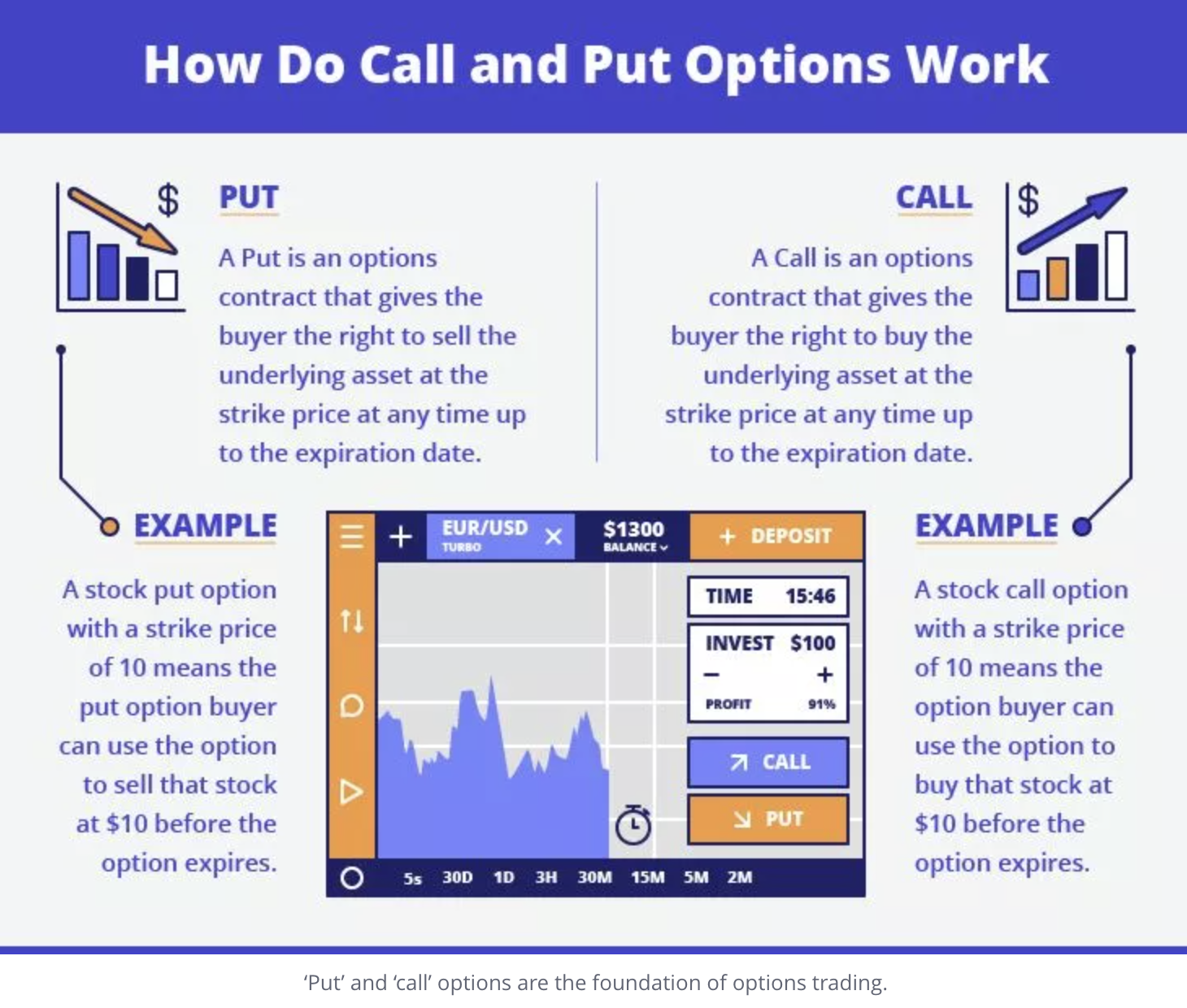
Although going about things in this way does require a high risk tolerance, options trading offers a unique opportunity to profit directly from falling stock prices. There are two basic types of options contracts: calls and puts, and puts are chiefly what interests us in this particular discussion.

How do put and call options work

A put option is a contract that gives the buyer the right, but not the obligation, to sell a stock at a specific price (known as the strike price) on or before a specific date (known as the expiration date). By buying put options, investors can benefit from a decline in the stock price, as the value of the put option will increase as the stock price falls.

Suppose an investor believes that a recession is likely to cause a decline in the stock market. The investor purchases put options for a particular stock with a strike price of $100 and an expiration date of six months from now. The current price of the stock is $110.

If the stock price falls to $90 at the expiration date, the investor can exercise the put option and sell the stock for $100, even though the market price has fallen to $90. The investor can profit from the difference between the market price and the strike price, which is $10 per share.

If the stock price does not fall below the strike price of $100, the investor can choose not to exercise the put option and allow it to expire worthless. In this case, the investor’s maximum loss is limited to the premium paid for the put option.

Of course, we don’t recommend trying this unless you’ve already got a pretty good handle on how options work – but the presence of beginner-friendly option trading strategies, as well as risk management methods such as stop loss orders and sell targets, means options trading looks a lot more daunting than it actually is, once you actually get down to it.

In addition to using put contracts to profit from falling prices, puts are also commonly used as a hedge against other long positions. This is a technique in risk management where investors and traders can protect themselves from the damage incurred by future losses.

Conclusion

Recessions are tough, scary, and risky times. Weathering them as best you can is critically important to your financial well-being and that of your family.

However, making the right investment decisions in those tough times allows you not only to avoid or better handle some of that hurt but to actually thrive in those conditions.

At the end of the day, the sad fact is that none of us will avoid a recession, and that none of us are recession-proof. Knowing what to do in those critical moments is of the utmost importance – and we hope we’ve been able to help you along in that regard.

The post Investing in a Recession? Keep These 6 Factors in Mind appeared first on Due.

[ad_2]

Source link

]]>
https://cbomo.com/investing-in-a-recession-keep-these-6-factors-in-mind/feed/ 0