New Delhi (India), February 16: As we’re moving ahead in 2024, the holiday sales 2023 numbers are here and they are more than just surprising. Falling in line with NRF’s prediction, the annual sales growth during the holiday season stood at 3.8% over 2022 to a record $964.4 billion, even in the backdrop of slow economic growth and inflation concerns.
This growth was driven by the rise of online sales, which demonstrated astonishing growth in the US alone with 7% YoY growth from the previous year. In December 2023, the growth number stood at 11% YoY surpassing the early prediction of 3%.
The question arises – what factors are fueling the expansion of online holiday shopping? Let’s explore this further.
Consumers Time Their High-Ticket Purchase Around Holiday Sales
Inflation of consumer prices has been constant at a 4% increase every year since May 2023, putting a pressure on the consumer household. Although the prices were easing down after July, consumers tend to time their purchases of high-ticket items like electronics, luxury goods, etc. to lucrative holiday sales that offer additional discounts and cashbacks. If we look at the categories that saw the highest growth in sales, grocery, electronics, leisure, and luxury items are leading the trend.
Easing Inflation
Another reason to which higher holiday sales can be attributed to is the pent up demands due to inflation up to July and pent up demands. The holiday sales often served as a strategic time for individuals to fulfill deferred buying decisions, taking advantage of promotional offers and discounts that are prevalent during this period.
Better & Predictable Supply Chains
In 2023, the surge in holiday sales amid inflation challenges can be attributed to the implementation of better and more predictable supply chains. Companies have increasingly invested in enhancing their logistical strategies, adopting advanced technologies, and fortifying inventory management systems. This proactive approach ensures a seamless flow of goods, minimizing disruptions caused by inflation-related uncertainties.
Healthy Labor Market & Wage Improvement
Payroll employment adding 2.7 million jobs in 2023, leading to a healthy labor market and subsequent wage improvement. By the second half of 2023, the job market in the US improved significantly, thereby boosting consumer spending from 15343.55 USD Billion in Q2 2023 to 15461.38 USD Billion in Q3 2023. Although the numbers are lukewarm if placed next to historical data going back to the pre-pandemic time, the spending index was more than just satisfactory as opposed to the initial projections.
Retailers Going Creative & All-Out in Discounts
Retailers took a smart move in 2023 holiday season by putting more emphasis on discounts and value-addition. As consumers were wary of rising prices, discounts were the best way to draw them to the checkout page and that’s what retailers cashed in. As per the data by Adobe Analytics, discounts peaked at 31% of the listed price in the electronics category, making it the most lucrative shopping category for the last season. (Read Full Report)
Aside from the discounts, consumers were also drawn toward completing the sale by Buy Now Pay Later (BNPL) options. As per the recent data, $16.6 billion of online sales were driven by BNPL, 14% up from 2022 holiday season.
Also, retailers tweaked their marketing strategies from 2022 by putting the spotlight on the value proposition of the product/service. They invested in creative marketing campaigns like virtual product visualizations, shoppable TV series on Netflix, and shoppable TikTok ads to reduce friction in the customer journey, allowing them to make a purchase without actually visiting the product website.
The Road Ahead for Holiday Marketing 2024
Drawing inspiration from the 2023 holiday season, here are a few valuable lessons to glean.
- Mobile-first approach:Most shoppers in 2023 didn’t want to interrupt their scrolling journey on their phone to shop. Therefore, most of them preferred to shop for their holiday season via smartphone itself. This implies that retailers now have to focus more on mobile-friendly and social media-friendly campaigns instead of web.
- Don’t just sell the product, sell value:Shoppers see the product and they might’ve seen it countless times before. But what draws them to hit the ‘buy’ button is the value the brand is offering. The value includes the benefits as well as the price point of the product – whether it’s reasonable, if not, is it available on a discount.
- Get creative in advertising: Make use of social commerce, if you haven’t yet. Given the success of TikTok Shop and Shoppable Ads, it’s evident that 2024 marketing trends will be ruled by social media. Set some budget aside to set your TikTok shop and invest in shoppable content and ads to directly connect with your audience.
Commenting on 2023 Holiday Sales Report Card, Udit Verma, CMO and Co-Founder of Trackier said, “After the dismal predictions, these results are a positive push for the retailers, filling them with optimism and vigor for the year ahead. These numbers are more than just surprise package, but a lesson that we cannot underestimate the dynamic nature of consumer preferences and behaviors, reminding businesses that staying attuned to the evolving needs and expectations of customers is paramount. Retailers and marketers who evolved with the changing face of consumer sentiment were welcomed into 2024 with smiling figures and a valuable lesson to continuously adapt, innovate, and prioritize consumer-centric strategies.”
Third-Party Cookies Are Going Away! What’s Next?
It’s official! 2024 will be the year when we’ll have to let go of third-party cookies. This transition isn’t going to be easy. Moving on is easier said than done, but isn’t entirely impossible.
According to the data, 78% of retail programmatic targeting still rely on 3P. But 2024 has an opportunity for retailers to invest in data partnership and first-party (& zero-party) data offered up by consumers directly. Aside from this, many advertisers and brands are coming up with innovative ways to plug this hole. This includes acquiring data with consumer consent, offering value in return, and making a commitment to uphold their privacy.
Having said that, 2024 is definitely going to be an interesting year in terms of advertising. Let’s see how brands and advertisers fare in terms of personalization and targeting in the absence of their ultimate weapon – 3PC.
Disclaimer: This article is part of sponsored content programme. The Tribune is not responsible for the content including the data in the text and has no role in its selection.

[ad_2]
Source link
On this week’s Affiliate Marketing Podcast, Lee-Ann welcomes David Pickard, the CEO of Phonexa UK. They discuss how to embrace the whole affiliate partnership economy, lead generation, and how Phonexa is helping clients and affiliates get more value from the marketing campaigns that they are running.
Phonexa is an enterprise grade tracking platform for performance and partner marketing, specifically. The suite is responsible for delivering true end-to-end tracking and attribution for the consumer lead and call lifecycle.
Lee-Ann points out that we are going through a bit of a revolution in terms of affiliate marketing, where traditional affiliates are not the only kinds of partners that we are bringing into our programs…
Listen in here for all of the insights:
Lead generation and the issue of reputation
Lee-Ann asks David a common question that affiliate managers often get asked, which is the topic of lead generation. Why has it been given such a bad rep under the affiliate umbrella?
David comments, “The battle that a lot of us are trying to have, often, is kind of an education process, right? I guess the tool that we have that helps us is data. That’s my methodology. You’ll probably hear me say a lot in this conversation: ‘Let the numbers do the talking’. If you are trying to attach personal feelings and emotions to things, you’ve got to be prepared to be wrong at some point. Because the numbers are going to catch up with you and tell you to do something different.
So, in terms of, why it’s got a bad rep – whether you want to call it misrepresentation and that kind of thing – I suppose a lot of people think of affiliates as the get rich, quick kind of people. They just want to dangle the carrot and incentivise people to go down funnels that ultimately don’t necessarily end in the consumer behaviour that you want or the positive outcomes that you’re looking for.
But ultimately, like I said earlier, if you’re truly attributing things based on numbers and statistics and performance, those behaviours should be able to be kicked out of the industry.”
Advice for the Affiliate Program Manager to step out of the traditional affiliate funnel
What is the best advice for the affiliate program manager to do in order to build their momentum and to stay alert to fraud when they look to embrace the whole affiliate partnership economy? David advises to “start at the start”.
He further explains, “I guess it sounds obvious. But look at what the problem is, which is typically acquisition is not transparent. Attribution is complex and difficult and not all sources along the funnel generate the same quality. Performance differs.
You have to have a good idea of what success would look like for you prior to launch. And most importantly, and I say this from experience, be ready to be wrong. So have an idea of on paper, this is what I think would be a good outcome. But also when it differs from that, and the numbers are telling you that the performance is a bit different, you know, swallow your pride a little bit and say, cool, now where do we go?”
Always Be Learning
Lee-Ann points out that when she speaks to and trains affiliate managers from multiple companies, from agencies, from networks, from brands, they often give up too quickly. They are likely to try something because somebody else tells them, “hey, this is what you should try.”
David agrees, “It does boil down to that thing that you mentioned earlier, that they’ve heard that someone else tried it and so I think I’m going to give it a go. That’s not good enough. You know, just hearing that someone else tried it and so you’re going to try it, too – is not enough. The first point I said there was have an idea of what success looks like for you, first. And that has to be based on your internal requirements, not just what someone else has done and they’ve had positive effects because you will never understand someone else’s campaign as well as them.
Listen to find out more about how to embrace the whole affiliate partnership economy:
- The importance of automation for reporting.
- The future of affiliate marketing and the practices to put in place to make the right decisions.
Key segments of this podcast and where you can tune in to go direct:
[8:30] The important part lead generation plays in your affiliate program.
[13:00] Why the cookie-cutter approach to affiliate management doesn’t work.
[28:00] The one piece of advice for affiliate managers about operating their programs more efficiently and engaging with non-traditional forms of affiliate partnerships.
Are You Ready for AMLeaders?
Join us at our essential AMLeaders training event, designed for Affiliate Managers aiming to elevate their skills. Access profound industry insights, and cultivate vital connections that pave the way for success at AMLeaders.
Taking place in London on October 23 from 1pm–6pm. Registration is now open. Tickets are limited.
Seize the opportunity to revolutionise your affiliate program. PI LIVE Europe delegates can save £50 on their booking – grab your ticket here.
Rate, Review & Subscribe on Apple Podcasts
“I love Affiverse’s Affiliate Marketing Podcast.” <– If that sounds like you, please give us a 5 Star rating here! Taking the time to do that, helps us support more people in our community to access digital and affiliate marketing insights, expert lead learnings and allows us to share the latest online marketing tactics that help Affiliate programs and businesses to grow.
Click here, scroll to the bottom, tap to rate with five stars, and select “Write a Review.” Also, if you haven’t done so already, subscribe to our weekly newsletter and never miss out on FREE insights and training.
[ad_2]
Source link
Sarah Esteverena, Chief Marketing Officer at Acceleration Partners.
Challenging times require marketers to rethink strategies that have worked in the past.
Whether or not we’re officially in a recession (not yet, say the powers that be), the economy has been flashing warning signs for months. The stock market is a roller coaster, inflation is still elevated well above recent norms, and it feels like we’re seeing headline-grabbing layoff announcements nearly every week.
Amid this uncertainty, many marketers are facing pressure to scale back their programs. But when businesses cut marketing dollars without a strategy to guide those cuts, that can have a negative impact on revenue—sending the company into a vicious spiral that can be difficult to recover from.
Chief marketing officers (CMOs) should follow these five tips to keep their marketing efforts as effective as possible, no matter what surprises the economy has in store.
1. Don’t panic.
Probably the worst thing that a marketing department can do during a downturn is to simply implement across-the-board cuts. Look, I get it: When the financial side of the C-suite is pressuring every business unit to trim the fat, it can seem like there’s no other option than to scale back every marketing effort. But remember: If a marketing program is working, then it is actually a revenue center—not a cost center. And obviously, no business should be cutting sources of revenue during tough times. When marketers have hard evidence to show the success of their programs, they can effectively lobby other business leaders to avoid cuts that would be detrimental to the company over the long term.
2. Measure performance.
Historically, one of the greatest challenges marketers and advertisers have faced during downturns is finding evidence to justify the dollars they’re spending. Intuitively, we’ve all always known that TV spots, magazine ads and billboards all drive sales. But we have limited tools to draw a direct connection between someone hearing a radio ad for a brand on her way to work and her purchasing it later that week. Partnership marketing (which includes traditional affiliate marketing, performance PR, performance influencer and other outcome-dependent tactics) offers a solution by “allowing businesses to work with partners on a cost-per-acquisition (CPA) basis” rather than paying upfront fees for traditional advertising or paid search. Commissions are only paid when a sale or a lead is completed—ensuring value for money in times of economic uncertainty, while still helping organizations reach their target audiences.
3. Pick up pennies.
If your wallet is full, you’re unlikely to search the sidewalk for loose change. But if you’re four cents away from being able to afford a sandwich, you might scour the sidewalk for some stray coins. Similarly, we marketers tend to ignore certain opportunities during boom times—opportunities that we should revisit when it’s time to tighten our belts. I often talk about the potential impact of improving our results by just 1%. When the money is flowing, and you’re planning to blow the doors off a major conference or a huge new campaign, you might not have the time to get that granular. But during tougher times, that 1% can be a difference maker.
4. Keep innovating.
An economic downturn might seem like a scary time to try something new. But by taking strategic risks, marketers can keep their companies ahead of their competition and uncover underpriced opportunities. For example, at my company we recently worked with a major apparel brand to launch a performance-based connected TV campaign. This was a completely new tactic for the company, and it helped the brand to achieve the reach of television while also providing hard data on metrics such as the number of impressions, site visit and channel delivery. The company achieved a significant boost in its period-over-period return on ad spend (ROAS), and that would not have happened if marketing leaders had been unwilling to try something new.
5. Rethink resource allocation.
When it comes to managing a large internal marketing team versus leveraging outside resources, there are pros and cons to both approaches. But during times of budget constraints, the advantages of working with an external agency really stand out. During a downturn, it can be much more effective for companies to outsource more of their marketing efforts. That’s because they can fairly easily dial their spending down in a way that is difficult to do when the company handles all of its marketing in-house—giving companies a powerful lever to help them control costs, without the pain of initiating layoffs. Then, when the economic picture improves, organizations can quickly scale their marketing back up, positioning them to take advantage of the moment.
Forbes Communications Council is an invitation-only community for executives in successful public relations, media strategy, creative and advertising agencies. Do I qualify?
[ad_2]
Source link
The Economy of Influence
A conversation with Emily Hund, the author of The Influencer Industry: The Quest for Authenticity on Social Media.

(Getty Images)
Influencers—the people who make their money through sponsorships, ads, and payouts for viewership on social media apps—have unmistakably shaped the world we live in, whether through promoting impossible and persuasive beauty standards, inaugurating new trends, or molding political discourse. In a new book, The Influencer Industry: The Quest for Authenticity on Social Media, digital culture researcher Emily Hund draws on years of interviews with influencers to make the case that they should be understood as workers—and that the industry should be regulated and subject to democratic control. For those used to glossing influencers’ careers as easy and unimportant—or those who justifiably criticize social media’s destructive effects on society—her position might sound provocative. But for all its ills, Hund argues, influencing is here to stay, and in order to change it we must understand it as a form of labor.
Lyra Walsh Fuchs: How did influencing develop as an industry?
Emily Hund: Over the course of the twentieth century, both within academia and marketing, influence moved from a lofty, philosophical idea into something that we can capture. Now we can pinpoint how influence happens; we can measure it; we can figure out who is more influential and why.
Simultaneously, there was the growth of celebrity culture, and the idea that celebrities should be looked to as lifestyle gurus. We should not just enjoy their movies but follow their every move and be invested in them as people. They, in turn, need to cultivate an image of themselves that is aspirational but accessible. Celebrity culture further expanded through reality television, which helped normalize the idea that a regular person might have access to that lifestyle.
The rise of self-branding also started to take hold in the 1980s and 1990s, along with the beginning of the hollowing out of the middle class. No longer could you assume that you’re going to work at a company for your whole career, or that you were going to do a similar job for your whole life. People increasingly have to shoulder the burdens of the workplace, cultivating an individual sense of security. Self-branding was seen as one way to protect yourself in this environment. If I can cultivate a self-brand so that people know who I am, that will be my currency. I’ll be able to get the next job or provide some sort of professional safety net for myself.
And then, at the beginning of the twenty-first century, there was the rise of technologies and ideologies that make the influencer as we now know it possible: blogging; optimism around the internet, and social media in particular; and the idea that anyone with an internet connection can go online and cultivate an audience. These tools to start a business or create a brand online became more widely accessible.
The financial crisis was the last straw. Millions of people lost their jobs, or were underemployed, and there was a further break with the idea that you can rely on a more traditional career path. Because there was so much optimism at the time around Silicon Valley, and social media was very novel, people flocked there. Maybe they said, “I don’t know what else to do. I’ve lost my job, so I’m going to start a blog, or I’m going to start posting online and try to keep myself afloat in some way. Maybe I’ll be able to drive some consulting or freelance projects, or at least point them out to potential employers.” There were a variety of reasons why this first wave of influencers did it, but it often had to do with economic precarity.
Advertisers were also trying to keep themselves afloat. Every industry was struggling. The advertising industry was impressed by how early bloggers and influencers were able to cultivate loyal or engaged audiences, and often about really niche topics. Quantification was also appealing—as was the idea of control. These were super-targeted audiences that could be easily measured because it was all happening online. Once advertisers saw what was going on with this first wave of influencers, we were off to the races.
Walsh Fuchs: You write about how a cottage industry of agencies popped up to interface between the advertisers and the bloggers. Was that the first phase of the expansion of the industry into something more?
Hund: When advertisers and early bloggers and influencers first started working together, no one knew what they were doing. It was not an established business or career path. So they were fumbling around and testing out different ways of working together. The influencers said, “You want to pay me? Or give me this purse? Great!” Then a broad umbrella of marketing agencies saw that advertisers were reaching out to people who were essentially tiny media businesses of their own—and they wanted a piece of it. In the early 2010s, there was huge growth of these marketing agencies. They said they had the best tools for understanding how influential these people actually were, or that they had the expertise to hand-select the right influencers for a brand, or that they had new technologies for ranking all the influencers out there.
These tools streamlined the process of seeking deals, pricing deals, and making agreements. They were supposed to inject efficiency into the industry. It helped increase the volume of deals, and provided advertisers access to tens of thousands of influencers. An advertiser can go to a marketplace and search for whatever keywords they think are relevant to their campaign, and then turn up all these results for relevant influencers. With some of these marketplaces, influencers can just sign up and join. If you don’t have much of a following, you may not get anything out of it, but you can certainly try. Then affiliate marketing expanded, as did new monetization technologies that expanded the industry.
Walsh Fuchs: How did social media platforms get in on the action?
Hund: In the beginning, deals played out on these platforms without them paying much mind. As the amount of money in the industry grew, the platforms decided to get involved and advocate for their interests. Optimization first happened at the level of marketing firms, which tried to pinpoint what numbers were most compelling to advertisers, what mix of metrics told a compelling story to potential sponsors, and what aesthetics were most compelling.
On the platform side, the way content gets ranked and selected—how the algorithms work—is not at all transparent. And the platforms are continually tweaking their algorithms, leaving influencers to guess how to optimize their own content. With TikTok getting so popular so fast, Instagram is trying to compete. They are clearly prioritizing video, pushing influencers to pivot. Influencers have to suss out what the algorithms are doing, and then adjust their content accordingly to get the most visibility on different apps.
Walsh Fuchs: There are influencers who have carved out a niche targeting other would-be influencers. They make content about how they built their following, and give tips to get views through the algorithm, such as by using a particular trending sound. I think their success indicates how many people want to be influencers. What is it that draws people to influencing as a career? I’ve even heard kids say, “I want to be a toy reviewer when I grow up.” It’s really seeped into our culture.
Hund: To me, it’s very obvious why being an influencer is an appealing career: it purports to offer autonomy and potential. People desire respect in the workplace; they desire not to be belittled or constrained in ways that are illogical. From the outside, being an influencer is really appealing. It seems like that person basically works for themselves, creating the content that they want to create. It seems like they are able to express themselves in the way they want. They appear to have a creative career that also brings financial rewards.
Something that really came through in my interviews is how women were the trailblazers in influencing. Part of that story is that many did not feel that more traditional career paths were going to allow them to live the lives that they wanted to live—especially for mothers or people who knew that they wanted to be mothers someday. They figured that influencing would allow them to continue working, have some creative fulfillment, and earn money for their families—but in a way that works for them. They don’t have to be chained to a desk in an office with a restrictive schedule or get approval to get time off when their kid is sick.
But the public narrative about what it’s like to be an influencer is not necessarily true. Yes, you are the proprietor of your own business, and yes, you can make choices about what your content looks like, but you are beholden to a number of stakeholders behind the scenes. It’s not like you just get to do whatever you want. You have to consider what your sponsors are asking of you and what your audience is asking of you, and also deal with platforms and algorithms and all their opacity. It’s a tremendous amount of work. It’s not part-time. It can also be very emotionally taxing to deal with constant feedback from followers. And if you work really hard to create a piece of content, and you post it and get not even close to the engagement that you’re used to, then you wonder if the platform did something to the algorithm, or if it was something you did, and your followers just didn’t like it. There’s a lot of guesswork and uncertainty. You sense that you’re wholly reliant on these platforms, and all this could go away tomorrow.
Walsh Fuchs: Have you watched The D’Amelio Show? It’s a reality show following two sisters, who rank in the top twenty most-followed people on TikTok, and their parents.
Hund: I have not.
Walsh Fuchs: On the show, they have mental health crises all the time, to the point that most episodes of the first season start and end with a warning and a hotline number. I see other influencers who talk about mental health, especially anxiety. How much of that is just reflective of wider trends?
Hund: It is unfortunately not surprising that people are experiencing mental health crises, because they are constantly having to put themselves out there and construct their public personas in a very particular way, so that they are not inflaming their audience or advertisers or the algorithm. And they are dealing with constant input from the public and from their professional colleagues, be those brands or fellow influencers. They’re constantly serving themselves up for judgment—in addition to working under these opaque conditions.
At the same time, it’s increasingly normalized to talk about mental health. In 2014 and 2015, when I first started interviewing influencers, they were sharing their various personal struggles with me. But it was not acceptable to post about them. They were still portraying themselves as whatever their authentic brand was on social media. They weren’t sharing much behind the scenes. In the last several years, that expectation has changed.
It’s a cultural shift, but also one enabled by changes in technology. Tools like Instagram Stories and TikTok created an expectation for influencers to be much more off the cuff—turn on your camera and talk about what’s going on—rather than being super curated. So it is also a way of cultivating that authenticity; coming out there and saying, “Hey, I’m having a really bad day and here’s why,” or, “I had to take a few days off posting because I just wasn’t feeling it and here’s why.”
Walsh Fuchs: At the close of the book, you advocate for some sort of industrial organization. You mention the Screen Actors Guild – American Federation of Television and Radio Artists (SAG-AFTRA) and also an existing Influencer Council. Can you tell us a bit more about these efforts?
Hund: SAG took many years to decide if it was going to let influencers in. It ultimately decided that the criteria for influencers joining the union was whether or not they do video or voiceover work. It’s great that influencers have one potential avenue to join a union and have some professional protections, but the nature of that deal is another incentive for influencers to present themselves in certain ways: to do more video content rather than writing or photos. The Influencer Council is an internal body that is trying to set ethical and business standards and promote education. These are nice steps, and I would like to see them expand.
If the people working in the industry are treated better, then that will also make it better for everybody else who’s engaging with the content: it would hopefully incentivize the influencers to focus more on higher-quality content and not be attracted by more dubious deals.
Influencing continues to change and expand, but the reality is that it is a new cultural industry. Film, television, radio, journalism, publishing, advertising: all these other cultural industries have internal codes of ethics and are subject to regulations of various types, and the public has a general understanding of what they do. Of course, those codes and regulations can always be improved, but the influencer industry doesn’t have much oversight. The Federal Trade Commission has guidelines, but it is difficult to consistently enforce them. There should also be a way to flag the content at the platform level so the public knows that they are engaging with influencer content.
Walsh Fuchs: That speaks to something you write about in the book: the rise of misinformation distributed by influencers across platforms. There are also the dubious health products and, of course, the amount of waste that comes from fast fashion and packages. Do you think a professional organization could address those problems?
Hund: The speed of consumption and the environmental impact of our consumer cycle are much bigger than influencers alone. But influencers have certainly played a role. And the influencer landscape has encouraged brands to create products that are made for this type of consumption. A professional organization isn’t going to solve all of these problems. But I think that it will hopefully, at least, promote the conversation, and become another pressure point for companies that are extraordinarily wasteful to rethink their practices.
Walsh Fuchs: What about on a more regulatory level? Are there any initiatives that you think should get attention?
Hund: There has to be attention paid to the lack of transparency between tech companies and their users more broadly. Platform companies have little accountability to their users. It’s particularly apparent in the case of influencers, because they are wholly dependent on these platforms to do their jobs. For them, it’s an urgent problem, because they can’t do their job if their tools aren’t working. For all of us who use these platforms, it’s wild that when you need help, there’s no one to turn to outside what they have chosen to share on their support page. There’s no real customer service. How do they get away with that?
Lyra Walsh Fuchs is Dissent’s associate editor.
Emily Hund is a research affiliate at the Center on Digital Culture and Society at the University of Pennsylvania’s Annenberg School for Communication and the author of The Influencer Industry: The Quest for Authenticity on Social Media.
[ad_2]
Source link
The risks covered by home warranties might be unpleasant, but for most homeowners, … Often, the contractors they send do awful work.
[ad_2]
Source link ]]>
A recent request from the Halifax Chamber of Commerce to have a hybrid work model requiring downtown municipal employees to be in the office three to four days a week isn’t sitting right with some critics.

One recommendation in the chamber’s municipal pre-budget submission for the 2023-24 year said having more people working downtown would “help stimulate the downtown area” as it recovers from three years of COVID-19.
Some downtown businesses that rely on the lunch-hour crowd told Global News they’ve been struggling with fewer customers, as working from home becomes more normalized.
Currently, Halifax Regional Municipality employees whose roles allow for a flexible work model can request to work from home up to three days a week.
Read more:
Halifax chamber calls for more in-office work days to help with downtown pandemic recovery
While some local downtown restaurants are in favour of the chamber’s recommendation, many people on social media have pushed back against it.
“That’s ridiculous. Great way to ask for mass retirements,” one person said on Twitter.
“How about making it easier and cheaper to patronize downtown?” said another.
A screenshot of Global’s initial article even made its way to the front of the “antiwork” Reddit page, where it was posted with the caption: “How about no?”
Coun. Waye Mason, whose district includes the downtown area, said in an interview Thursday that he understands where the chamber is coming from, and recognized that businesses downtown are still struggling from the impacts of COVID-19.

“But we also have to think about the fact that HRM employees, and all employees … the way they work has changed,” he said. “We’re seeing people working from home more across all sorts of different industries, and there are good reasons for that.”
Coun. Waye Mason wants to see more people downtown, but is unconvinced the recommendation will have a material impact on the economy.
Vanessa Wright/Global News
Mason is unconvinced the chamber’s recommendation will make a material difference in the downtown economy.
“If you’re at home, you might go out and have lunch anyway, and if you’re downtown you might brown-bag it,” he said.
Mason said cities have changed in the last few years, and the Monday-to-Friday downtown crowd isn’t the same as it once was.
“Businesses will have to change, the business mix downtown will change. Some will succeed and thrive, and some will find that it’s harder to succeed and they might close,” he said. “We’re going to continue to support, trying to get people downtown.”
Numbers ‘don’t make any sense’
Shawn Cleary, the councillor for Halifax West-Armdale, said having more workers downtown, “on the face of it, sounds great.”
“The issue I have,” he told Global News, “is (the chamber’s) numbers don’t make sense.”
In its initial recommendation, the chamber said Halifax has roughly 3,600 to 5,000 employees. But HRM spokesperson Klara Needler said earlier this week that there are just under 800 flexible work agreements in place, less than 50 per cent of which are for employees who work downtown.
So in terms of who the chamber’s recommendation would apply to, “we’re only left with a few hundred workers,” Cleary said.
“If they can do the job that they’re employed to do, and they can do it as a mix from home and from the office, then I don’t see why we would force them into an office,” he said.
Coun. Shawn Cleary said only a fraction of municipal workers get to work from home.
Vanessa Wright/Global News
Cleary added that while some people working downtown can walk to the office, others have to drive in from more suburban areas, contributing to pollution.
“That’s a lot of greenhouse gas emissions just because someone wants you to buy a lunch downtown,” he said.

Patrick Sullivan, president and CEO of the Halifax Chamber of Commerce, estimated earlier this week that the change would lead to $2 to $4 million in increased spending downtown — but after the actual number of downtown municipal workers was clarified, he revised that number to $500,000.
While Sullivan admitted he “did misspeak” when he gave the initial 3,600-5,000 number of municipal employees, he said in an interview Thursday that he believes the point still stands.
“Our concern is the vibrancy of our downtown core. We lost that vibrancy during the pandemic, we’d love to see it back,” he said. “There are many businesses that have people returning to work more often, I would encourage the municipality to do that.”
He said he encourages all municipal employees who have flexible work agreements “to perhaps increase the number of days that they’re in the office, whether it’s to spend money in downtown, or downtown Dartmouth, or Bedford, or Sackville, to support the businesses and to make efficient use of the buildings that they’re currently paying rent for.”
Sullivan also said he has about 15 staff members at the chamber’s headquarters in Burnside, who mostly work in the office and are “spending money in Burnside.”
He noted the chamber made a number of other recommendations to the municipality as well in its pre-budget submission.
“It talks about a lot more than a hybrid work environment, it talks about more efficient spending, it talks about longer-term plans that the municipality should be thinking of,” he said.
“There’s a lot to talk about in this vibrant growing area of Halifax.”
Revitalizing downtown Halifax
In an interview, Halifax business professor Ed McHugh said the chamber’s request is an “interesting situation.”
“What you have is one organization almost telling another organization how to manage its employees. And so on the very surface, that just doesn’t feel right,” he said.


However, McHugh noted that the Chamber of Commerce must work in the best interests of its members, some of whom are struggling due to a lack of business downtown.
He said employees across the country are fighting the return to the office, as the pandemic helped people realize “there are a number of things in the world of work that people can do now from home, just as efficiently.
“And once some employees got a taste of that, and managers have very satisfied employees who are quite happy to do that, it does add to employee retention,” he said.
Ed McHugh says there are other ways to get people downtown, like increasing the housing supply and improving transit.
Callum Smith / Global News
McHugh said in order to work from home, employees must show they can work in an unsupervised environment.
“If you’ve got a good, competent, mature employee who can do that, and the job can be done just as efficiently from home, I see no reason why employees can’t work from home,” he said.
Not having a good reason to force staff back to the office, he said, could create problems for employers. “I think that employee then starts to look around.”

McHugh said it will be interesting to see if the city accepts the chamber’s recommendation.
“I’m sure there are people inside the municipality who right now feel slightly insulted that they’ve been told how to manage their employees,” he said.
“You do want to see your municipality and your chamber … getting along, so I think behind closed doors, there’s going to have to be some conversations to get to a middle ground on this.”
He said there are other ways to boost the downtown economy, such as adding more housing and improving transit to move people to the city core more efficiently.
Lars Osberg, a professor in Dalhousie University’s Department of Economics, agreed.
“The whole role of the downtown in urban areas is now up for grabs in a way that it just wasn’t before COVID,” he said. “Maybe we ought to be thinking more about a reallocation of activities, more downtown living, and more suburban offices.”
For instance, Osberg said it might be possible to convert empty office buildings into apartments.
“We do have a housing shortage right now, so empty buildings that can be converted to a better use are probably a good idea,” he said.
Sullivan, the chamber president and CEO, said he supports the idea of converting unused office space to housing so it can be put to “better use.”
“We support a vibrant downtown, we want more people downtown,” he said. “If that means they’re working downtown, great. If that means they’re living downtown, that’s also great.”
Read more:
Vernon, B.C.’s chamber suggests converting office space to housing as remote work continues
Osberg said it might be a tough ask to get employees back in the office, as there are “lots of benefits” for employees working from home — time and money saved from not having to commute, and the ability to take care of things around their homes and care for children.
And he noted that when unemployment rates are relatively low, like they are now, that shifts the balance of power at the workplace.
“If it’s jobs chasing people, then people have choices,” he said.
— with files from Vanessa Wright

[ad_2]
Source link
At the same time, the company is ramping up investments in media and innovation to help preserve elasticities and build unit demand by boosting consumers’ value perceptions of its products, executives said during the company’s third quarter sales and earnings call yesterday.
This strategy also would allow General Mills to hedge against additional possible price hikes, should they be necessary.
“We continue to forecast total input cost inflation of approximately 14 to 15% for the full year in fiscal 2023, including double-digit inflation in the second half. Looking beyond this fiscal year, we expect inflation to decelerate but remain above historical averages” in the mid-single-digit range for total input costs in fiscal 2024, CEO Jeff Harmening told investment analysts.
While commodity costs are coming down from their peaks, CFO Kofi Bruce attributed the ongoing inflation to continued labor pressure, energy costs and “other conversion costs that go into taking raw materials, creating value-added inputs that go into our products.”
Other harder to calculate but still potentially impactful costs contributing to inflation are added pressure from supply chain disruptions and product changes that allowed the company to continue to serve in a disrupted environment, Bruce said.
On that note, Harmening acknowledged General Mills service levels still are below its “normal range of 98 to 99%,” but it is improving and should reach 90% in the US by the end of the quarter.
Strategies for managing inflation
To manage rising inflation, Bruce said General Mills will “approach the fiscal year with an eye towards leveraging first, the productivity we get through our HMM cost savings programs. And to the extent that there is additional margin that we need to protect, we’ll use the other levers we have up to and including SRM.”
The company also will take into account inflation as it plans merchandising and marketing, said Jon Nudi, president of North American Retail at General Mills.
He explained that while General Mills is “getting back into merchandising in some categories that we couldn’t support from a service standpoint over the last few years,” it also knows that “ everyone in the industry is dealing with increased costs and inflation as well, so we expect to make sure that we’re rational from a merchandising standpoint as we move forward.”
Given that price points were up double digits across General Mills’ categories, the company is loath to pile on extra hikes, preferring instead to leverage price architecture and mix, Nudi said.
“We are much more sophisticated today than we were even a few years ago, and I think that’s helping us to make the right moves in the market, which is helping with the elasticities as well. So, it’s something we’ll stay focused on,” he explained.
Marketing, innovation investments keep consumers engaged
If price increases become necessary, General Mills is laying the foundation to justify them by investing in marketing and innovation – strategies that also should protect market share from private label if the economy drops into a recession.
“If we do run into a recessionary period, historically, we’ve held up pretty well. Obviously, private label does well during that period, but we’ve held our own and hold share relatively flat. It is really the third and fourth tier players in categories that seem to get hit the hardest from a share staple,” Nudi said.
General Mills’ ability to hold its own against private label “is not really an accident,” but rather can be attributed to its investment in consumer spending, Harmening said.
“We’ve been investing in marketing. And so, you see, over the last four years, our compound annual rate of growth and marketing spend is up, I think, about 4% or 5%” to keep pace with pound growth if not sales growth, Harmening said.
Explaining that “healthy investments in brands is critical for long-term growth,” Harmening said General Mill is investing behind “compelling, digitally enabled, high ROI campaigns, such as Cheerios’ heart health, 20% More Meat news on Blue Buffalo’s Wilderness line and our latest global Haagen-Dazs campaign.”
Innovation reinforces elasticities
General Mills also is investing in innovation to keep consumers engaged with brands and drive sales.
“Over the past three years, we’ve kept up our innovation pressure, and our new product retail sales have been 30% higher than the category average. We are continuing that focus with our fiscal 2023 innovation,” Harmening said.
As examples, he pointed to the company’s recent launch of mini versions of its Cinnamon Toast Crunch, Reese’s Puffs and Trix.
Many of these strategies already are paying off for General Mills, which reported net sales of $5.1b – a 13% increase – in its third quarter, along with a 16% increase in organic net sales. Operating profit also was up 20% in constant currency and earnings per share were up 17%.
“With stronger and more broad-based business momentum, we have raised our guidance and now expect organic net sales to increase 10 to 11%, adjusted operating profit to grow 7 to 8% in constant currency, and adjusted diluted earnings per share to grow 8 to 9% in constant currency,” Kofi said.
He added: “These profit and EPS ranges include a three-point headwind from divestitures and an estimated one-point headwind from the ice cream recall.”
[ad_2]
Source link
When it comes to inflation, For smaller purchases, you might just pay a few dollars extra. For large projects, it could mean thousands. But as Meredith Lea found out, economic concerns are not turning many customers away from home improvement projects.
Friday, March 3rd 2023, 6:59 PM EST
[ad_2]
Source link
Morsa Images | Digitalvision | Getty Images
Workers and companies see benefits of remote work
In 2019, about 5% of full-time work was done from home. The share ballooned to more than 60% in April and May 2020, in the early days of the Covid-19 pandemic, said Nicholas Bloom, an economist at Stanford University who has researched remote work for two decades.
That’s the equivalent to almost 40 years of pre-pandemic growth virtually overnight, his research shows.
The share of remote work has steadily declined (to about 27% today) but is likely to stabilize around 25% — a fivefold increase relative to 2019, Bloom said.
“That’s huge,” he said. “It’s almost impossible to find anything in economics that changes at such speed, that goes up by 500%.”
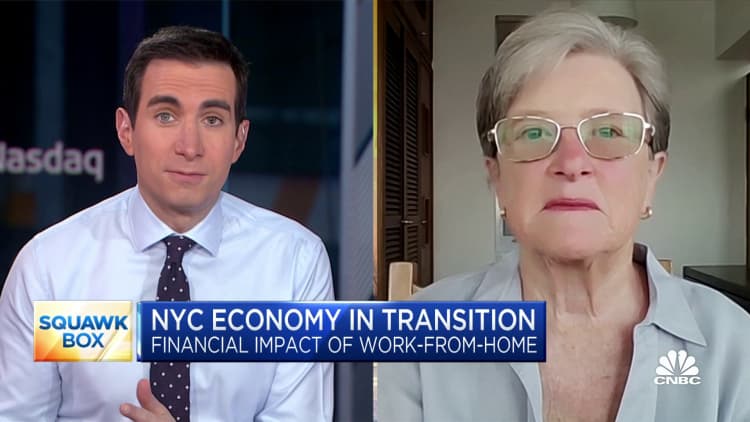
Initially, remote work was seen as a necessary measure to contain the spread of the virus. Technological advances — such as videoconferencing and high-speed internet — made the arrangement possible for many workers.
Both employees and companies subsequently discovered benefits beyond an immediate health impact, economists said.
Employees most enjoy having a reduced commute, spending less time getting ready for work and a having a flexible schedule that more easily allows for doctor visits and picking up kids from school, Bloom said.
Some workers have shown they’re reluctant to relinquish those perks. Companies such as Amazon and Starbucks, for example, recently faced a backlash from employees after announcing stricter return-to-office policies.
Employers enjoy higher employee retention and can recruit from a broader pool of applicants, said Julia Pollak, chief economist at ZipRecruiter. They can save money on office space, by recruiting from lower-cost areas of the country or by raising wages at a slower pace due to workers’ perceived value of the work-at-home benefit, she said.
It’s almost impossible to find anything in economics that changes at such speed.
Nicholas Bloom
economist at Stanford University
For example, job seekers polled by ZipRecruiter say they’d be prepared to take a 14% pay cut to work remotely, on average. The figure skews higher — to about 20% — for parents with young children.
Twitter recently shut its Seattle offices as a cost-cutting measure and told employees to work from home, a reversal from an earlier position that employees work at least 40 hours a week in the office.
“The benefits for employers are pretty substantial,” Pollak said.
Hybrid work model is a ‘win-win’
Momo Productions | Digitalvision | Getty Images
Most companies have turned to a “hybrid” model, with a work week split between maybe two days from home and three in the office, economists said.
That arrangement has yielded a slight boost in average worker productivity, Bloom said. For one, the average person saves 70 minutes a day commuting; roughly 30 minutes of that time savings is spent working more, he said.
“Hybrid is pretty much a win-win,” Bloom said.
About 39% of new hires have jobs with a hybrid work arrangement, while 18% of new jobs are fully remote, according to ZipRecruiter. Both shares are up relative to their pre-pandemic levels (28% and 12%, respectively).
“It’s still an evolving trend, but the movement is very much toward increased remote work,” Pollak said.
Of course, not all workers have the option to work remotely. About 37% of jobs in the U.S. can plausibly be done entirely at home, according to a 2020 study by Jonathan Dingel and Brent Neiman, economists at the University of Chicago.
There are large variations by occupation and geography. For example, jobs in retail, transportation, hospitality and food services are far less likely than those in technology, finance, and professional and business services to offer work-from-home arrangements.
Remote work may endure even in a recession
Not everyone agrees that the benefits of working from home outweigh costs.
Evidence suggests employee mentoring, innovation and company culture may suffer if jobs are fully remote, Bloom said. Workers cite face-to-face collaboration, socializing and better work-life balance as top benefits of in-office work, his research finds.
Companies that are fully remote often have in-person gatherings or retreats as a way to build company culture, Bloom said.

Workers have enjoyed a high degree of bargaining power due to a hot labor market characterized by low unemployment and ample job openings. If the economy cools and their bargaining power dissipates, it’s unclear whether some employers would introduce stricter work-from-home policies, economists said.
For one, employers may see remote work as a useful way to trim labor costs in the face of recession, Bunker said. The more likely scenario is on the margin: perhaps three or four days in the office instead of one or two, he said.
The technology sector is a useful indicator, he said. Tech job postings have fallen this year amid industry struggles, but the share of Indeed job ads offering a remote work benefit has remained constant, Bunker said.
“It’s been quite sticky in the face of hiring pullbacks,” he said.
[ad_2]
Source link
[ad_2]
Source link