- Home Depot drops after annual sales forecast cut
- Capital One up as Berkshire Hathaway reveals stake
- Horizon falls after FTC to block Amgen’s deal to buy co
- Futures: Dow down 0.24%, S&P off 0.07%, Nasdaq flat
Now that the debt ceiling debate appears to have been resolved, we could see more risk-taking among investors. That’s a good thing for smaller stocks, like the ones we buy for our portfolio. Below I take a closer look at what’s going on this week in the S&P 500 (SPY) and how this impacts our next move. Read on for more….
(Please enjoy this updated version of my weekly commentary originally published June 1st in the POWR Stocks Under $10 newsletter).
The debt ceiling deal has passed the House and looks set to pass the Senate. That’s been marginally good for stocks, with the S&P 500 (SPY) up about 3% over the last week.
There are still plenty of concerns for the economy, but it looks like the debt ceiling won’t be one of them.
It’s not really a surprise that the US avoided a default (the consequences of which could have been catastrophic).
The real surprise is that it didn’t come down to the very last minute for Washington to get a deal done. Attention will now shift back to the Fed and the fight against inflation.
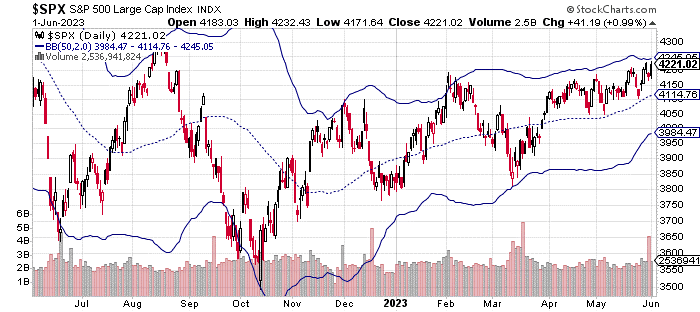
You can see in the chart above, the SPX (S&P 500 index) is near the top of its two standard deviation range.
That doesn’t necessarily imply it’s going to pull back, but mean reversion is a real thing with stocks, so there could be some selling pressure in the near future – albeit short-lived, most likely.
With the debt ceiling issues mostly out of the way, the jobs report tomorrow will be front and center for many investors.
The job market remains strong, which is both good and bad. It’s good because people have jobs (obviously). It’s bad because it makes it more likely that the Fed will continue raising rates to fight inflation.
The Fed doesn’t appear to be in a rush to raise rates at this stage, though. There’s currently an 80% chance of a rate hike pause at the June FOMC meeting (according to the futures market).
However, there’s over a 50% chance the Fed hikes rate at the July meeting.
The Fed is attempting to achieve a soft landing. That is, they want to combat inflation (sending it lower) without torpedoing the economy.
I’m not sure it’s possible, although it has been achieved in the past. We’ll have to wait and see if they can capture that magic this time around.
Volatility, as seen in the VIX chart below, wavered during heading into the final days of the debt ceiling debate.
However, you can see where the VIX is now approaching 15. Below 15 is generally considered a low volatility regime for the market.
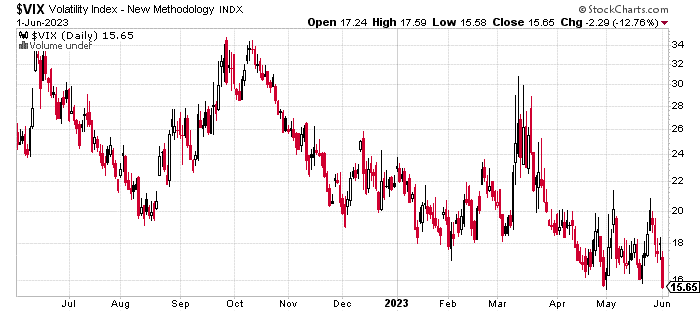
It’s not unusual for market volatility to soften as we move into the summer vacation months.
However, it’s a bit different this year with at least one interest rate hike expected over the summer period.
Despite the Fed doing a reasonable job of telegraphing their moves, further rate hikes could introduce a measure of volatility into stocks in the coming weeks.
Ultimately though, we may be approaching a period where investors are willing to take more risks on stocks.
Lower volatility typically means investors will take more chances on small stocks and value names. That certainly implies good things for us, which is the area we tend to operate in.
What To Do Next?
If you’d like to see more top stocks under $10, then you should check out our free special report:
What gives these stocks the right stuff to become big winners, even in this challeging stock market?
First, because they are all low priced companies with the most upside potential in today’s volatile markets.
But even more important, is that they are all top Buy rated stocks according to our coveted POWR Ratings system and they excel in key areas of growth, sentiment and momentum.
Click below now to see these 3 exciting stocks which could double or more in the year ahead.
All the Best!
Jay Soloff
Chief Growth Strategist, StockNews
Editor, POWR Stocks Under $10 Newsletter
SPY shares closed at $427.92 on Friday, up $6.10 (+1.45%). Year-to-date, SPY has gained 12.32%, versus a % rise in the benchmark S&P 500 index during the same period.
About the Author: Jay Soloff

Jay is the lead Options Portfolio Manager at Investors Alley. He is the editor of Options Floor Trader PRO, an investment advisory bringing you professional options trading strategies. Jay was formerly a professional options market maker on the floor of the CBOE and has been trading options for over two decades.
The post Moving on From the Debt Ceiling… appeared first on StockNews.com
[ad_2]
Source link
We continue to put our idle money to work in our portfolio. For the time being, we’ll be focusing on additions rather than deletions (although that could change based on new info). Once the debt ceiling stuff is resolved, I think the market will be in a nice position to rally for the second half of the year. Hopefully, we’ll have that purely political headache out of the way by next week. Let’s take a look at what’s going on this week….
(Please enjoy this updated version of my weekly commentary originally published May 25th in the POWR Stocks Under $10 newsletter).
Stocks have pulled back a bit and volatility has gone up as we approach the debt ceiling. This is no surprise (both the behavior of the market and the fact that the ceiling has yet to be resolved).
That being said, I still think there’s a less than a 1% chance we actually default on debt. One way or another, something will get worked out.
In the meantime, life goes on. Tech stocks jumped 2.5% on Thursday after great earnings from NVIDIA (NVDA).
Speaking of NVDA, as overvalued as it may be (trading at 218x earnings), the company has posted some very positive news.
The stock is now valued at almost a trillion dollars and it’s the 5th largest component of the S&P 500 (SPY).
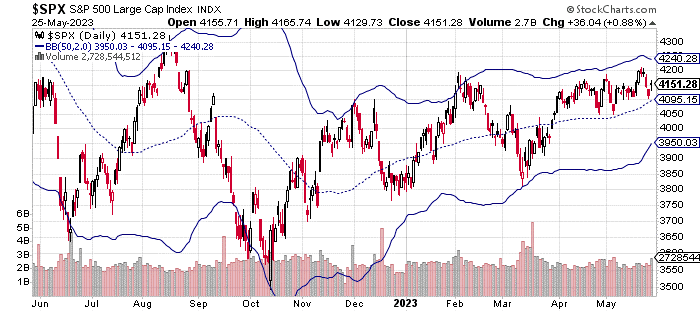
The S&P 500 pulled back to its 50-day moving average before the NVDA news sent it back higher. It remains within the 2 standard deviation range that you can see on the chart above. Positive news on a debt ceiling deal could send the index much higher in a hurry.
Of course, as we get closer to the actual debt limit, volatility will go up and stocks will go down. Most people don’t believe an actual default will happen, but the financial markets have no choice but to react as we come down to the wire.
There isn’t a whole lot of meaningful economics news this week, although PCE comes out after this issue is released. The metric (which is an alternative to CPI in terms of looking at inflation) could potentially move the market if the results are a big surprise.
The markets are now at about a 50/50 chance on a rate increase at the next Fed meeting in June.
We have a few more weeks until then, so things can obviously change. PCE results may go some way towards convincing the markets one way or the other what the Fed is going to decide.
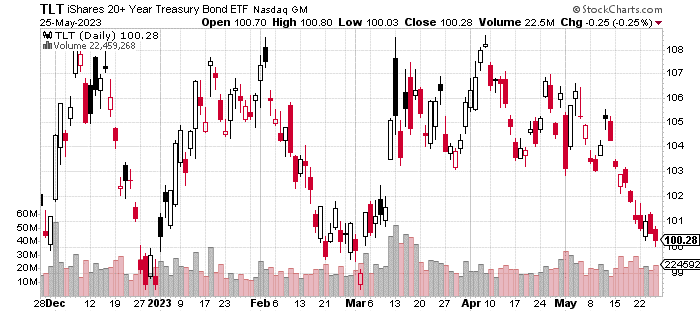
Looking at the chart of iShares 20+ Year Treasury Bond ETF (TLT), bond prices have come back down recently.
Keep in mind, bond prices move inverse to bond yields, so this move is likely due to the greater expectations of a rate hike than what we saw a few weeks ago. If there is a rate hike, I strongly suspect it will be the last one of the year.
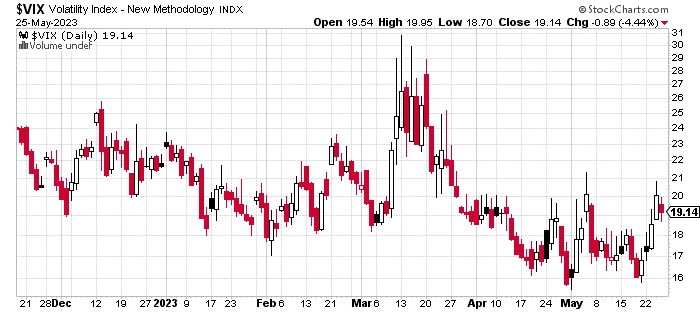
The VIX (the market volatility index) has climbed a fair amount over the last week as a response to the approaching debt ceiling. Again, this isn’t really a surprise under the circumstances. The index is still under 20, which is about the long-term median level. .
The 18-20 level in the VIX doesn’t tend to be a place the index sits at for very long (as you can see in the chart above). It’s kind of a transition level historically.
Whether market volatility goes higher or lower depends almost entirely on what happens with the debt negotiations. We’ll know a lot more next week.
What To Do Next?
If you’d like to see more top stocks under $10, then you should check out our free special report:
What gives these stocks the right stuff to become big winners, even in this challeging stock market?
First, because they are all low priced companies with the most upside potential in today’s volatile markets.
But even more important, is that they are all top Buy rated stocks according to our coveted POWR Ratings system and they excel in key areas of growth, sentiment and momentum.
Click below now to see these 3 exciting stocks which could double or more in the year ahead.
All the Best!
Jay Soloff
Chief Growth Strategist, StockNews
Editor, POWR Stocks Under $10 Newsletter
SPY shares were unchanged in after-hours trading Friday. Year-to-date, SPY has gained 10.25%, versus a % rise in the benchmark S&P 500 index during the same period.
About the Author: Jay Soloff
Jay is the lead Options Portfolio Manager at Investors Alley. He is the editor of Options Floor Trader PRO, an investment advisory bringing you professional options trading strategies. Jay was formerly a professional options market maker on the floor of the CBOE and has been trading options for over two decades.
The post Will Resolving the Debt Ceiling Touch Off the Next Market Rally? appeared first on StockNews.com
[ad_2]
Source link
May 16 (Reuters) – Dow futures fell on Tuesday after a dour forecast from Home Depot ahead of critical debt limit talks, and retail sales data that will offer more insight on the economy’s health.
The main indexes started the week with modest gains as trading was range-bound amid a wrangling in Washington between the White House and Republicans.
They will sit down later in the day to try to make progress on a deal to raise the U.S. government’s $31.4 trillion debt ceiling and avert an economically catastrophic default.
“There is little chance we will see a resolution to the U.S. debt ceiling issue today,” said Ipek Ozkardeskaya, senior analyst at Swissquote Bank.
“The negotiations will likely remain tight as Republicans ask decent spending cuts to accept a debt ceiling relief, while Biden is not willing to compromise on spending into the election year.”
Dow Jones Industrial Average (.DJI) component Home Depot (HD.N) shed 4.4% in premarket trading after the home improvement chain cut its annual sales forecast, with Americans cutting back on spending on tools and building materials as inflation stays sticky.
Shares of rival Lowe’s Companies Inc (LOW.N) fell 3.2%, while retail giant Walmart Inc (WMT.N) slipped 0.4%.
Focus will also be on economic data, with retail sales expected to increase by 0.8% in April after falling 0.6% in the month before.
Data recently has pointed to a slowing U.S. economy, which is starting to feel the heat of the Federal Reserve’s restrictive monetary policy, and also heightened expectations for when the central bank will pause its hiking cycle.
At 6:56 a.m. ET, Dow e-minis were down 80 points, or 0.24%, S&P 500 e-minis were down 3 points, or 0.07%, and Nasdaq 100 e-minis were up 5.25 points, or 0.04%.
Shares of Capital One Financial Corp (COF.N) jumped 6.3% after Berkshire Hathaway Inc (BRKa.N) on Monday disclosed it has begun investing in the consumer lender.
Berkshire also upped its stake in HP Inc (HPQ.N), sending its shares up 1.6%, while shedding stake in regional bank US Bancorp (USB.N), which slipped 1.2%.
Horizon Therapeutics (HZNP.O) slid 17.8% as the Federal Trade Commission is expected to file a lawsuit to block Amgen Inc’s (AMGN.O) $27.8 billion deal to buy the company. Shares of Amgen rose 1.2% in thin volumes.
Reporting by Shreyashi Sanyal in Bengaluru; Editing by Maju Samuel
Our Standards: The Thomson Reuters Trust Principles.
[ad_2]
Source link
A Pacific Investment Management Co. office landlord that defaulted on $1.7 billion of mortgage notes sent shockwaves through a troubled part of the real estate market.
For years, property owners have been grappling with the rise of remote work — a problem so large that one brokerage estimates roughly 330 million square feet (31 million square meters) of office space will become vacant by the end of the decade as a result. But low interest rates allowed the investors to muddle along more easily without worrying about the debt.
[ad_2]
Source link