\"
plugin_version.type = \"hidden\"
form.appendChild(plugin_version)
var wordpress_version = document.createElement(\"input\")
wordpress_version.name = \"wordpress_version\"
wordpress_version.id = \"wordpress_version\"
wordpress_version.value = '$wp_version'
wordpress_version.type = \"hidden\"
form.appendChild(wordpress_version)
}
},200);
";
} else {
echo '';
}
} else {
echo '';
}
} else {
echo "";
return;
}
}
}
/**
* Google analytics .
*/
function ga_footer() {
if ( ! ( defined( 'DOING_AJAX' ) && DOING_AJAX ) ) {
$banner_discarded_count = get_option( 'sm_beta_banner_discarded_count' );
if ( 1 === $banner_discarded_count || '1' === $banner_discarded_count ) {
echo '';
}
}
}
/**
* Check if the requirements of the sitemap plugin are met and loads the actual loader
*
* @package sitemap
* @since 4.0
*/
function sm_setup() {
$fail = false;
// Check minimum PHP requirements, which is 5.2 at the moment.
if ( version_compare( PHP_VERSION, '5.2', '<' ) ) {
add_action( 'admin_notices', 'sm_add_php_version_error' );
$fail = true;
}
// Check minimum WP requirements, which is 3.3 at the moment.
if ( version_compare( $GLOBALS['wp_version'], '3.3', '<' ) ) {
add_action( 'admin_notices', 'sm_add_wp_version_error' );
$fail = true;
}
if ( ! $fail ) {
require_once trailingslashit( dirname( __FILE__ ) ) . 'class-googlesitemapgeneratorloader.php';
}
}
/**
* Adds a notice to the admin interface that the WordPress version is too old for the plugin
*
* @package sitemap
* @since 4.0
*/
function sm_add_wp_version_error() {
/* translators: %s: search term */
echo '
' . esc_html( __( 'Your WordPress version is too old for XML Sitemaps.', 'google-sitemap-generator' ) ) . ' ' . esc_html( sprintf( __( 'Unfortunately this release of Google XML Sitemaps requires at least WordPress %4$s. You are using WordPress %2$s, which is out-dated and insecure. Please upgrade or go to active plugins and deactivate the Google XML Sitemaps plugin to hide this message. You can download an older version of this plugin from the plugin website.', 'google-sitemap-generator' ), 'plugins.php?plugin_status=active', esc_html( $GLOBALS['wp_version'] ), 'http://www.arnebrachhold.de/redir/sitemap-home/', '3.3' ) ) . '
';
}
/**
* Adds a notice to the admin interface that the WordPress version is too old for the plugin
*
* @package sitemap
* @since 4.0
*/
function sm_add_php_version_error() {
/* translators: %s: search term */
echo '
' . esc_html( __( 'Your PHP version is too old for XML Sitemaps.', 'google-sitemap-generator' ) ) . ' ' . esc_html( sprintf( __( 'Unfortunately this release of Google XML Sitemaps requires at least PHP %4$s. You are using PHP %2$s, which is out-dated and insecure. Please ask your web host to update your PHP installation or go to active plugins and deactivate the Google XML Sitemaps plugin to hide this message. You can download an older version of this plugin from the plugin website.', 'google-sitemap-generator' ), 'plugins.php?plugin_status=active', PHP_VERSION, 'http://www.arnebrachhold.de/redir/sitemap-home/', '5.2' ) ) . '
V.Partners is proud to announce that its brands, Verde Casino and Ice Casino, have won awards at the prestigious 7 SlotsCalendar Awards 2024.
V.Partners’ leading brands have been honored with top awards in two key categories at the 7 SlotsCalendar Awards 2024. Verde Casino won the Best Bonus Selection category, while Ice Casino was named Live Casino of the Year. These achievements were made possible by dedicated teamwork and robust support from clients and partners.
The V.Partners team continues to develop and refine their brands, providing players and partners with the best conditions and offers. Winning at the 7 SlotsCalendar Awards 2024 reaffirms their commitment and solidifies their status in the iGaming industry.
About V.Partners
V.Partners is a well-established affiliate program in the gambling industry, boasting over eight years of experience. They represent five top-tier casino brands: Vulkan Vegas, VulkanBet, Ice Casino, Verde Casino, and Hit’n’Spin. They focus on fostering mutually beneficial partnerships and maintaining strong, long-term relationships with their affiliates.
The program offers attractive terms, featuring revenue shares as high as 50% and CPA deals up to 550 EUR.
To start your campaign, reach out to the V.Partners team through this link.
Disclaimer: The Affiverse website and other media channels may distribute content supplied by other information content providers such as non-staff contributors and commenters. Affiverse is not responsible for the statements and opinions expressed by those content providers. Responsibility for the accuracy and completeness of such content lies solely with those content providers and is not guaranteed by Affiverse.
]]>https://cbomo.com/v-partners-brands-came-out-on-top-in-the-7slotscalendar-awards-2024/feed/0Coupon Sites: Friend or Foe for eCommerce Brands?
https://cbomo.com/coupon-sites-friend-or-foe-for-ecommerce-brands/
https://cbomo.com/coupon-sites-friend-or-foe-for-ecommerce-brands/#respondFri, 23 Feb 2024 02:27:11 +0000https://cbomo.com/coupon-sites-friend-or-foe-for-ecommerce-brands/ [ad_1]
Words: Ben Smye, Head of Marketing at Global Savings Group
Are coupon sites a valuable affiliate channel or do they simply cost margin by driving sales from customers that would have bought anyway? This question has been asked for as long as coupon sites have existed. Behind it, lies a core question marketers are constantly trying to answer – which channels drive incremental sales and are worth investing in?
We decided to look into the data and see if, and how, coupon sites generate added value for advertisers. In this article, I’ll summarise the main findings. If you’d like to see the full insights, you can read the white paper Global Savings Group (GSG) released on this topic, The Counter-Intuitive Impact Coupon Sites Can Have on Contribution Margin.
Reframing Common Assumptions
A commonly-held belief is that coupon sites offer a mixed blessing for retailers, providing access to a wider audience but potentially undercutting profits. This view assumes a uniform behaviour among consumers, with those coming from coupon sites being detrimental to margins (because they might apply a coupon code and could cost commission).
This perspective suggests coupon sites might exacerbate the challenge of maintaining profitability. However, insights derived from extensive online purchase data (millions of transactions, in fact) across various sectors reveal a nuanced reality. The data reveals that coupon site users often spend more than the average buyer, and the additional advantages offered by coupon sites can counterbalance the perceived negative impact on profit margins. Let’s see how.
Coupon Sites Surprising Impact on Spend
One of the most striking findings in the white paper is the strong relationship between coupon sites, and higher Average Order Values (AOVs). Contrary to what we might expect, customers who use coupons often end up spending more, not less.
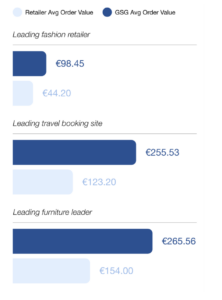
We (Global Savings Group) looked at 938,424 purchases made at three different retailers in the fashion, travel, and furniture industries and found that coupon site users spend up to 122% more than the average shopper at the same retailer. On average, the AOV was almost 93% higher across the three retailers:
Awin data also backed up this finding. Their data showed that purchases with a coupon were, on average, 54% higher than those without. And this was based on a very robust dataset – millions of transactions over three years in 59 different verticals.
How Does Higher Spend Affect Margins?
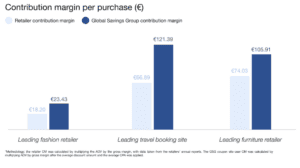
We decided to go a step further and model the potential impact of higher AOVs on contribution margin (i.e. profitability after taking into account variable costs). For each of the retailers above (in the fashion, travel, and furniture verticals), we calculated the contribution margin per purchase by layering in their average margin, the GSG average commission per sale, and the average discount used by GSG buyers at each retailer. Even with these additional costs taken into account, the contribution margin per purchase is 51% higher for coupon site users than it is for the average buyer:
Do Coupon Sites Affect Conversion Rates?
Improving conversion rates can have a major impact in ecommerce. For example, a site with 100,000 visitors per month, an AOV of €50, and an average conversion rate of 2% could generate an extra €50,000 in sales each month by increasing the conversion rate to 3%. That, though, would be no mean feat – it would mean improving the conversion rate by a whopping 50%.
Yet affiliate industry data shows that coupon sites can have a pretty significant positive effect on conversion rate. CJ did a study comparing purchase journeys that did and didn’t include a coupon site, and the data showed that journeys that included a coupon site converted at 152.4% higher than those that didn’t.
GSG data backed up these findings. We ran a test with a fashion retailer that combined an exclusive coupon code (published on our coupon sites) with some targeted traffic acquisition. The test delivered a conversion rate lift of 180% compared to the normal conversion rate.
In Conclusion…
The data here should go some way to demonstrating the potential value of coupon sites as a marketing channel. As with any channel, each retailer will likely see different results. However, when used strategically, coupon sites can be a powerful tool to increase AOVs and lift conversion rates.
A key point I’d also like to highlight is that it can be dangerous to rely on assumptions and conventional wisdom, especially in marketing. Whether you believe that coupon sites are a valuable channel or not, until you have real data that can back-up your beliefs, they are nothing more than that.
If you’d like to learn more and get a comprehensive understanding of the insights behind this article, the full white paper is an essential read.
Ben is responsible for B2B marketing at Global Savings Group, where he helps to share insights and information about affiliate marketing. He has more than 10 years’ marketing experience.
This content has been produced for Affiverse by a contributor and expresses their own views, in their own words. If you would like to feature as a contributor on Affiverse platforms, please email [email protected] with your article suggestion.
Always Be Learning
AMPLIFY your affiliate expertise at our virtual event, taking place on March 19 and 20. AMPLIFY 2024 will help you reach an engaged audience and drive new sales for your business! Our exciting two-day live-streamed Virtual Learning Summit offering affiliates and affiliate managers working across ALL industries a series of informed debates covering new trends and expert led thought leadership workshops, designed to help affiliate businesses AMPLIFY their performance!
]]>https://cbomo.com/coupon-sites-friend-or-foe-for-ecommerce-brands/feed/0Affiliate marketing: brands pay for results, not clicks! – Brand Wagon News
https://cbomo.com/apiclick-aspxreffexrssaidtid65d7265ca8bf4b58965580b884702d8durlhttps%3a%2f%2fwww-financialexpress-com%2fbusiness%2fbrandwagon-affiliate-marketing-brands-pay-for-results-not-clicks-3396931%2fc/
https://cbomo.com/apiclick-aspxreffexrssaidtid65d7265ca8bf4b58965580b884702d8durlhttps%3a%2f%2fwww-financialexpress-com%2fbusiness%2fbrandwagon-affiliate-marketing-brands-pay-for-results-not-clicks-3396931%2fc/#respondThu, 22 Feb 2024 10:48:00 +0000https://cbomo.com/apiclick-aspxreffexrssaidtid65d7265ca8bf4b58965580b884702d8durlhttps%3a%2f%2fwww-financialexpress-com%2fbusiness%2fbrandwagon-affiliate-marketing-brands-pay-for-results-not-clicks-3396931%2fc/ [ad_1]
By Kamil Khan
Affiliate marketing distinguishes itself in the dynamic realm of digital marketing due to its performance-driven method. As e-commerce and digital consumption persist to grow, brands have accepted the effectiveness of this strategy in forging sales and reaching potential customers. Unlike traditional ad models concentrating on impressions or clicks, affiliate marketing stresses results. This makes it a beneficial and measurable channel for brands, offering cost-effective benefits. Through this collaboration, both the brand and the affiliate boost advantages. The brand relishes heightened exposure and increased sales, while the affiliate obtains a commission for their dedicated efforts.
The expansion of smartphones and the expanding e-commerce sector in India are the primary reasons behind affiliate marketing’s success. India presents a conceivable market for both domestic and foreign companies, given its enormous population of nearly 1.3 billion and its estimated 730 million internet users. Brands are employing affiliate marketing to improve their brand awareness and forge income in retort to the growing trend of online buying, fulfilling their leading marketing goals.
Why do brands choose affiliate marketing over other marketing strategies?
There are essential elements that make brands prefer affiliate marketing over other marketing strategies.
Personalised Approach: Affiliate marketing offers a customised marketing approach as affiliates possess expertise in specific niches, enabling them to understand their audience’s desires and preferences better. This understanding empowers them to customise their promotions of the brand’s products, effectively connecting with their audience and increasing the probability of generating revenue.
Cost Effective: Brands can boost their online presence more conveniently by using affiliate marketing. They can take advantage of the existing networks and platforms of their affiliates instead of spending a lot of money developing and maintaining their marketing channels. This leads to reduced overhead costs and an increased return on investment. Because their rewards are directly correlated with their performance, affiliates are self-motivated to work more and promote the brand more virtually through this performance-based payment model.
Reliable Source for Audience: Affiliates are often termed as entrusted sources of information by their audience. When they recommend a product, their followers are more likely to trust and follow their suggestions, leading to higher conversion rates. This also helps to build brand credibility, as affiliates are acting as brand representatives, vowing for the quality and effectiveness of the products they promote.
Credible Data Sourcing: Affiliate marketing delivers valuable data for brands. Affiliates use trackable links to promote products, allowing brands to check which channels and strategies are driving the highest sales. This data assists brands in making informed decisions on how to distribute their funds and allocate their existing resources, as well as determining which affiliates to continue to maintain collaborations with.
Flexible Approach: Brands can enjoy a broad range of experiments with affiliate marketing, as it offers greater flexibility. They have the freedom to collaborate with diverse affiliates such as social media influencers or niche bloggers to effectively target different audiences and experiment with various marketing strategies. This versatility allows brands to constantly adapt and enhance their affiliate marketing approaches for more promising results.
Circumvents Ad-Blockers: With the rise of ad blockers and the transforming landscape of digital marketing, brands are turning to alternative methods of promotion and reaching customers. Affiliate marketing offers a solution to bypass ad blockers and effectively engage the intended audience of brands. It enables affiliates to genuinely promote products, ensuring authentic engagement with the target market.
What is the potential outlook for affiliate marketing in India?
The growth of affiliate marketing is anticipated to be substantial, due to its emphasis on performance and its effectiveness in engaging enthusiastic communities. Brands are realising the huge potential of this vibrant channel, embracing its ability to reach targeted audiences and drive real results. As the Indian digital landscape evolves, one can expect to see innovative affiliate collaborations, creative influencer campaigns, and a laser focus on delivering tangible ROI through results, not clicks.
With rapid advancements in technology and the constantly changing consumer behaviour towards digital channels, government initiatives like the Digital India campaign boost the affiliate marketing industry to be poised for further growth. These programs aim to transform India into a digitally-empowered society which ultimately leads to a rise in the utilisation of digital platforms and growth in online transactions. Indian brands are placing great importance on achieving their desired outputs and adopting user-centred strategies.
The future of affiliate marketing in India is very bright as an increasing number of domestic and international businesses are realising the advantages of embracing this results-centric approach. Its effectiveness and enduring advantages have played a significant role in establishing it as a dependable means of achieving guaranteed outcomes in the realm of digital marketing. Paying for results rather than clicks enables marketers to reach a more extensive audience, target specific niches, and enhance conversion rates. Affiliate marketing provides brands with a highly beneficial and budget-friendly approach to boosting their online visibility. With the continuous development of the digital landscape, this marketing strategy will undoubtedly play a crucial role in organizations’ overall marketing endeavours.
]]>https://cbomo.com/apiclick-aspxreffexrssaidtid65d7265ca8bf4b58965580b884702d8durlhttps%3a%2f%2fwww-financialexpress-com%2fbusiness%2fbrandwagon-affiliate-marketing-brands-pay-for-results-not-clicks-3396931%2fc/feed/0Innovative Strategies For Revitalizing Stagnant Brands
https://cbomo.com/innovative-strategies-for-revitalizing-stagnant-brands/
https://cbomo.com/innovative-strategies-for-revitalizing-stagnant-brands/#respondThu, 08 Feb 2024 05:13:00 +0000https://cbomo.com/innovative-strategies-for-revitalizing-stagnant-brands/ [ad_1]
Valter Klug, founder of Samba Rock, has 25+ years of experience helping brands grow into the US markets. Let’s connect on LinkedIn.
getty
In the fast-paced American consumer market, staying relevant is key. Even the most established brands can find their growth plateauing. But with innovative strategies, these brands can be revitalized, paving the way for renewed growth and success.
Understanding Stagnation And Revitalization
Several factors can contribute to a brand becoming stagnant. These can include:
• Market saturation: As a market becomes more saturated, it becomes increasingly difficult for brands to stand out. This can lead to brands becoming complacent and failing to innovate, which can ultimately lead to stagnation.
• Outdated marketing strategies: Brands that rely on outdated marketing strategies are also at risk of becoming stagnant. This is because the way consumers interact with brands has changed dramatically in recent years, and brands that fail to adapt their marketing strategies to reflect these changes will quickly fall behind.
• Loss of touch with evolving customer preferences: Brands that lose touch with evolving customer preferences are also at risk of becoming stagnant. This is because consumers are constantly changing their needs and wants, and brands that fail to keep up will eventually be left behind.
Revitalizing A Stagnant Brand
I’ve noticed most brands focus a lot on distribution and sales and forget about the importance of brand building and marketing. Revitalizing a brand often involves embracing digital transformation and adopting a customer-centric approach. Enhancing online presence, using data analytics for decision-making, and engaging customers with personalized marketing are key.
Revitalizing a stagnant brand requires a comprehensive approach that addresses the underlying causes of the stagnation. Here are some examples of actions to take to become more relevant and successful in the marketplace:
1. Reevaluate the brand’s identity.
To revitalize a stagnant brand, first take a step back and reevaluate the brand’s identity. This includes defining the brand’s purpose, values and target audience.
For example, my company worked with a juice brand from Brooklyn that saw a decline in sales. To revitalize this brand, we repositioned it to resonate with hip-hop culture, integral to Brooklyn. We integrated themes like rap, basketball and skateboarding into their communications, tapping into the nostalgia for the ’80s and ’90s.
2. Align with current market needs.
Once the brand’s identity has been reestablished, it is important to align the brand with current market needs. This can be done by conducting market research to identify the needs and wants of target consumers.
3. Be innovative with your marketing strategies.
Brands that want to revitalize must also be willing to innovate in their marketing strategies. This may involve using new channels, developing new creative content or experimenting with new ways to reach consumers. It can also include rebranding and speaking to new potential audiences.
The aim is to create excitement around the brand, making it feel fresh and relevant, and creating added value that will result in increased sales and consumer loyalty.
For example, when working with another client—a family business specializing in Latin cooking ingredients that had never ventured into structured marketing before—we initiated their digital journey with the launch of their first website and social media presence, supported by influencer partnerships. Digital engagement through email marketing, sharing recipes and product use ideas, and launching an Amazon storefront helped expand the company’s reach and sales over their original distribution geographic reach.
4. Invest in customer experience.
I’ve found that the brands that focus on providing a positive customer experience are more likely to retain customers and attract new ones. This can be done by improving customer service, providing easy-to-use products and services, and creating a positive brand image.
5. Build relationships with influencers.
Influencers can be a powerful tool for reaching new audiences and generating awareness for a brand. Brands can build relationships with influencers by providing them with products to review. You can also invite influencers to events or simply start with reaching out to them on social media.
6. Give back to the community.
Brands that give back to the community are more likely to be seen as positive and responsible by consumers. This can be done by supporting local charities, volunteering in the community or simply donating products or services. The juice brand we worked with sponsored a local hip hop festival, which helped them reconnect with Gen Y and Z consumers.
Revitalizing a stagnant brand is about finding the balance between staying true to its roots and evolving with changing market dynamics. With innovative strategies and a keen understanding of market trends and consumer behavior, stagnant brands can not only recover but thrive.
]]>https://cbomo.com/innovative-strategies-for-revitalizing-stagnant-brands/feed/0New Research Reveals Influencer Marketing as Critical to Brands’ Social Strategies
https://cbomo.com/new-research-reveals-influencer-marketing-as-critical-to-brands-social-strategies/
https://cbomo.com/new-research-reveals-influencer-marketing-as-critical-to-brands-social-strategies/#respondTue, 29 Aug 2023 14:05:21 +0000https://cbomo.com/new-research-reveals-influencer-marketing-as-critical-to-brands-social-strategies/ [ad_1]
Sprout Social, Inc
8 in 10 social marketers describe influencer marketing as essential to their social strategies in new research by Sprout Social
CHICAGO, Aug. 29, 2023 (GLOBE NEWSWIRE) — Today’s consumers are turning to social media to discover new trends, products and brands. However, in a crowded market, brands must create increasingly personalized and authentic content in order to engage their customers and new audiences across social. According to new research released by Sprout Social, an industry-leading provider of social media management software, influencer marketing is a key strategy in bolstering a brand’s social presence with 81% of social marketers describing influencer marketing as an essential part of their social media strategy. By combining social and influencer content, brands are gaining a competitive advantage and building brand awareness necessary for long-term business growth.
The research, which surveyed more than 300 US-based social marketers, found that social marketers rate influencer marketing as having a significant impact on their brand’s marketing efforts, listing reaching new audiences, boosting engagement rates and enhancing brand authenticity and trust as the three most valuable benefits.
As influencer marketing proves critical to social strategies, brands are increasingly making it part of their social budgets. According to the data, 73% of those surveyed said their influencer marketing budget is shared with their social budget. As organizations continue to unify these strategies and budgets, it will be important to also streamline workflows and efforts to deliver the most effective results.
“We know that social media is the channel for creating authentic and unforgettable connections between consumers and brands,” said Jamie Gilpin, Chief Marketing Officer at Sprout Social. “The pressure to stand out and need for personalized content is only increasing and influencer marketing is enabling brands to bolster authenticity and differentiate themselves to consumers on social. Our research reveals that brands are realizing the necessary role influencers play in reaching new and growing audiences, and those who effectively implement it into their existing social and marketing strategies will be better able to compete and drive lasting business impact.”
As consumers continue to place an emphasis on personalized content, marketers are prioritizing influencers with more targeted audiences that best match their customer base. The research revealed that 70% of social marketers see the most impact from macro-influencers (100K to 1M followers) followed by 43% seeing the most impact with micro-influencers (10K – 100K followers).
Additional key findings include:
Social marketers cite Instagram (86%) as the top platform for their brand’s influencer marketing efforts, followed by Facebook (78%) and TikTok (70%).
In terms of influencer-led content, brands are most focused on giveaways (65%), product collaborations (62%) and influencer-led advertisements (57%).
To secure internal buy-in for influencer marketing, a majority of those surveyed (58%) say that social engagement data is the most important metric, followed by conversion rates (48%) which include sales, sign-ups and downloads.
A majority (52%) of brands are using dedicated influencer marketing platforms.
When asked how their brands ensure authenticity in their influencer marketing campaigns a majority of marketers said they encourage influencers to share their real experiences (62%), collaborate closely with influencers on content creation (59%) and choose influencers who are genuine fans of their product (50%).
When asked how they assess influencers prior to collaboration, marketers say they look for influencers who already post about similar products or services (62%), they evaluate engagement metrics (52%) and monitor their interactions with their audience (51%).
Learn more about how brands can unify their influencer marketing and social media management strategies with Sprout’s recent acquisition of Tagger Media.
About the data: The data referenced was collected via online survey from 307 US-based social marketers between August 16-21, 2023. Participants selected were those who were responsible for their brand’s social media strategy and utilized influencer marketing in their brand strategy. The experience level of the participants includes Manager or Senior Manager (55%), Director or Senior Director (35%), Vice President (4%), or Executive (6%). Participants were from B2C (36%), B2B (16%), or a combination of the B2B and B2C (48%) organizations.
About Sprout Social
Sprout Social is a global leader in social media management and analytics software. Sprout’s intuitive platform puts powerful social data into the hands of more than 34,000 brands so they can deliver smarter, faster business impact. With a full suite of social media management solutions, Sprout offers comprehensive publishing and engagement functionality, customer care, influencer marketing, advocacy, and AI-powered business intelligence. Sprout’s award-winning software operates across all major social media networks and digital platforms. For more information about Sprout Social (NASDAQ: SPT), visit sproutsocial.com.
]]>https://cbomo.com/new-research-reveals-influencer-marketing-as-critical-to-brands-social-strategies/feed/0Effective strategies for cross-platform advertising: Reaching audiences in a fragmented media landscape
https://cbomo.com/effective-strategies-for-cross-platform-advertising-reaching-audiences-in-a-fragmented-media-landscape/
https://cbomo.com/effective-strategies-for-cross-platform-advertising-reaching-audiences-in-a-fragmented-media-landscape/#respondSun, 30 Jul 2023 05:29:34 +0000https://cbomo.com/effective-strategies-for-cross-platform-advertising-reaching-audiences-in-a-fragmented-media-landscape/ [ad_1]
By Sahil Chopra
Different social media platforms cater to different content types: some are best suited for pictures, others for videos. As new platforms continually emerge in the digital landscape, audiences become increasingly fragmented. This dispersion poses a significant challenge for brands and marketers aiming to reach their target demographics. Yet, the fierce competition among these platforms also brings opportunities for cross-platform advertising. This form of advertising has become a cornerstone of effective marketing strategies, allowing brands to utilise various content formats and engage audiences across multiple platforms.
In the current digital marketing scenario, we see a blend of traditional and modern platforms. From TV and radio to digital media, consumers are flooded with a wide array of content and platform choices. This abundance of options introduces a new dilemma for brands and marketers: identifying the type of content that will draw in more customers across diverse platforms. However, this predicament also presents an opportunity for cross-platform advertising strategies that ensure brands’ reach, regardless of platform preferences.
A cross-platform advertising approach consolidates all marketing and advertising efforts to effectively reach the target audience across multiple platforms. It ensures a consistent brand message delivery across all platforms, enhancing conversion opportunities. This strategy capitalises on each platform’s unique attributes, thereby augmenting the overall reach of advertising campaigns.
The successful execution of a cross-platform advertising strategy hinges on effective budget allocation. Brands need to understand where their audience spends most of their time and invest accordingly. For instance, if a significant portion of a brand’s target audience frequents digital video platforms, it would be beneficial for the brand to allocate advertising resources there. By wisely channeling budgets, brands can amplify the reach and impact of their cross-platform advertising initiatives.
Data serves as the backbone of a successful cross-platform advertising strategy. It enables brands to make informed decisions regarding advertising spend distribution. Data insights can reveal the effectiveness of various advertising channels, helping companies optimise their cross-platform strategies. Furthermore, data assists brands in evaluating the impact of their advertising efforts on brand growth and sales, facilitating ROI calculations for their cross-platform strategies.
In today’s diverse media landscape, cross-platform advertising is a powerful tool for businesses and marketers. It allows brands to adeptly navigate the media environment and connect with their target audiences through strategic investment allocation and data utilisation. As the media landscape continues to evolve, the significance of a robust cross-platform advertising strategy will only amplify.
Cross-platform advertising is not just a navigation tool for the multifaceted media environment; it’s a blueprint for success.
]]>https://cbomo.com/effective-strategies-for-cross-platform-advertising-reaching-audiences-in-a-fragmented-media-landscape/feed/0Influencer Marketing Makes Its Way to Threads App: Brands and Creators
https://cbomo.com/apiclick-aspxreffexrssaidtid64ba0ce2200d4e7480fc52417af317efurlhttps%3a%2f%2fwww-businessinsider-com%2finfluencer-marketing-threads-brands-startups-creators-instagram-app-social-media-2023-7c/
https://cbomo.com/apiclick-aspxreffexrssaidtid64ba0ce2200d4e7480fc52417af317efurlhttps%3a%2f%2fwww-businessinsider-com%2finfluencer-marketing-threads-brands-startups-creators-instagram-app-social-media-2023-7c/#respondFri, 21 Jul 2023 04:43:15 +0000https://cbomo.com/apiclick-aspxreffexrssaidtid64ba0ce2200d4e7480fc52417af317efurlhttps%3a%2f%2fwww-businessinsider-com%2finfluencer-marketing-threads-brands-startups-creators-instagram-app-social-media-2023-7c/ [ad_1]
Threads is the newest app to take social media by storm.
With over 150 million downloads, brands and marketers alike are eyeing the platform.
Insider spoke with influencer marketing experts and creators about sponsored content on Threads.
There may not be hashtags yet on Instagram’s new app Threads, but that’s not stopping #ads from appearing all over the latest social-media platform.
Within two days of Threads’ launch on July 5, certain brands and influencers started posting paid, sponsored content.
Streaming platform Hulu inked a deal via influencer-marketing company Influential with comedy creator Adam Rose, who has an audience of over 4 million on TikTok and was given early access to Threads. Meanwhile, creator-economy startup Hashtag Pay Me partnered with micro influencer Kristen Bousquet.
Hashtag Pay Me offered Bousquet $200 to promote the company on her Instagram stories and on Threads just a day after the app launched.
“Once we finished that partnership, I used that as an intro to reach back out to other brands that I’ve worked with previously,” Bousquet told Insider. She’s since posted more sponsored content to Threads.
Hulu worked with creator Adam Rose on a sponsored Threads post.
Screengrab/Threads
Threads has posted record growth with more than 150 million downloadsin its first two weeks. Brands are quickly taking note of its potential.
“Anytime there’s a new platform that comes out, there are a couple of things that brands get excited about,” said Krishna Subramanian, cofounder of influencer-marketing platform Captiv8. “One is the eyeballs and being that first mover and doing something that’s very unique to that platform that gets a lot of exciting attention. As you start to move on, it really comes down to how you can drive results from that platform specifically.”
Affiliate links from platforms like LTK and Amazon are also peppered throughout the Threads feed.
“With a new platform like this, we always tell our existing creators, ‘Look, this is an expansion opportunity for you,'” said Amber Venz Box, cofounder and president of LTK. “We also look to see who really creates something out of this new space. We will see a new generation of creators who take advantage of this first-mover opportunity that only comes every few years.”
Parent company Meta is keen to make Threads as advertising-friendly as its sister app Instagram. A week after the app launched, the company was already looking into introducing branded content tools, per Axios.
The tools have yet to launch, and even then, marketers will need concrete metrics to judge how paid content performs. Several influencer-marketing experts told Insider that Threads is just too new, and while it has rudimentary metrics like likes, replies, and reposts, it lacks crucial data like demographics, impressions, reach, and post saves.
“As a marketer, you need data in hand,” said Alessandro Bogliari, cofounder and CEO of The Influencer Marketing Factory. “Without data, you have nothing.”
Determining how much creators should get paid will also take a while, and some are bound to lose out.
“There are no benchmarks for what creators should be pricing for a Thread, so it feels like the Wild Wild West right now,” said Ayomi Samaraweera, founder of startup Canopy for Creators.
Insider spoke with 14influencer marketing experts, creators, and startup founders to see what the early days of brand partnerships look like on Threads. For some, the new turf is unlocking opportunity and expanding reach. Others are skeptical of the platform because of issues like data collection, and the desire to keep their feeds “ad-free.”
Meta did not respond to Insider’s request for comment.
Threads is a shiny new object for influencer marketing
When Hulu teamed up with Rose for the company’s first sponsored post on Threads promoting the animated series “Futurama,” it measured success on “innovation and buzz,” for lack of better metrics, Brittany Mehciz, Hulu’s VP of social media and influencer partnerships, said in a statement.
The sponsored post, framed as “Which Futurama character are you?” has more than 760 likes and over 140 replies. To measure the success of the Hulu promotion, Rose is eyeing engagement on the post.
“How many likes is it getting compared to my organic posts?” Rose said. “And more importantly with a particular piece of content like this where it’s question-and-answer based, how many replies are you getting?”
To begin with, Threads sponsorships are not likely to be exclusive to the app, and brands may ask creators to post on other social-media platforms when discussing a paid collaboration. Both Bousquet’s and Rose’s deal included cross-posting to Instagram, for example.
Many influencer-marketing executives see a lot of potential in the direct relationship between Instagram and Threads.
“The shareability between platforms is something that’s quite attractive,” said Thomas Walters, the Europe CEO and cofounder of influencer-marketing agency Billion Dollar Boy. “It’s a simpler ask to pull together a program that’s featured across such closely related apps.”
Besides sponsored posts, affiliate marketing is also finding its mojo on the app, like on Amazon Prime Day.
Ajai Guyot posted an Amazon link to Threads during Amazon Prime Day.
Screengrab/Threads
As a part of the annual event, which came a week after Threads launched, creator Ajai Guyot posted an affiliate link to curtains that were on sale and found it much more seamless than sharing a link on an Instagram story or directing people to a link in bio.
“I’ve been tracking my Amazon storefront and dashboard, seeing how many times the link was clicked,” Guyot said. “And so far it’s more than it’s been when I put it in my stories.”
Threads is also an appealing Twitter alternative to brands. After years of grappling with a lack of moderation and polarizing content on Twitter, advertisers may find a boon in Threads.
After Elon Musk took over, brand safety has become even more of a concern, said Ryan Detert, founder and CEO of Influential.
Some brands and users who built most of their online presence and businesses on Twitter are starting to pull out or question whether to continue using it, including social-media consultant Matt Navarra, who’s used Twitter as the main platform for his business for years.
“There are a lot of people, and I would be one of them, that are keen to have a true Twitter alternative and a way to escape the platform of Twitter at this time because of what’s been going on there and what Elon Musk’s decisions have been,” Navarra said.
While Meta’s had its own moderation qualms, Instagram has become a top destination for advertisers and Threads could soon be added to their list of platforms to run sponsored content on.
To advertise or not to advertise
Even though many brands are taking active steps to integrate Threads into their marketing plans, some creators are hesitant to go all-in.
A few are carefully monitoring the app in the hopes that Meta will make good on its promise to soon introduce engagement analytics on Threads so that brands and creators can track how sponsored content performs.
Lifestyle creator Sooraj Saxena said he’s waiting for the platform to “mature a bit” before he adds it to his toolkit.
“I want more analytics to work with before I get started,” he said.
Others are also concerned about the way Threads collects user data. One video creator, who wished to remain anonymous for this story, said that he was concerned about how the platform stores information, accesses the camera and microphone, and more.
“I’m on enough apps already where they monitor me, so I don’t want to add another one to the mix,” the creator said.
Some creators see Threads as a clean slate that should be free of influencer marketing.
“I have zero plans to monetize Threads. Ever. In fact, I don’t want to see it,” fashion and lifestyle creator Taryn Hicks told Insider. “As a creator, but also as a person who enjoys using the app, when you start monetizing platforms [and] putting ads in, is when apps start losing the fun and losing the vibe of that best friend chat. I don’t have ads in my group texts with my best friends.”
Some creators, like travel creator Jessica Ufuoma, are turning down sponsored content requests from brands for this reason.
“Threads being quite new, I’m taking a more cautious approach first,” said Ufuoma. “Introducing paid collabs at this time may be tone deaf.”
For these and other reasons, the app will need to launch new features fast — such as hashtags, improved search, trend discovery, and more — if it wants to keep the momentum going. If usage plummets, it won’t be worth it for brands to spend money marketing on the platform.
In the dynamic world of marketing, understanding your customers and tailoring your strategies accordingly is the cornerstone to achieving success. Traditional approaches to customer segmentation have their limitations, but with the advent of artificial intelligence (AI), businesses can now take their customer understanding to new heights. AI-driven customer segmentation has emerged as a game-changer, empowering businesses to extract deep insights from vast amounts of data and optimise their marketing efforts like never before.
Today, AI is revolutionising brand marketing strategies by enabling businesses to gather and analyse vast amounts of data, extract actionable insights, and deliver personalised experiences to their target audiences. The impact can be seen across various areas of marketing. Let’s explore some compelling use cases that demonstrate how AI is transforming brand marketing:
Personalised Recommendations: One of the most significant advancements in brand marketing is the ability to provide personalised recommendations to customers. Companies like Amazon and Netflix use AI algorithms to analyse customer preferences, browsing behaviour, and purchase history to offer tailored product or content recommendations. This level of personalisation enhances customer satisfaction, increases sales, and fosters customer loyalty.
Targeted Advertising: AI-driven customer segmentation allows brands to precisely target their advertisements to the right audience. Platforms like Facebook and Google use AI algorithms to analyse user data and behaviour, enabling brands to deliver ads to users who are most likely to be interested in their products or services. This targeted approach maximises ad spend efficiency, improves conversion rates, and enhances overall marketing effectiveness.
Content Creation and Optimisation: AI technologies are streamlining content creation and optimisation processes for brands. For instance, tools like Wordsmith and Articoolo use AI algorithms to generate written content, such as news articles or product descriptions, based on predefined templates and data inputs. AI-powered tools also help optimise content by analysing user engagement metrics, recommending improvements, and automating A/B testing to identify the most effective content variations.
Social Media Analysis: AI plays a crucial role in analysing social media data to understand customer sentiment and brand perception. Brands can use AI-powered tools to monitor social media platforms and identify trends, sentiments, and conversations related to their products or services. By gaining real-time insights, brands can proactively engage with customers, address concerns, and manage their online reputation effectively.
Voice-activated Assistants: Voice-activated assistants like Amazon’s Alexa, Apple’s Siri, and Google Assistant have become increasingly popular, providing brands with new marketing opportunities. Brands can develop voice-activated skills or actions that offer personalised recommendations, make purchases, or provide valuable information to users. These AI-driven voice assistants enable brands to engage with customers in a hands-free, intuitive manner.
Predictive Analytics: AI-powered predictive analytics helps brands forecast customer behaviour and make data-driven marketing decisions. For instance, retailers can use AI algorithms to analyse historical sales data, customer preferences, and external factors to predict demand and optimise inventory management. This ensures products are available when and where customers need them, reducing costs and enhancing customer satisfaction.
These use cases demonstrate how AI is revolutionising brand marketing strategies, allowing businesses to deliver personalised experiences, optimise advertising efforts, streamline content creation, enhance customer service, and make data-driven decisions. By leveraging AI technologies effectively, brands can stay ahead of the competition, drive customer engagement, and achieve marketing success in the digital age.
Now let us delve on the various facets revolving around the use of AI for carving effective marketing strategies.
The Importance of Customer Segmentation
Customer segmentation lies at the heart of effective marketing. By dividing your customer base into distinct groups based on shared characteristics, behaviours, and preferences, you can target your marketing efforts with precision. It allows you to create personalised experiences and deliver the right message to the right audience at the right time. Traditional segmentation approaches, however, often fall short in providing the level of granularity and accuracy required in today’s competitive landscape.
The Rise of AI in Customer Segmentation
Enter AI, armed with machine learning and data analytics capabilities. AI has transformed the way businesses approach customer segmentation, enabling them to analyse vast amounts of data and extract valuable insights. This advanced technology can uncover hidden patterns, identify trends, and reveal behavioural nuances that were once beyond human comprehension. The power of AI lies in its ability to process data at scale and continuously learn from it, making it an invaluable tool for marketers.
Benefits of AI-Driven Customer Segmentation
The advantages of AI-driven customer segmentation are manifold. Firstly, it offers increased accuracy by leveraging advanced algorithms that can detect intricate patterns and relationships within data. Secondly, AI-driven segmentation is highly scalable, allowing businesses to process and analyse massive datasets efficiently. Moreover, AI eliminates manual effort, enabling marketers to focus on strategic decision-making rather than time-consuming data analysis. Real-world examples abound, showcasing how companies across various industries have achieved remarkable results through AI-driven customer segmentation.
Advanced Techniques in AI-Driven Customer Segmentation
AI-powered customer segmentation employs a range of advanced techniques that push the boundaries of traditional segmentation. These techniques include clustering algorithms, predictive modelling, and natural language processing. Clustering algorithms identify distinct customer groups based on similarities, enabling businesses to create targeted marketing campaigns. Predictive modelling utilises historical data to forecast customer behaviour, helping businesses make data-driven decisions. Natural language processing allows companies to analyse customer feedback and sentiments, gaining valuable insights into preferences and satisfaction levels.
Leveraging AI-Driven Insights for Effective Marketing Strategies
The insights derived from AI-driven customer segmentation hold immense potential for crafting effective marketing strategies. Armed with a deep understanding of customer preferences, businesses can tailor their messaging, offers, and recommendations to resonate with each segment. This level of personalisation fosters stronger customer engagement, boosts conversion rates, and drives business growth. Targeted marketing campaigns based on AI-driven insights have proven to be highly effective, leading to increased customer satisfaction and brand loyalty.
Addressing Ethical and Privacy Concerns
As with any technological advancement, AI-driven customer segmentation raises ethical and privacy considerations. Businesses must handle customer data responsibly, ensuring compliance with privacy regulations and maintaining transparency in data usage. Ethical considerations include avoiding discriminatory practices and using customer data for the benefit of both the customer and the business. Striking the right balance between personalisation and privacy is paramount.
Best Practices for Implementing AI-Driven Customer Segmentation
Implementing AI-driven customer segmentation requires a strategic approach. Businesses should prioritise data quality and invest in data integration to ensure accurate insights. Additionally, cross-functional collaboration is crucial, involving teams from marketing, data analytics, and IT to maximise the value of AI-driven segmentation. Continuous monitoring and evaluation are essential to refine and optimise segmentation models over time.
Success Stories of AI-Driven Customer Segmentation
Several companies have already reaped the rewards of AI-driven customer segmentation. For instance, a leading e-commerce retailer utilised AI algorithms to identify distinct customer groups and tailor their marketing messages accordingly. This resulted in a significant increase in customer engagement and conversion rates. Similarly, a global telecommunications provider used predictive modelling to identify customers with a higher propensity to churn, allowing them to implement proactive retention strategies and reduce churn rates.
AI-driven customer segmentation has revolutionised the way businesses understand and engage with their customers. The benefits of AI, such as enhanced personalization, targeted marketing, and improved customer retention, are invaluable in today’s competitive landscape. However, businesses must navigate ethical considerations and prioritise data privacy. By adopting best practices and constantly learning from successful case studies, companies can unlock the full potential of AI-driven customer segmentation and gain a competitive edge in the market.
]]>https://cbomo.com/ai-driven-customer-segmentation-unlocking-insights-for-effective-marketing-strategies/feed/0DTC brands are investing in affiliate marketing
https://cbomo.com/apiclick-aspxreffexrssaidtid649aea8ebb6f452f9b7a44563f4528d0urlhttps%3a%2f%2fadage-com%2farticle%2fmarketing-news-strategy%2fdtc-brands-are-investing-affiliate-marketing%2f2501636c1477784617/
https://cbomo.com/apiclick-aspxreffexrssaidtid649aea8ebb6f452f9b7a44563f4528d0urlhttps%3a%2f%2fadage-com%2farticle%2fmarketing-news-strategy%2fdtc-brands-are-investing-affiliate-marketing%2f2501636c1477784617/#respondTue, 27 Jun 2023 13:56:32 +0000https://cbomo.com/apiclick-aspxreffexrssaidtid649aea8ebb6f452f9b7a44563f4528d0urlhttps%3a%2f%2fadage-com%2farticle%2fmarketing-news-strategy%2fdtc-brands-are-investing-affiliate-marketing%2f2501636c1477784617/ [ad_1]
Publishing realities
Publishers are seizing on affiliate marketing to make up for lost traditional ad revenue.
“You have major media houses who’ve lost revenue in traditional digital ad buys having to shift to affiliate marketing,” said Blagica Bottigliero, who was most recently the director of affiliate marketing at JEB Commerce and has worked with brands such as Cotopaxi and Dr. Squatch. Bottigliero cited Condé Nast and Meredith publications, as well as offshoots of other outlets specifically created for affiliate marketing, such as New York Times-owned Wirecutter and the Wall Street Journal’s Buy Side.
Articles with affiliate links often include a disclosure line that says something like “every product on this page was chosen by an editor. We may earn commission on some of the items you choose to buy,” to make it clear that the publication is earning money off these placements.
For DTC brands, paying publishers via affiliate marketing can help secure coverage in coveted publications—coverage that can be make-or-break for new entrants in competitive categories.
Vivek Agarwal, founder of DTC swim company Ookioh, said that three years ago, if he wanted an Ookioh suit in a magazine spread, he could contact a fashion editor, and that was it. But now Ookioh must now add affiliate marketing to the mix—and offer a solid commission percentage to stand out.
“Almost all the fashion editors love our stuff. But it’s the affiliate managers and the commerce managers who are behind the scenes, and they only look at numbers—so you have to sort of make your value proposition better for them to consider you,” Agarwal said.
And as more of his competitors use editorial affiliate marketing, he said he has had to boost commissions paid to the publishers to get placements: The brand increased its commission rate from 10% of each sale made through affiliate links to 15% of each sale, leading to an overall increase in its affiliate spend.
Of course, depending on the publication, the details of these commissions and what it takes to make a list vary. Betches, for instance, has been growing its affiliate efforts recently; and David Spiegel, chief revenue officer at Betches Media, confirmed that it’s becoming increasingly competitive as more DTC brands enter the space, and more media companies double down on the strategy.
For DTC brands, he said, affiliate marketing became more appealing after Apple cracked down on privacy and DTC companies needed to diversify concrete sales channels. At the same time, due to the recent economic downturn, publishers were trying to diversify their revenue.
“It has become a much more competitive marketplace,” Spiegel said.
]]>https://cbomo.com/apiclick-aspxreffexrssaidtid649aea8ebb6f452f9b7a44563f4528d0urlhttps%3a%2f%2fadage-com%2farticle%2fmarketing-news-strategy%2fdtc-brands-are-investing-affiliate-marketing%2f2501636c1477784617/feed/0How travel brands can take flight with affiliate marketing
https://cbomo.com/apiclick-aspxreffexrssaidtid6441992634c64791ac7e282ceb3503f3urlhttps%3a%2f%2fwww-marketingmag-com-au%2ffeatured%2fhow-travel-brands-can-take-flight-with-affiliate-marketing%2fc19098730028584/
https://cbomo.com/apiclick-aspxreffexrssaidtid6441992634c64791ac7e282ceb3503f3urlhttps%3a%2f%2fwww-marketingmag-com-au%2ffeatured%2fhow-travel-brands-can-take-flight-with-affiliate-marketing%2fc19098730028584/#respondThu, 20 Apr 2023 19:57:28 +0000https://cbomo.com/apiclick-aspxreffexrssaidtid6441992634c64791ac7e282ceb3503f3urlhttps%3a%2f%2fwww-marketingmag-com-au%2ffeatured%2fhow-travel-brands-can-take-flight-with-affiliate-marketing%2fc19098730028584/ [ad_1]
The clocks have gone back, temperatures are falling, and the cost of living is rising. As Australia prepares to enter another winter, prospects for the nation’s travel industry are surprisingly bright as many consumers continue to play catch-up after two years of confinement. Stuart McLennan explores affiliate marketing and travel.
Amid consumer concerns about soaring interest rates and surging inflation and living costs, Australians have demonstrated a keen interest in travel, perhaps a bigger appetite than ever. According to our recent consumer study, 75 percent of Australians plan to take flight this year even as living costs top their concerns.
In a competitive environment where value for money is top of mind, consumer data and insights are the key to attracting and retaining customers. Affiliate marketing’s exceptional access to data on consumer preferences and behaviour, strong targeting capabilities, and deep integration with enthusiast media make it one of marketing’s most effective and underrated channels for reaching travellers at the moment of decision.
A win for all involved
The internet is the obvious first port of call for consumers seeking travel inspiration. Google is often a first stop, with our survey revealing 58 percent of Australians start their travel plans with queries to the popular search engine.
But Google’s isn’t the only choice when it comes to researching travel. Our study found over a third of Australians look to travel booking sites and influencers to seek inspiration. In addition, social media advertisements have the best conversion rate. A third of Australians said they made a travel-related purchase after viewing an ad on a social media platform.
Influencers are also a strong inspiration for women, particularly for Millennials and Generation Z. Our research shows women are twice as likely than men to be inspired to travel by friends and family. When it comes to booking, young Aussie travellers below 35 are more inclined to take action after seeing an ad on social media, airline loyalty programs and even buy-now pay-later platforms.
These numbers highlight why affiliate marketing, a resilient and low risk digital marketing strategy in which a brand leverages publisher partners to market products and services, is perfect for travel marketing. Affiliate links are a mainstay of travel-related content like articles, review sites, Instagram posts and YouTube vlogs. Many publications and social media influencers partner with affiliate networks that reward customers with discounts, cashback, loyalty points for making purchases sourced through their content.
For brands, there are obvious benefits to compressing the time between an expression of consumer interest and conversion. Embedded commerce shortens the customer journey by enabling purchase at the point of inspiration and even an opportunity to go through checkout within the content. Publishers and influencers receive commissions for inspiring their audiences to purchase, and satisfaction with their purchases in turn builds their credibility and stronger relationships.
These qualities make affiliate marketing a win for everyone involved: the brand finds a buyer at the moment of decision and closes a sale, publishers and influencers monetise their content, and consumers earn are rewarded for their purchasing activity.
Travel marketers are uniquely positioned to take advantage of affiliate marketing because it’s already natural to the industry to infuse offers with a variety of affiliate-friendly tactics such as coupon codes or buy-now pay-later offers. Customers can also be rewarded for sharing referral codes with their social circle, thereby creating a word-of-mouth ripple effect. Indeed, our research showed that Australian women in particular are likely to be encouraged by peer recommendation.
Making affiliate marketing activity fly
Despite concerns, our research shows Australians are enthusiastic about travel, making right now a prime moment for travel brands to connect with consumers and incentivise purchases in innovative ways.
Affiliate marketing is a powerful platform for reaching consumers as they dream of their next holiday with meaningful incentives to purchase, such as unique discounts and loyalty rewards. It also creates opportunities to encourage customers to tap into the power of word-of-mouth marketing by offering rewards to share their bookings socially.
Affiliate marketing is a resilient and low risk marketing channel that can help travel brands thrive in times of economic turbulence. With the right approach, travel marketers can maximise revenue from online sources while offering Australians escape this winter for some much-needed rest and relaxation.
Stuart McLennan is the senior vice president, Asia-Pacific, Rakuten Advertising.