It found that each additional day an employee worked from home – up until the fifth day – led to a corresponding deterioration in productivity, efficacy, turnover intentions, depression, anxiety and loneliness.
Employees who worked from home five or six days a week, however, scored better than those who worked from home four days a week – the frequency associated with the worst performance scores – on all metrics other than loneliness.
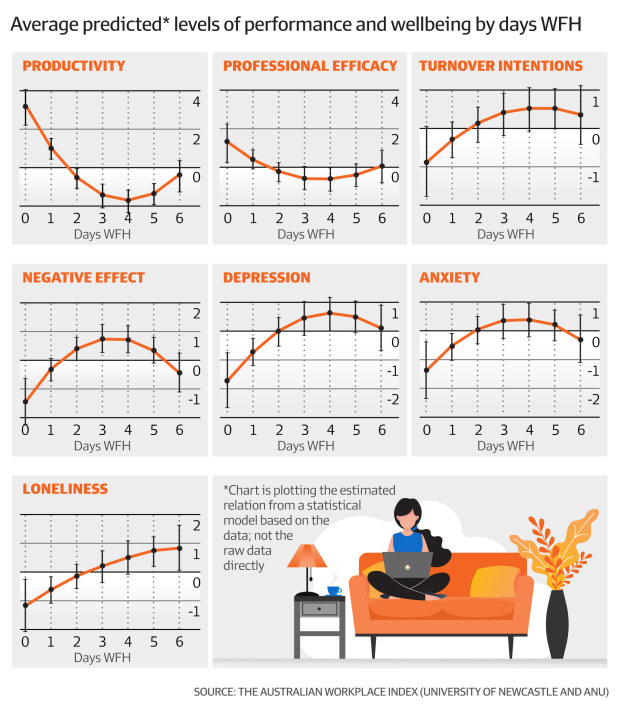
WFH made us less productive on average
The slight improvement on day five meant that people who worked remotely full-time were about as productive as those who worked in the office two days a week, but not as productive as those working in the office three or more days each week.
Report co-author Kieron Meagher, an economics professor at ANU, said that while some studies found working from home had increased the productivity of software engineers and other occupations that required a high degree of focused or independent work, his research found “the outcomes were much more negative” when a wider variety of white-collar occupations were studied.
“We found that productivity and professional efficacy both dropped when people were working from home more,” Professor Meagher said.
But he told The Australian Financial Review that good job design and better managers helped soften these effects.
Better managers could fix it
“If your manager makes your job suitable for working from home – provides you with support, makes sure there isn’t conflict and there’s lots of co-ordination with coworkers – then those negative effects start to go away,” Professor Meagher said.
“And presumably, they could go away entirely if an organisation handled it well enough.”
The study, which did not investigate other potential benefits such as fewer sick days, more time spent with families and less time commuting, found that improving working conditions by giving workers more manageable workloads, greater autonomy and more support from supervisors significantly improved performance and wellbeing outcomes.
It was based on online surveys that asked random samples of Australian employees how many days a week they worked from home or a location other than their main workplace. These employees were then required to say how much they agreed with a series of statements and to answer questions such as, “How much did you accomplish today based on what you planned to accomplish?”
Women and educated workers were overrepresented in the sample. And respondents were mostly required to give answers on so-called Likert Scales, where 0 could mean “strongly disagree” or “none of the things I had planned”, and 10 could mean “strongly agree” or “all the things I had planned”.
The researchers, who also included Christina Boedker from the University of Newcastle and Aeson Luiz Dela Cruz from Macquarie University, used these responses to determine how the number of days each week an employee worked from home affected everything from average levels of anxiety and depression to average turnover intentions and average self-assessed productivity.
Remote work can ‘enhance productivity’
It comes after a study from Swinburne University last year found that hybrid working had clear benefits for employee wellbeing, but employers had to tailor their approach to the needs of individuals and provide ongoing support to get the most out of it.
Sean Gallagher, who co-authored that report and is the director of Swinburne University’s Centre for the New Workforce, told the Financial Review that companies must introduce more structure to their hybrid working models.
“[Our] own research finds that designating certain days for remote work can enhance individual productivity, particularly when it involves routine business-as-usual, task-based work,” Dr Gallagher said.
“Deep, focused work also thrives in these conditions. Yet, for more interactive, collaborative endeavours focused on complex work, the office environment is irreplaceable.”
[ad_2]
Source link