Amazon’s Alexa unit has historically been unprofitable, losing billions of dollars since its introduction in 2014 — but AI could help turn things around.
According to a Friday Reuters report citing eight sources “with direct knowledge” of Amazon’s plans, including current and former Amazon employees who worked on the voice assistant, Amazon is considering putting a higher AI-powered Alexa behind a subscription paywall.
Amazon is currently working on upgrading the free version of Alexa to one with AI capabilities, per Reuters, and plans to add a higher, subscription level of the voice assistant that can process more complex AI prompts.
The two levels of Alexa are internally known as the “Remarkable Alexa” and the “Classic Alexa.” Sources told Reuters that Amazon has thought about a $5 to $10 per month subscription for “Remarkable Alexa” to differentiate the two.
“Classic Alexa” will remain free, according to the report.
If implemented, the subscription would be the first major reframing of the voice assistant since Amazon introduced it.
 Amazon Echo Show 8 previewing new Alexa AI features. Credit: Al Drago/Bloomberg via Getty Images
Amazon’s Echo smart home devices with Alexa have been surprise hits since they launched, but a 2022 BI report showed that even though they’re bestsellers, most of them sold at cost.
Related: Amazon Swaps Plastic Pillows For Paper Shipping Materials
Amazon already previewed a generative AI version of Alexa in September and showed off how the voice assistant could talk with more personality and take in more context.
Amazon stated then that it had sold more than half a billion devices with Alexa and that AI features “will be available to Alexa customers in the U.S. soon.”
[ad_2]
Source link
Multi-billion dollar AI community startup Hugging Face announced its fourth acquisition to date on Thursday, a $10 million buy of a small AI collaboration platform called Argilla.
Hugging Face CEO Clément Delangue now says he’s getting acquisition requests from many more startups — at least 10 a week.
“This year, in particular, it has increased quite a lot,” he told Bloomberg.
 Clément Delangue, CEO of Hugging Face. Tom Williams/CQ-Roll Call, Inc via Getty Images
Hugging Face lets developers openly share and test AI models that anyone can use, and has partnered with companies like Google and Microsoft. The company claims to have over a million AI models, datasets, and apps on its platform.
After a $235 million August funding round, with investments from Amazon, Nvidia, Intel, and other big tech names, Hugging Face is now valued at $4.5 billion.
Delangue’s remarks that he sees more AI startups looking to be acquired could signal that the AI industry is consolidating, or entering the stage when competitors begin merging, per Bloomberg.
Related: Unicorn Founders Launch AI Business Credit Score Startup
Huge tech companies have been quietly acquiring AI startups recently. According to a February report from portfolio management company Stocklytics, Apple has made the most AI startup acquisitions compared to its peers, buying 32 startups last year and at least one more this year.
Google bought 21 AI startups and Meta acquired 18, per the same report.
AI stood out last year as one of the best-performing industries for unicorn, or billion-dollar valuation business, growth.
A February Morningstar report found that more than four of every 10 startups that became a unicorn in 2023 focused on AI and machine learning.
Related: Want to Start a Billion-Dollar Business? Look to These Two Industries
[ad_2]
Source link
After endless rumors, Apple has finally revealed how it’s upgrading the iPhone with a jolt of AI.
Apple, the largest smartphone maker in the U.S., held its annual Worldwide Developer Conference on Monday and announced “Apple Intelligence” at the event, or AI for the iPhone.
It’s also partnering with OpenAI to bring ChatGPT to Apple products, starting with OpenAI’s newest GPT-4o model.
 Apple CEO Tim Cook at the Apple Worldwide Developers Conference (WWDC) on June 10, 2024 in Cupertino, California. (Photo by Justin Sullivan/Getty Images)
Apple’s new AI upgrades Siri and allows the voice assistant to work inside apps to get things done. For example, Siri will soon be able to search through your photos, find a picture of your driver’s license, extract the numbers, and put it in a web form for you.
Another new feature, Genmoji, means that iPhone users can generate emojis from a written prompt on their phone keyboard.
“What’s truly unique” about Apple Intelligence “is its understanding of your personal context,” Apple senior vice president of software engineering Craig Federighi said.
In one example, Apple’s new AI will be able to rank notifications on the lock screen to minimize distractions and put higher-priority notifications first.
ChatGPT in your iPhone will be able to answer prompts that Siri can’t while keeping user info and questions private, according to Apple.
Related: OpenAI’s New ChatGPT Sounds Almost Human in Latest Update
Apple’s new private cloud compute safeguard for its AI “sets a brand-new standard for privacy,” according to Federighi.
Under the standard, Apple processes AI requests locally, on devices, as much as it can; it only sends relevant data to servers the company created.
Apple says it never stores data.
This is the first time Apple has announced “profound new intelligence capabilities,” as CEO Tim Cook called it. However, Apple has already made internal improvements to one product lineup to support AI.
In May, Apple announced an all-new M4 chip, which Apple vice president of platform architecture Tim Millet called an “outrageously powerful chip for AI.”
Related: Apple Event: New iPad Pro Looks, Acts Like a MacBook Air
The chip powers Apple’s new line of iPad Pros.
iPads will also be getting a calculator app for the first time in 14 years with Apple Pencil support, Apple announced at WWDC. Users can write down or sketch out math problems on the calculator and have the app solve them.
Schedule Texts, Hide Apps
iPhone users will also soon be able to take advantage of a new software update, iOS 18.
The new iOS 18 will allow users to lock an app with FaceID on their iPhone and hide apps entirely from the home screen — plus schedule text messages to send later, and add any emoji or sticker to a text to respond.
iOS 18 also means that iPhone users can customize the home screen with new colors and place apps in new places along the screen.
Apple is officially adopting RCS (Rich Communication Services) on its iPhones, which means that Android phones will be able to send high-quality photos and videos to iPhones.
Related: How to Present Like Steve Jobs at Apple Developers Conference
A public beta of iOS 18 will come out in July, and the general public will get to use it starting in September.
[ad_2]
Source link
By Marcia Savage, SAP
Studies show that socially conscious consumers are willing to pay more for goods from brands that are committed to environmental sustainability. Would they do the same for products that are AI-free?
Gartner predicts that by 2027, 20% of brands will lean into differentiating themselves predicated on the absence of artificial intelligence in their business and products.
31% of U.S. B2B marketers use AI for chatbots, coding, and design, according to a Sagefrog Marketing Group survey. Another 30% use AI for content and presentations.
getty
In other words, if consumers question the authenticity of marketing materials and ads containing AI-generated content, savvy CMOs could build marketing strategies around the absence of AI images or text.
That approach to AI and marketing wouldn’t come out of nowhere. In fact, Americans are now more concerned than excited about AI in their daily lives, a Pew Research Center survey found. And 72% of consumers are worried about AI-based content potentially spreading false or misleading information, according to Gartner. This mistrust will lead some to seek out AI-free brands, the firm believes.
“A subsection of brands will shun AI and prioritize more human positioning. This ‘acoustic’ concept will be leveraged to distance brands from perceptions of AI-powered businesses as impersonal and homogeneous,” said Emily Weiss, a senior researcher at Gartner.
AI and marketing stats
Sounding these kinds of alarm bells now might feel premature given that AI is still emerging in most marketing plans. But that’s changing faster than many people realize.
Consider these numbers:
- Roughly 80% of CMOs reportedly plan to boost spending on AI and data this year, up 57% from last year, an Accenture survey found.
- 31% of U.S. B2B marketers use AI for chatbots, coding, and design, according to a Sagefrog Marketing Group survey. Another 30% use AI for content and presentations.
- More than a third (35%) of CMOs use generative AI as part of their everyday toolkits, according to an annual survey by global digital network Dentsu Creative.
Nicole Leffer, an independent CMO AI advisor, says such stats prove the train has left the station for the adoption of AI in marketing and that trying to differentiate around not using it would be ill advised.
Leffer argues the significant cost and time savings that AI automation brings organizations – which some studies indicate could be more than 50% – means companies that avoid AI would eventually have to charge more than competitors who do use it. While some CMOs might take that path, she doesn’t believe the approach is sustainable.
“People are already adjusting to the idea of AI in their lives,” she says. While they might be willing to pay extra money for a product that’s green, protects the planet, and saves future generations, she doesn’t see consumers doing the same for AI-free products.
Setting AI guardrails in marketing
While experts say CMOs would be almost foolhardy to let AI opportunities pass them by, they advise establishing some general guardrails for AI-generated content, such as only using:
- Real human beings: While it’s been common marketing practice to leverage digitally created characters or avatars in content, AI presents some scary opportunities for creating deep fake images that are indistinguishable from the real thing. Marketers might want to consider avoiding that approach or being completely transparent if they do employ faux people.
- Real products: The blowback from misrepresenting how a product looks or acts by using AI could be significant. Regulators could even view it as false advertising. Be careful with this and have firm and transparent policies around it.
- Meticulous verification: AI can be incredible, but it does have issues, namely its tendency to fill in holes in its training by making stuff up. It’s similarly prone to bouts of plagiarism as well as race, gender, and political biases. As such, no marketing or advertising executive should include AI-generated content if it hasn’t been thoroughly checked by humans.
Treading the unknown
There will be growing pains as marketers experiment with AI and push the bounds of written, audio, photographic, and video content authenticity, Leffler says. It’s not yet known, for example, how consumers might react to a television commercial featuring AI-generated human beings or AI representations of products.
“There’s a huge difference between not using AI for specific applications like this that could be viewed as misrepresenting the reality of what you’re selling, versus not using AI to help with anything,” she says.
All that’s really known is that these AI technologies are emerging so fast it will be difficult to stop and consider their ethical implications in real time.
Still, it’s important that CMOs begin investing in AI today, if they aren’t already, because the technology is going to change their world.
“If you wait another year, you’re going to be seriously behind,” Leffler says. “The pace at which this is growing and changing is unlike anything else marketers have experienced, so do it now.”
This story was originally published on The Future of Commerce.
[ad_2]
Source link
By Aakrit Vaish
In the dynamic world of marketing, understanding your customers and tailoring your strategies accordingly is the cornerstone to achieving success. Traditional approaches to customer segmentation have their limitations, but with the advent of artificial intelligence (AI), businesses can now take their customer understanding to new heights. AI-driven customer segmentation has emerged as a game-changer, empowering businesses to extract deep insights from vast amounts of data and optimise their marketing efforts like never before.

Today, AI is revolutionising brand marketing strategies by enabling businesses to gather and analyse vast amounts of data, extract actionable insights, and deliver personalised experiences to their target audiences. The impact can be seen across various areas of marketing. Let’s explore some compelling use cases that demonstrate how AI is transforming brand marketing:
- Personalised Recommendations: One of the most significant advancements in brand marketing is the ability to provide personalised recommendations to customers. Companies like Amazon and Netflix use AI algorithms to analyse customer preferences, browsing behaviour, and purchase history to offer tailored product or content recommendations. This level of personalisation enhances customer satisfaction, increases sales, and fosters customer loyalty.
- Targeted Advertising: AI-driven customer segmentation allows brands to precisely target their advertisements to the right audience. Platforms like Facebook and Google use AI algorithms to analyse user data and behaviour, enabling brands to deliver ads to users who are most likely to be interested in their products or services. This targeted approach maximises ad spend efficiency, improves conversion rates, and enhances overall marketing effectiveness.
- Content Creation and Optimisation: AI technologies are streamlining content creation and optimisation processes for brands. For instance, tools like Wordsmith and Articoolo use AI algorithms to generate written content, such as news articles or product descriptions, based on predefined templates and data inputs. AI-powered tools also help optimise content by analysing user engagement metrics, recommending improvements, and automating A/B testing to identify the most effective content variations.
- Social Media Analysis: AI plays a crucial role in analysing social media data to understand customer sentiment and brand perception. Brands can use AI-powered tools to monitor social media platforms and identify trends, sentiments, and conversations related to their products or services. By gaining real-time insights, brands can proactively engage with customers, address concerns, and manage their online reputation effectively.
- Voice-activated Assistants: Voice-activated assistants like Amazon’s Alexa, Apple’s Siri, and Google Assistant have become increasingly popular, providing brands with new marketing opportunities. Brands can develop voice-activated skills or actions that offer personalised recommendations, make purchases, or provide valuable information to users. These AI-driven voice assistants enable brands to engage with customers in a hands-free, intuitive manner.
- Predictive Analytics: AI-powered predictive analytics helps brands forecast customer behaviour and make data-driven marketing decisions. For instance, retailers can use AI algorithms to analyse historical sales data, customer preferences, and external factors to predict demand and optimise inventory management. This ensures products are available when and where customers need them, reducing costs and enhancing customer satisfaction.
These use cases demonstrate how AI is revolutionising brand marketing strategies, allowing businesses to deliver personalised experiences, optimise advertising efforts, streamline content creation, enhance customer service, and make data-driven decisions. By leveraging AI technologies effectively, brands can stay ahead of the competition, drive customer engagement, and achieve marketing success in the digital age.
Now let us delve on the various facets revolving around the use of AI for carving effective marketing strategies.
The Importance of Customer Segmentation
Customer segmentation lies at the heart of effective marketing. By dividing your customer base into distinct groups based on shared characteristics, behaviours, and preferences, you can target your marketing efforts with precision. It allows you to create personalised experiences and deliver the right message to the right audience at the right time. Traditional segmentation approaches, however, often fall short in providing the level of granularity and accuracy required in today’s competitive landscape.
The Rise of AI in Customer Segmentation
Enter AI, armed with machine learning and data analytics capabilities. AI has transformed the way businesses approach customer segmentation, enabling them to analyse vast amounts of data and extract valuable insights. This advanced technology can uncover hidden patterns, identify trends, and reveal behavioural nuances that were once beyond human comprehension. The power of AI lies in its ability to process data at scale and continuously learn from it, making it an invaluable tool for marketers.
Benefits of AI-Driven Customer Segmentation
The advantages of AI-driven customer segmentation are manifold. Firstly, it offers increased accuracy by leveraging advanced algorithms that can detect intricate patterns and relationships within data. Secondly, AI-driven segmentation is highly scalable, allowing businesses to process and analyse massive datasets efficiently. Moreover, AI eliminates manual effort, enabling marketers to focus on strategic decision-making rather than time-consuming data analysis. Real-world examples abound, showcasing how companies across various industries have achieved remarkable results through AI-driven customer segmentation.
Advanced Techniques in AI-Driven Customer Segmentation
AI-powered customer segmentation employs a range of advanced techniques that push the boundaries of traditional segmentation. These techniques include clustering algorithms, predictive modelling, and natural language processing. Clustering algorithms identify distinct customer groups based on similarities, enabling businesses to create targeted marketing campaigns. Predictive modelling utilises historical data to forecast customer behaviour, helping businesses make data-driven decisions. Natural language processing allows companies to analyse customer feedback and sentiments, gaining valuable insights into preferences and satisfaction levels.
Leveraging AI-Driven Insights for Effective Marketing Strategies
The insights derived from AI-driven customer segmentation hold immense potential for crafting effective marketing strategies. Armed with a deep understanding of customer preferences, businesses can tailor their messaging, offers, and recommendations to resonate with each segment. This level of personalisation fosters stronger customer engagement, boosts conversion rates, and drives business growth. Targeted marketing campaigns based on AI-driven insights have proven to be highly effective, leading to increased customer satisfaction and brand loyalty.
Addressing Ethical and Privacy Concerns
As with any technological advancement, AI-driven customer segmentation raises ethical and privacy considerations. Businesses must handle customer data responsibly, ensuring compliance with privacy regulations and maintaining transparency in data usage. Ethical considerations include avoiding discriminatory practices and using customer data for the benefit of both the customer and the business. Striking the right balance between personalisation and privacy is paramount.
Best Practices for Implementing AI-Driven Customer Segmentation
Implementing AI-driven customer segmentation requires a strategic approach. Businesses should prioritise data quality and invest in data integration to ensure accurate insights. Additionally, cross-functional collaboration is crucial, involving teams from marketing, data analytics, and IT to maximise the value of AI-driven segmentation. Continuous monitoring and evaluation are essential to refine and optimise segmentation models over time.
Success Stories of AI-Driven Customer Segmentation
Several companies have already reaped the rewards of AI-driven customer segmentation. For instance, a leading e-commerce retailer utilised AI algorithms to identify distinct customer groups and tailor their marketing messages accordingly. This resulted in a significant increase in customer engagement and conversion rates. Similarly, a global telecommunications provider used predictive modelling to identify customers with a higher propensity to churn, allowing them to implement proactive retention strategies and reduce churn rates.
AI-driven customer segmentation has revolutionised the way businesses understand and engage with their customers. The benefits of AI, such as enhanced personalization, targeted marketing, and improved customer retention, are invaluable in today’s competitive landscape. However, businesses must navigate ethical considerations and prioritise data privacy. By adopting best practices and constantly learning from successful case studies, companies can unlock the full potential of AI-driven customer segmentation and gain a competitive edge in the market.
[ad_2]
Source link
This article originally appeared on Business Insider.
Businesses are struggling to attract talent and wages are a part of the problem. But pay isn’t the only reason employers are finding it hard to retain workers. Artificial intelligence may be another factor.
Over the past few months, I’ve applied to five fast food jobs: Crumbl Cookies, McDonald’s, Wendy’s, Hardee’s, and Waffle House. I successfully landed a part-time job as a server at Waffle House and it was the only one with a human point of contact during the application process.
Claypool started her job at Waffle House 48 hours after her interview. Courtesy of Amanda Claypool
Almost immediately after I applied for a job, using the Waffle House website, I got a call from a hiring manager to schedule an in-person interview. Forty-eight hours after I reported to that interview I was starting my first training shift.
Unfortunately, the jobs that made me apply with AI chatbots left me annoyed and uncertain.
McDonald’s hiring process
McDonald’s uses AI chatbots to automate its hiring process, but it made things more complicated.
I applied to McDonald’s and answered the questions the chatbot named Olivia asked me. Most of them were screening questions: “what is your name,” “are you legally allowed to work in the United States,” and “when are you available to work.” Once the chatbot deemed I was qualified it was supposed to schedule me for an interview, but it didn’t.
Claypool communicated with a chatbot during the pre-interview process for McDonald’s. McDonald’s
Instead of setting up an interview, the chatbot asked how it could further assist me. This left me confused. I asked it again how to apply for a job at McDonald’s and it responded by providing me with a generic corporate email address.
Claypool did not receive a job application from McDonald’s. McDonald’s
AI chatbots are still in their infancy. Even though they should guide applicants through the process, they’re still prone to problems and not everyone understands how to use AI. I can only imagine how an applicant who isn’t tech savvy or may not speak English as a first language might feel in a similar situation.
Wendy’s hiring process
The Wendy’s chatbot had no problem scheduling me for an interview.
When I arrived at my Wendy’s interview, I discovered the chatbot hadn’t communicated my availability to the hiring manager. At this particular location, they were only hiring for the breakfast shift on the weekends. I was looking for a shift in the evenings.
The interview was scheduled for 30 minutes. It lasted five. The hiring manager asked me several times if I was sure I couldn’t work on Saturday mornings. I was sure. Before I left, he jotted down my number and told me he’d give me a call if anything opened up. He never called.
Crumbl Cookies’ hiring process
The automated application process at Crumbl Cookies seems short, but it wasn’t easy.
I applied to be a baker at Crumbl Cookies. Of all the places I applied to, this application was the shortest. It only had three sections and the application portal only asked for my availability and contact information.
Many online job applications are complex, but this was a relief.
Crumbl Cookies
Even though it was short it wasn’t as simple as I had initially hoped. After I completed the form, I received an email instructing me to text a phone number. When I did that, I was sent a link to fill out another application.
Crumbl, like a lot of the places I applied to, uses a third-party platform for recruiting. The second application asked me to create a general profile and fill out other fields, including a video cover letter for the recruiting platform.
HigherMe
Once the second application was submitted I thought I was done, but I wasn’t. I received an email alert that said I had to register my “applicant profile.”
The process started out simple, but the further I went the more complicated it became. I was shocked to receive a third email outlining additional conditions, which included working a minimum of 18 hours each week for an hourly rate of $9.50 plus tips.
I wasn’t informed of these requirements at any point in the application process and I had to accept the conditions before I could be offered an interview. Had I known the information sooner, I wouldn’t have even wasted my time with the application.
After about 30 minutes of applying for the job, I decided not to move forward with the interview.
Hardee’s hiring process
I applied for a job at Hardee’s which uses the same AI chatbot as Wendy’s and McDonald’s.
The Hardee’s AI initially scheduled me for an interview on a Friday afternoon. On the day of the interview, I received an automated reminder with an option to reschedule. I wanted to see what that experience would look like so I decided to change my interview time.
I rescheduled the interview for the following Monday which happened to be Memorial Day. I was surprised by the open availability I was given to reschedule an interview — especially on a holiday.
My gut told me a hiring manager probably wouldn’t be at the restaurant. I was right.
When I arrived a worker told me the manager wouldn’t be back until Wednesday. The worker didn’t consult the chatbot’s scheduling system — or her manager’s availability — she just told me to come back on Wednesday morning at 10 a.m.
Aside from the chatbot, I had no one to reach out to and confirm a new interview time. I decided it wasn’t worth the effort of returning and hoping the manager would be available.
Automation seems like a good solution for a lot of problems, but that doesn’t always mean it’s the right solution
The nationwide labor shortage is really a problem of connecting available workers to employers that need them, but AI chatbots don’t always fix this.
To be fair, AI chatbots can make it easier to screen applicants and schedule interviews. But the chatbots I encountered made it harder for me to schedule a successful interview, let alone get the job. I was left confused and unsure about the status of three applications at three different restaurants — this doesn’t help managers.
Adding more human contact, rather than less, could be one way to solve the problem. Or at the very least, make it easier for applicants to apply for a job.
[ad_2]
Source link
Adapt or die: 3 things businesses must do to avoid becoming irrelevant in the AI revolution
Describing artificial intelligence as a disruptive technology is a colossal understatement. We are entering an AI boom, with AI-ification happening across industries globally. The big players are all getting involved, many have played their hand and the others are still working away behind the scenes. Dropbox just laid off 500 people to focus on AI, Apple is reportedly about to launch something. It’s all kicking off.
Businesses are facing an adapt or die dilemma, some for the second time in three years.
What’s happening right now has a similar theme to Covid-19, where businesses were forced to make better use of technology to stay afloat during a few years of lockdowns and restricted travel. To thrive in that crisis, you had to think smart, lest you fell behind or became irrelevant.
Why businesses must act on artificial intelligence
Adapting during 2020 came out of necessity. Doing so meant escaping obsolescence. Now it’s not quite the same, or is it? Bill Gates famously called artificial intelligence the next big revolution, and he thinks AI will teach children to read and write within the next 18 months. There’s no doubt that AI is creating new opportunities, but is it removing them for those who don’t act?
Like with those technologies of the past that completely changed the playing field, sceptics will need to quickly change their views. Maybe you think your business or industry won’t be affected. Maybe you think this fad will simply pass by, like affiliate marketing or crypto. Maybe you think AI advancements are nothing but science fiction, and it’ll be another century before any of this really takes hold.
If you’re in the camp of ignorance or denial, you need to revisit your views and understanding of AI. If you’re still unclear on the power of ChatGPT 4, created by OpenAI and just one of the AI tools being used by entrepreneurs who want to get ahead, watch OpenAI cofounder Greg Brockman’s TED talk on just what their technology can do.
If you’re struggling to see how artificial intelligence will change your business, you need to think more creatively about how your competitors, new entrants to your field, or even your customers will replace part or all of your services in the future. Here are three things to do ensure you adapt rather than die.
1. Do more research about AI
Start from the bottom with a beginner’s mind and find out the state of AI in your industry. What are people using it for, how and why? These people won’t be discussing it on LinkedIn or presenting on stage, they’ll be gathering tips in forums and chatting with friends. They’ll be building prototypes, running experiments and taking new opportunities to become AI entrepreneurs. The AI entrepreneurs who emerge in your industry will be the winners who take all.
As an established business, you hold advantages over new players in the industry, but only for so long. If someone offers a product nearly as good as yours for a fraction of the price, you’re fighting a losing battle. With sufficient research, you’re able to see what some of the smartest minds in the world are thinking about. Use this to figure out how you combat potential competitors and see where you could invest in AI yourself.
2. Go back to first principles
To imagine the role of artificial intelligence in your business, go back to basics with how it operates. Answer the simple question: what is your business here to do? What is the true value it delivers for customers? Why does your business even exist? Go deeper and keep going until you’re at the simplest explanation, likely in the format, “I create [outcome] for [audience].”
Now, your job is to figure out how to achieve the same outcome, for the same people, but in the most effective way possible, using every tool available. Armed with your first principles, which will remain largely unchanged through the AI revolution, you can reimagine how you operate and deliver value. Can you deliver the same result but faster or cheaper by integrating AI? Can you deliver a better product or service using the power of AI? Find the value and pass it onto your customers.
Adapt or die: 3 things businesses must do to avoid becoming irrelevant in the AI revolution
3. Start integrating AI into your processes
One option is to go all in with artificial intelligence, another is to take baby steps. While letting others take the risks and seeing where you land might work, you will still want to get involved on some level. This means that even if you’re not about to launch a bunch of tools and use AI to completely revolutionize your business, you should think about how existing tools can help you create more output. While you don’t have to overhaul everything immediately, you should become familiar with the scope of AI, and experiment with it within your business.
Ignoring this will mean you become an observer and then a user, not a creator and a leader. No one else is going to incorporate AI into your business for you. They’ll simply see you as a potential future client of theirs. If a tiger began to chase you, would you rather already be running away, or standing still, waiting for it to get close? A little experience and understanding gives you huge advantages over those who are burying their heads in the sand, not even trying to understand how it works or how they can use it.
This revolution is not going away. Similar to the essential pivoting that took place during 2020, entrepreneurs cannot ignore what artificial intelligence is going to do to businesses. Do you want to do what everyone else is doing; reading the news and observing the hype, or do you want to make your mark and reap the benefits that the first movers are already seeing? Before you declare it’s not for you and turn a blind eye, do some research, go back to first principles, and look to see where you can integrate the technology.
[ad_2]
Source link
Ashton Kutcher is all for the AI revolution.
The actor-turned-entrepreneur just launched a $240 million AI investment fund, Sound Ventures AI Fund, with music manager Guy Oseary, and he says other companies need to hop on the artificial intelligence bandwagon if they don’t want to be left behind.
“If you’re a company, and you’re sleeping on this, you’re probably going to be out of business,” Kutcher said while discussing ChatGPT during a panel at the Milken Institute’s Global Conference, per Business Insider. “It’s that good and that powerful from a utilization standpoint.”
He continued to explain how AI has the “promise” and “potential” to impact a variety of industries, like allowing more access to education, medical, legal, and other personalized services at a lower cost.

Image credit: Jerod Harris | Getty Images – Ashton Kutcher speaking during a panel at the Milken Institute’s Global Conference
“I look at AI as an equity and inclusion play that is massive,” he added.
So far, Sound Ventures’ investment portfolio includes OpenAI, Anthropic, and StabilityAI.
“We believe this is potentially the most significant technology we will experience since the advent of the internet,” Kutcher said in a statement to Variety following the news of his latest endeavor. “The foundation model layer companies are defining the category, and, in our view, they have the power to transform businesses and everyday life. That is a conversation we want to be in.”
Prior to launching the AI Fund, Sound Ventures was founded in 2015 and manages $1 billion in assets with notable investments from Airbnb, Uber, and Affirm.
What Is Ashton Kutcher’s Net Worth?
In conjunction with his various business endeavors and his successful acting career, Kutcher has an estimated net worth of $200 million.
[ad_2]
Source link
In our ever-expanding digital world, passwords are an inevitability: email, apps, subscriptions and loyalty programs — nearly everything is designed to be secure behind a self-set code that permits entry. According to technology site TechCo, the average person has about 100 passwords, so it’s no surprise that when signing up for a new account, individuals can sometimes get lazy with word choice. However, there’s a new risk to password vulnerabilities: artificial intelligence.
A new report by Home Security Heroes found that 51% of common passwords can be cracked in less than a minute using an AI password cracker, and 81% can be cracked in less than a month.
Home Security Heroes used the AI password cracker PassGAN to run through a list of 15,680,000 passwords. The odds of AI decoding one’s password increase when a password has a minimal amount of characters and lacks variety (only using lowercase, only using numbers, etc.). Still, it found that it took PassGAN less than six minutes to crack a password of seven characters, even when it contained symbols.
Related: Elon Musk Says We Should Stop Rapid AI Development Right Now — Here’s Why
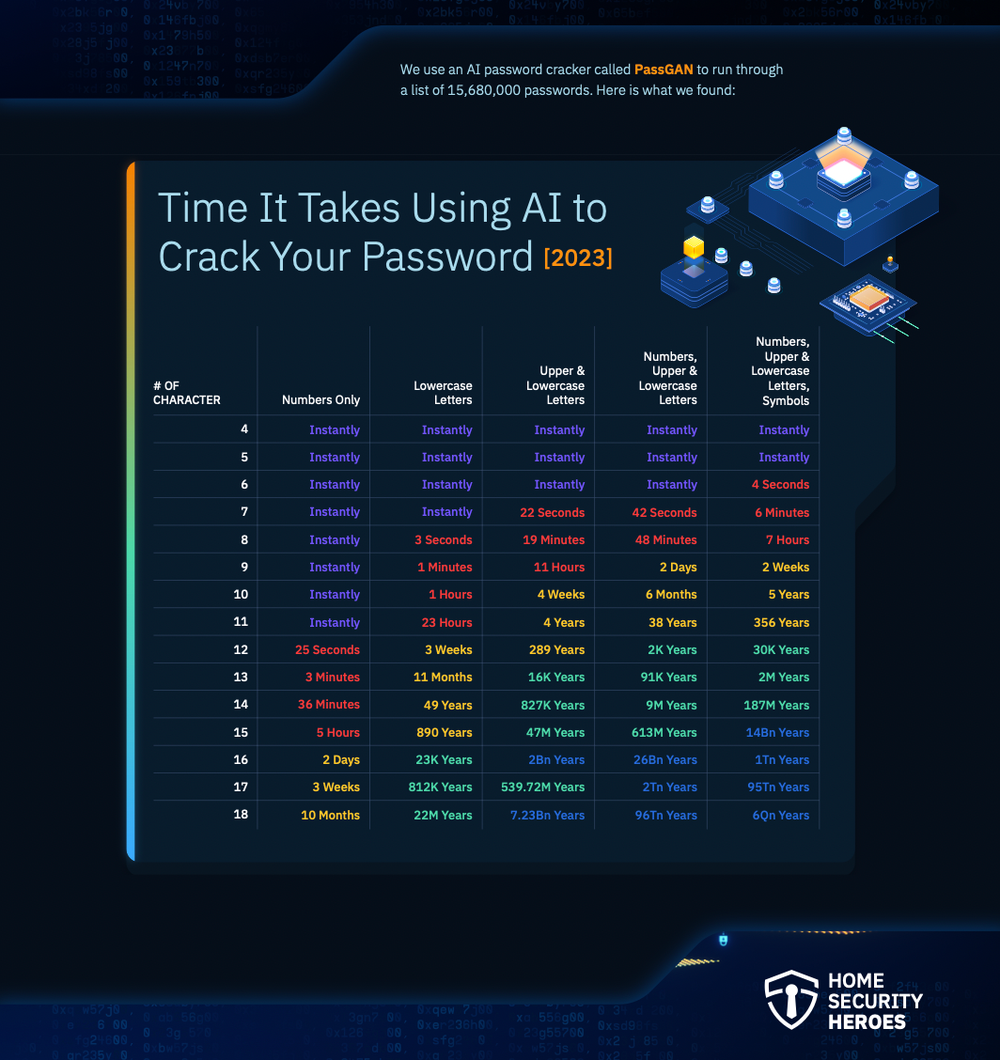
How to set a password that’s safe from AI:
According to Home Security Heroes’ findings, it takes AI significantly longer to crack a password with more characters and variety. In essence: The longer the password and the more letters, numbers and symbols you use, the safer it is from AI.
A password with 14 characters composed of upper and lower case letters, symbols and numbers takes AI an average of 187 million years to crack, as opposed to a password of seven characters composed of just upper and lower case letters — which takes AI an average of 22 seconds to crack.
Although it might be more time-consuming, if you want to ensure password security as AI technology advances, it’s best to keep your passwords at least 10 characters long, with some combination of upper and lower case letters, symbols and numbers.
Related: How AI Is Shaping the Cybersecurity Landscape — Exploring the Advantages and Limitations
[ad_2]
Source link
Opinions expressed by Entrepreneur contributors are their own.
ChatGPT is everywhere, but we are only scratching the surface of the potential for such generative artificial intelligence (AI) capabilities. There are incredibly exciting opportunities for its role across innovation and research and development (R&D) just underneath the surface. Determined to find the answer, our innovation team dug deeper.
If you haven’t already begun experimenting or implementing the generative language model developed by OpenAI into your business processes, you’ve at least heard of ChatGPT. The chatbot has garnered significant attention in the AI community and beyond due to its human-like and conversational abilities—the service reached 100 million users in less than two months.
While the true threat or promise of generative AI will continue to be debated, it is more than certain that businesses can unlock real value for innovation by leaning into the application’s advanced language processing capabilities. New levels of consumer insights, more efficient processes and faster ways of working are just beneath the surface. To put the tool to the test, we used ChatGPT to simulate how we might drive new product development.
Related: Here’s How Your Business Can Use 3 Popular AI Content Creation Tools
1. The ideation process: quality input yields a quality output
The answer you’re looking for depends on how you frame the question. Not as simple as it sounds! ChatGPT leverages a massive body of data from across the internet (over 570GB of data —approximately 300 billion words) to quickly answer user questions. And the question’s specific phrasing, wording, and context significantly influence the response.
Say you are looking for the next great innovation in laundry for a consumer products company. According to a report by Grand View Research, you already know that the global market for laundry care products is expected to grow at a compound annual growth rate of 4.9% from 2021 to 2028 (ChatGPT could also tell you this if you didn’t know). You could simply ask, “What will be the next disruptive laundry product?” ChatGPT will then list a few potential directions for disruptive laundry products like sustainable laundry solutions, smart laundry devices, multi-functional products, etc. The response is interesting and might help affirm some initial thinking, but probably nothing you didn’t already know.
But what if you tried a more creative angle like, “What do people love about laundry?”. This question is not as intuitive. But the insights from ChatGPT are potentially much more interesting and lead you to build a deeper understanding of consumer behaviors and emotions to anchor the next great innovation or product design.

Image credit: Francesco Fazio | openai.com/blog/chatgpt
Questions that lead to more questions lead to potential insights. This is the true power of a tool like ChatGPT. But it all starts with the question, and it pays to think about exactly what you want to know and how to frame the question.
Related: What Does ChatGPT Really Mean For Businesses?
2. The discovery process: less time researching and more time thinking
Underlying all innovation is discovery, from contextual (market research, trend analysis) to behavioral (ethnographic immersion). It is essential but incredibly time-consuming.
ChatGPT can do in seconds what traditional research might take hours and days—quickly gather information on a wide range of topics, sort through the data, and provide a view of what is important and what isn’t. Say you thought of four potential ideas for new laundry products, and now you want to gauge their relative attractiveness. You can ask ChatGPT to rank them for you based on their potential appeal to customers and even go further by asking ChatGPT to think about the types of customers that these ideas would most appeal to.

Image credit: Francesco Fazio | openai.com/blog/chatgpt
Just like the internet made encyclopedias obsolete, ChatGPT is turning traditional research on its head. In a matter of seconds, ChatGPT was able to rank new product ideas and provide a point of view of appeal by customer segment. This shortcuts the initial, more time-consuming research and allows you to go deeper into more specific areas of interest and shift your focus to higher-order tasks.
Related: Will ChatGPT Become Another Race to the Bottom in Marketing?
3. Preparing to go in market: accelerating the creative process
Companies are already starting to use generative AI to handle most basic and transactional customer interactions. But ChatGPT can also lean into the more creative process as well. Want to brainstorm copy for a marketing campaign? Or draft your new company’s mission statement? Or create a starter list of KPIs for your growing sales team? ChatGPT can quickly help you get started.
For example, let’s say you have built a new stain removal product and are ready to launch in market. Using ChatGPT, you can quickly brainstorm potential concepts for marketing campaigns and help draft advertisement copy. Your creative team now has a starting point to evaluate further and refine. Let’s say your team aligns on a campaign centered on eco-friendliness, ease of use, and stain-removing power. You can go a step further and ask ChatGPT to create compelling posts for social media. Here’s what you’d get:

Image credit: Francesco Fazio | openai.com/blog/chatgpt
Not bad, huh? Seeking opportunities to implement generative AI in tasks like these can help significantly accelerate and enhance your go-in-market strategy.
Generative AI and the future of innovation
The applications for generative AI do not just have potential; they are already changing the game’s rules for innovation. New concept development, accelerated research and discovery, and go-to-market strategy are just a couple of opportunity areas to leverage generative AI.
However, it’s not going to replace human decision-making. We know that the massive body of data used by generative AI tools is already available content. In fact, the data underlying ChatGPT is only current up to 2021. So not only is it somewhat dated, but it also can’t replace true primary research.
As long as you know the data you are working with and its strengths and limitations, generative AI’s abilities can still be incredibly powerful. And how much benefit it can provide comes down to knowing what questions to ask, where to dig deeper, and how to translate that knowledge into real action.
[ad_2]
Source link