Advisors with a defined marketing strategy falls to the lowest rate in five years (20% in U.S.), yet confidence in meeting practice goals remains high
Less than half of U.S. advisors currently use or plan to use generative AI for marketing, compared to 56% of Canadian advisors
NEW YORK and TORONTO, Feb. 7, 2024 /PRNewswire/ — As macroeconomic volatility has led to an influx of investors seeking financial advice, advisors are increasingly looking to next-generation technology such as generative AI to address their marketing challenges and meet the increased personalization expectations of prospects and clients, according to global Fintech leader Broadridge Financial Solutions, Inc. (NYSE: BR) annual financial advisor marketing survey.
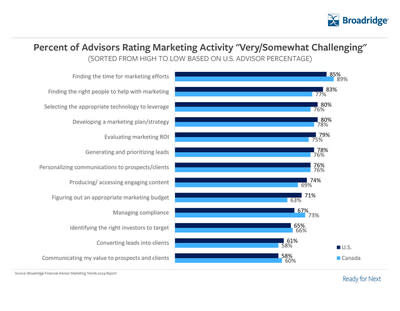
In its fifth year, this annual survey evaluates North American registered financial advisors’ sentiment and activities around digital marketing strategies, shedding light on the successes and challenges that advisors are facing. According to this year’s survey, advisors are now more than ever struggling with their marketing efforts due to a lack of time and expertise needed to build a successful strategy, yet many are finding success in building their practices through a personalized content approach and leveraging next-generation technologies such as AI to reach their prospective and current client base.
Frequent, Meaningful Communications Serve as Drivers for Advisor Growth
As investors demand a more high-touch experience from their advisors, financial advisors who communicate more frequently with their clients are found to be far more confident in meeting their practice goals. Sixty-eight percent of U.S. advisors who communicate at least quarterly with their clients are confident in meeting their goals compared to 51% who communicate with clients annually or less frequently. Similarly, U.S. advisors who are personalizing their content marketing are more confident in reaching their practice goals (71% compared to 62%), and have almost double the rate of being “very confident” in reaching practice goals next year (30% vs. 18%).
Those who are personalizing their content are also more likely to:
-
convert social media leads to clients (45% vs. 34%)
-
use generative AI (50% vs. 38%)
-
spend more time on marketing efforts (an average 2.5 vs. 1.9 hours a week)
-
have a defined marketing strategy (32% vs. 10%)
-
generate more website leads (an average of 3.3 leads person month vs. 1.9)
An important element in an advisor’s growth strategy is personalized educational content that forges deeper relationships and helps clients achieve their unique goals, and yet many advisors find challenges in developing and sharing personalized education. The top reasons that U.S. advisors don’t share educational content with clients are that they’re not sure how to best go about it (49%), don’t find enough time (46%), perceive a lack of interest from clients (44%), and run into compliance issues (34%). To overcome these challenges, many financial advisors are leveraging innovative technology solutions. The survey found that over half (56%) of Canadian advisors are currently using or plan to use generative AI in digital marketing strategies compared to 43% of U.S. advisors.
Advisor AI Usage and Perceptions
The top use cases for AI among North American advisors include generating personalized content, developing personalized marketing campaigns, automating administrative tasks and communications and segmenting clients and prospects, highlighting how generative AI is a key tool in enabling advisors to engage with clients in more meaningful ways while lowering their operating costs.
Along with generative AI, advisors are also looking to ramp up their investments in social media for digital marketing, with 57% of Canadian currently or planning to invest in social media marketing compared to 43% of U.S. advisors. This is likely because Canadian advisors are placing a greater emphasis on attracting Millennial and Gen Z clients compared to their U.S. counterparts. Canadian advisors have also been more successful in converting social media leads to clients (44% vs. 39% of U.S. advisors), with LinkedIn and Facebook being the top two social media platforms for lead conversions across North America.
“An advisor recently told me she no longer competes only with other advisors when building a sustainable practice with younger clients, she competes against TikTok influencers as well. 2023 was the year of generative AI, and tech-savvy advisors can break through the clutter as they develop use cases to better personalize their content and communications for multi-generational clients,” says Kevin Darlington, General Manager, Head of Broadridge Advisor Solutions. “However, many concerns and questions remain around the technology, so advisors should understand the risks and opportunities to leveraging generative AI in a digital marketing strategy to remain compliant while attracting prospects. Similarly, social media has become a popular tool to attract the next generation of potential clients and should be harnessed effectively for lead generation.”
The Number of Advisors with a Defined Marketing Strategy Reaches Lowest Level in Five Years
The number of advisors leveraging a defined marketing strategy has fallen due to the number of challenges that advisors face when it comes to marketing. Nearly all advisors (99% of U.S. and 98% of CA) find marketing activities challenging. The top two challenges North American advisors face include finding time for marketing initiatives and sourcing the right expertise. However, having a defined marketing strategy can help ease these pressures.
The number of U.S. advisors who have a defined marketing strategy is at the lowest level since 2019; 20% in 2023 compared to 28% in 2019. Similarly, only 21% of Canadian advisors report having a defined marketing strategy.
Despite a decline in advisors with a defined marketing strategy, those who leverage one are significantly more confident in meeting their practice goals over the next 12 months (83% and 89% of U.S. and Canadian advisors, respectively, compared to 62% and 61% of U.S. and Canadian advisors without a defined marketing strategy).
Seventy percent of U.S. advisors with a defined marketing strategy saw an increase in inbound requests in the past 12 months compared to just 44% of advisors without a defined marketing strategy. For Canadian advisors, the difference was nearly double – 63% of those with a defined marketing strategy saw an increase in the number of inbound requests compared to 32% of advisors without a defined strategy.
“We conduct this survey annually to analyze how advisor behavior is evolving with the changing financial advice landscape. There is a direct correlation between advisors who spend more time on their marketing efforts, their levels of confidence, and the number of prospects they attract,” adds Darlington. “It simply shows that devoting the right amount of time to create a defined strategy drives measurable results, helps advisors map out their time commitment and allocate the appropriate resources before they set out to engage in marketing. Advisors should leverage the right tools and technology that can save them time, resources and allow them to be intentional with their efforts to get the highest ROI.”
Read the detailed insights from Broadridge’s fifth-annual financial advisor marketing survey here.
Methodology
The Broadridge survey was conducted by 8 Acre Perspective, an independent marketing research firm. A total of 403 U.S. financial advisors across primarily IBD and RIA channels completed the survey, which was fielded from October 20-November 15, 2023. A total of 131 Canadian financial advisors across primarily IBD and Regional Full-Service Brokerage channels also completed the survey, which was fielded from October 25-December 4, 2023.
For further details on survey methodology, please contact a Broadridge media representative.
About Broadridge
Broadridge Financial Solutions (NYSE: BR), a global Fintech leader with over $6 billion in revenues, provides the critical infrastructure that powers investing, corporate governance and communications to enable better financial lives. We deliver technology-driven solutions to banks, broker-dealers, asset and wealth managers and public companies. Broadridge’s infrastructure serves as a global communications hub enabling corporate governance by linking thousands of public companies and mutual funds to tens of millions of individual and institutional investors around the world. In addition, Broadridge’s technology and operations platforms underpin the daily trading of on average more than U.S. $10 trillion of equities, fixed income and other securities globally. A certified Great Place to Work®, Broadridge is a part of the S&P 500® Index, employing over 14,000 associates in 21 countries.
For more information about Broadridge, please visit www.broadridge.com.
Media Contact:
Matthew Luongo
Prosek Partners
+1 646-818-9279
mluongo@prosek.com

View original content to download multimedia:https://www.prnewswire.com/news-releases/fifth-annual-broadridge-survey-reveals-time-and-expertise-top-challenges-in-advisor-marketing-strategies-302055725.html
SOURCE Broadridge Financial Solutions, Inc.
[ad_2]
Source link
HousingWire Annual is strategically placed in October to bring the greatest minds in housing together. At HW Annual, they will be mapping out their playbooks for the future. The event serves as a starting line for conquering next year. With less than 100 days left until these leaders meet in Austin, Texas at the Hyatt Lost Pines, sign up today to not only optimize your time at the event, but also to take advantage of some of the lowest rates available. Click the button below to register for the can’t-miss housing event of the season.
At this year’s HW Annual, attendees can catch Sandra Thompson, director of the Federal Housing Finance Agency, Baron Silverstein, president at Newrez, Amory Wooden, chief marketing officer at Anywhere Brands, Frank Martell, President and CEO at loanDepot, Jay Promisco, chief production officer of Sierra Pacific Mortgage, Sarah Gonzalez, president and chief operating officer at Panorama Mortgage Group, Tyler Hodgson, executive vice president of growth at UMortgage and Cindy Keith, chief strategy officer at NFM Lending all on stage for three days of non-stop housing industry knowledge.
Future-proof your business with this year’s powerful HW Annual agenda. From listening to executives at the biggest companies in real estate and mortgage to dedicated panels on growing women in leadership and how to build competitive marketing strategies, you can find inspiration on stage in Austin, Texas.
Be sure to secure your room at the Hyatt Lost Pines by September 11 to stay at a discounted rate. Any rooms reserved after this date will pay full price for their accommodations. The Hyatt Lost Pines sits on hundreds of acres of beautiful Texas hill country. The resort includes several bars and restaurants, golf courses and pools. When you aren’t attending sessions, there are several opportunities to connect and relax on the property.
Plus, when the sessions are over for the day, the fun at HW Annual keeps going. Stay on property at the Hyatt Lost Pines to join us for cocktail receptions and networking events.
Add sessions like, “More Data, Less Vibes,” and “Strategy and Operation Tactics From the Top,” to your schedule. Catch inspirational leaders on stage, discussing the business tactics you need to win the current market.
HW Annual is HousingWire’s capstone mortgage event, connecting leading professionals from the housing economy seeking to grow, innovate and win market share. This is where strategies are formed, deals are inked and lifelong relationships are solidified. Remember, HW+ members receive special perks like 50% off your admission to HW Annual, so go here to become a member. Haven’t received a discount code yet? Reach out to us at [email protected] Join us in Austin, Texas October 10-12 for community, content and commerce.
[ad_2]
Source link
Volunteers Kierra Chante and Michaela Triche prepare to cut plywood as New Orleans Area Habitat for Humanity hosts a Pride Build on Tennessee Avenue in New Orleans on Friday, June 23, 2023. Pride Build brings together local members of the LGBTQ community and allies to help build a home for a local family. The home will be purchased at a no-interest mortgage by a hard-working single mom. In lieu of a cash down payment, the homebuyer has worked more than 250 volunteer hours helping others become first-time homeowners. (Photo by Brett Duke, NOLA.com | The Times-Picayune)
[ad_2]
Source link

Khloé Kardashian: Makeup, Ash K Holm; Hair, Irinel De León; Stylist, Dani Michelle: Seamstress, Mia Paranto; Manicurist, Zola Ganzorigt: Pedicurist, Millie Machado. Emma Grede: Makeup, Christina Cassell; Hair, Vernon François; Stylist, Simon Robins.
Image Credit: Greg Swales
The model wears a faded denim jumpsuit that hugs her curves like slalom skis. She’s tugging at the zipper that goes up the front. And the photo of her appears on the Instagram page for fashion brand Good American, where it garnered more than 3,000 likes and comments along the lines of “OMG,” “NEED,” and “OBSESSED.”
But amidst the emoji flames and heart-eyed smiley faces, a user who goes by the handle @jazziolebabe writes: “Prices r too high.” That’s sure to have a familiar ring to anyone with a company that sells things. “Customer obsession” is hot lingo these days, especially in retail. Everyone is scrambling to know what their shoppers want and need — and comments on social media are an obvious destination, because even negative feedback can be incredibly valuable. But finding useful insights often means dredging through the sewer of knives-out viciousness and abusive one-upmanship. And what do you do with something like “Prices r too high”? OK, sure — but last time you checked, you were in business to make a profit.
Related: How to Accelerate Your Success as a Female Founder
Making use of social media comments and other customer feedback is always tricky, whether you’re an everyday entrepreneur or someone like Khloé Kardashian, who has more than 300 million followers on Instagram alone. She also happens to be the cofounder of Good American along with Emma Grede, a fashion-industry veteran who’s becoming increasingly famous herself for her Shark Tank “guest shark” appearances. “You have to get a good sense of when people are just talking to talk,” Kardashian says, “and when to go, ‘You know what? I’ve read this enough, and where there’s smoke, there’s fire. Let’s pay attention to this.'”
More than anything else, learning to pay attention is what’s helped Grede and Kardashian build their size-inclusive brand Good American into a serious force in fashion, employing over 100 people and doing more than $200 million in sales last year.
A few years ago, when they saw a number of comments piling up about prices, they took note. While they’d always meant for their clothes to be accessible, Good American is not a low-end brand; jeans go for around $99 to $199. That’s because the production costs to make well-fitting apparel from sizes 00 to 32 Plus are hefty. Lowering the price by decreasing quality was not an option. So they focused hard on their customers, both on social media and off, and tried to look at shopping through their eyes, asking: What are we spending so much money on?
That’s when they saw the problem: A woman’s weight fluctuates. “It’s true regardless of where they are on the size scale,” says Grede. “I mean, I’ll be up or down six pounds depending on the time of the month — “
“Depending on the day,” Kardashian quips.
The point, says Grede, is that “these women have two or three different sets of jeans in that closet.”
What if they could solve this? The question led to an idea: They’d innovate a fabric that stretches four sizes, as magically as the fictional jeans in the 2005 movie Sisterhood of the Traveling Pants. Instead of lowering their cost, they’d increase their product’s value — saving their customers from having to buy multiple sizes. It was frustratingly slow and expensive to pull off, but in the end, definitely worth it: Their “Always Fits” jeans, launched in 2020, have become one of Good American’s best-selling denim products.
Related: Supermodel Karlie Kloss’s Lesson to Young Women: Never Be Afraid to Ask Questions!
For Grede, it was proof of a process that now underlies the brand’s success: You listen, identify pain points, and then invest in creating features that aren’t being duplicated elsewhere. “It puts a moat around our company, right?” she says.
It’s a moat built on voices.
You probably know who Khloé Kardashian is — but just in case you missed all 20 seasons of Keeping Up With the Kardashians, the various spinoffs, and the current show, The Kardashians, then here’s the quick of it: Khloé is the youngest of the three original Kardashian sisters. She is “the funny one,” down-to-earth and good-natured, and always trying to make peace.
Grede, on the other hand, did not come from celebrity royalty. She grew up in East London, a scrappy Black girl raised by a single mom, in a family of women who embraced their curves. She was barely 26 when, in 2008, she started a brand marketing company called ITB Worldwide that was eventually acquired by Rogers & Cowan (she won’t say for how much). By then, she’d already embarked on her next act.
The idea for a size-inclusive apparel line came to her when she realized she was part of a problem. “I was working for the biggest fashion brands in the world, casting these seemingly diverse campaigns, and I thought, Wouldn’t it be amazing if they actually made clothes to fit some of these girls?” she says. “We talk about women having equal opportunity, and yet we let the fashion industry dictate that if we’re over a certain size, we aren’t important enough to service. It felt archaic to me. I just thought there was a huge opportunity.”
Related: 8 Qualities to Drive Your Success as a Female Entrepreneur
In 2015, she shared these thoughts with Kris Jenner, the Kardashian family matriarch, whom Grede had met through her fashion work. The following week, Grede was on a plane to Los Angeles to pitch the idea to Khloé. The meeting was in a conference room in Culver City, California, and all she had was a PowerPoint she’d worked up on the flight — essentially a manifesto of values, some images pulled off the web, and a bad placeholder name. Kardashian was wary.
“When I was younger, I took every opportunity to hawk products or do this and that — I didn’t even know what I was doing half the time,” Kardashian says. By 2015, however, she was much better equipped to evaluate a good business deal, and she was only interested if she deeply cared about the project. She took the meeting with Grede, but wasn’t expecting much.
In the room, though, Kardashian was impressed by Grede. She also immediately understood the presentation: The customer was her.
Growing up, before all the fame and social media, Kardashian was a cheerful, confident, athletic kid. She liked being physically bigger than Kim and Kourtney — until she became an object of the gossipy press. “I never knew I was, I guess, chubby or fat until the weeklies and tabloids started telling me I was,” she says, her voice hovering for a split second, as if careful to sidestep that old cavity of insecurity. But even in her younger days, she hated shopping. In the ’90s and early 2000s, there was no e-commerce, and in stores, larger clothes were ghettoized. “My sisters loved to go to little boutiques or chichi department stores. I was always being ushered to some underground basement, always being thrown a mumu or just being told, ‘No, you can’t shop here.’ And it made me feel so much less than.” Nothing was worse than trying to buy jeans, especially trendy ones like Frankie B. “No disrespect to Frankie Bs — but I have a butt and it’s not getting in Frankie Bs!”
Despite all that, Kardashian still felt sexy and attractive. “More power to me,” she jokes. But she knew other women did not feel the same. In Grede’s presentation, she saw a brand that could channel and spread that confidence around.
“The only thing I didn’t enjoy,” says Kardashian, “was the placeholder name. I don’t even remember what it was.”
“I do,” Emma mutters.
Related: 7 Practical Ways to Celebrate and Support Women Entrepreneurs
At this point, we’re all lounging couchside in a nook of a cavernous photo studio in Calabasas, the Los Angeles suburb of gated communities where Kardashian lives. Having ditched her stilettos and tight jeans, Kardashian is now dressed as if for a kid sleepover, in a fuzzy onesie. She nestles into the cushions and floods the space with a warm “we got this, girlfriend” appeal. Next to her, Grede is clad in Good American jeans and a work shirt. She has an easy confidence around her famous cofounder, and bristles with barely contained enthusiasm. Come on, I prod. Tell us the placeholder name.
Grede busts out laughing: “Absolutely not.”
Even without a name, from that first meeting, the two women saw what their advantage was. “The people making the decisions in fashion,” says Grede, “were largely white men and not connected to the customer.” She and Kardashian knew the customer intimately. And they realized that if they could get inside her head even more, they could make a lot of clothes for her.
So that became their game plan: Focus on the connection, consistently improve it, and learn to watch their followers as intensely as their followers have always scrutinized Kardashian.

Image Credit: Greg Swales
Good American launched on October 18, 2016. It was a nerve-wracking day. Kardashian may have many advantages over the average entrepreneur — in reach, in resources — but to her, this also meant the bar for success was extraordinarily high. Anything short of a smash hit could be portrayed as a humiliation. And this was the first time she wasn’t just endorsing a product or partnering with a sibling; it was a genuinely new business. Good American was producing jeans in sizes 00 to 24 — designed to look cute and sexy on women of all shapes, which was something of a groundbreaking proposition at the time.
Right as they were about to launch, Grede told Kardashian that they should aim for $1 million in sales — that day.
“The number just came from foolery,” Grede says now. “I never thought we’d do it.” But Kardashian took it seriously. “In my head, I was like, “Let’s do a million? Sure, Emma, that’d be amazing,” she recalls. “But it’s a lot of fucking money! And then to have it be filmed? I can’t go down like this.”
Because, of course, it was being filmed: The tape was rolling for Keeping Up with the Kardashians. Kardashian leaned into a full-fledged freak-out. “I’ve always been known as the fattest sister,” she told the camera. “And now that I’m over it, I don’t want to be known as the failing sister.”
Before that day, she and Grede had given retailers an ultimatum: They’d work only with stores that agreed to carry their full size range and display it all in one place — no separate floors for “petites” or “plus-size” (a term they avoided because of its negative connotations). In 2016, this was still not how stores tended to organize their clothes, but Nordstrom agreed and became their launch partner. “It meant trusting their vision,” says Pete Nordstrom, the company’s president and chief brand officer, explaining, “The brand had widespread appeal, as it was the first denim line to offer expanded sizes at a great value.”
Getting to launch was harder than they thought. Maybe Good American had product-market fit, but the actual fit of jeans on all these bodies was elusive. At the top of the size range, body shapes vary widely, so you can’t just enlarge smaller sizes. You’ve got to create different patterns, innovative fabric, and altered manufacturing processes. Factories just threw the specs back at Kardashian and Grede and said they didn’t make sense. Hiring was a pain, because there were so few fashion people who had worked with larger apparel. And then they needed models. “Back then, there was Ashley Graham…and Ashley Graham…and Ashley Graham,” says Grede of the trailblazing curvy supermodel. That left real women. So, how would they find them?
“We posted for our first open casting call,” Kardashian says. She did it on Instagram.
“We posted?” Grede cuts in. “Khloé, you posted. I had, like, 27 followers.”
Kardashian ignores her. “We didn’t even have the name yet. We were, like, hoping 10 girls come.”
They nervously waited on the appointed day at Milk Studios. Some 5,000 women showed up — a lesson about what their customer connection could do. “I knew Khloé had an enormous fan base, but I didn’t get that it was a two-way street,” says Grede. “I was like, That’s gonna be super useful for us.”
When they debuted online and at select Nordstrom stores, Good American did indeed hit $1 million in sales on day one. And immediately, the founders faced a major decision. “Another retailer, who should remain nameless because they are now our client,” says Grede, “put in an astronomical order for sizes 0 through 8.”
In scale, this was the kind of put-you-on-the-map order any young brand would dream of — but again, their sizing went up to 24. If that retailer only sold sizes 0 to 8, it would chip away at what made Good American special. It would also kick their core customer back down to the basement. “And then what does that make us? Just like everyone else?” asks Kardashian. “We were like, ‘You either take the full size range or you don’t. We’re not gonna sell our souls any more than we already have.'”
She smiles. Still, it was a hard decision. “Saying no to that level of sales from that type of retailer?” says Grede. “That was very difficult.”
Once Good American was out there, it was time to refine the brand. Buoyed by the responsiveness to the open casting call — which Good American has made a regular part of its marketing strategy — Grede and Kardashian started holding targeted focus groups on social media, asking women how the clothes could be better, what else they wanted, what their needs were. “But even with focus groups,” says Kardashian, “it gets murky, because everyone has an opinion.”
So they started looking closely at the returns. Early on, they noticed that a lot of size 14s and size 16s came back. “When you see that,” Kardashian says, “you do have to go, OK, why? Let’s look again at these comments.” What they learned is that customers were falling between the cracks of the even-numbered conventional sizes. So in 2018, they invented a size 15. “To this day, it’s our third or fourth best-selling size month-to-month,” Grede says.
Then they discovered another problem with customer feedback: Sometimes what people say they want is different from what they’ll actually buy. And sometimes the thing they’re asking for just doesn’t make sense for the business. Grede and Kardashian haven’t always gotten it right. Like when everyone was going crazy for rigid jeans, “we made them — of course we did,” Grede says dryly. It didn’t take long for them to realize that rigid jeans are not the most natural fit for curvy ladies. “We were quick to be like, ‘OK, we fucked up, and we gotta figure this one out,'” says Kardashian, putting an optimistic spin on it. “But it was also a great learning experience, because you wanna be with the trends, but maybe it’s okay to do ‘rigid’ with a smidge of stretch. Like, our girl needs that.”
Eventually, Grede and Kardashian built a data and analytics team to formalize the feedback process. But they continued observing their audience on their social channels, like detectives searching for clues. And about four years ago, they noticed something curious. By then, Good American had expanded into bodysuits, and customers were posting photos of themselves on social media swimming in them. Which was great, except…
“We were like, ‘The bodysuits are not made to get wet!'” says Kardashian.
“There’s an opening in the crotch,” explains Grede.
“Right,” Kardashian seconds. “It could snap open.”
Should they develop a swimwear category? they wondered. Their customers clearly wanted it. And selling swimsuits in the smaller sizes seemed like a no-brainer. But what about the higher sizes? Would really curvy women buy teeny bikinis and monokinis? The cofounders looked more carefully at the bodysuit category and noticed that in the sexier cuts, the larger sizes were actually selling better than the smaller ones. “So the wheels were turning, and we could get a little bit of a foreshadowing based on what other things were selling,” says Kardashian.
They decided to risk it, and the first line was ready in June 2020, just as beaches had emptied for COVID and Good American’s retailers were shutting stores and sending back orders. It was a hard time, but they launched the suits anyway, and swimwear grew into their second biggest category.
The next decision involved something their stylists picked up on: The models at the open-casted campaign shoots didn’t have attractive shoes or boots that fit around their calves. Grede saw an opportunity — they could get into footwear. But Kardashian worried that, unlike the swimsuits, this would be expensive, and the final product would be too high-priced.
“I’m not gonna lie, we were both scared,” Grede says.
“You were way more on board than I was,” Kardashian says.
“Well,” Grede concedes, “I do have that kind of mindset that, you know, we’ve done a lot of difficult things at Good American. Like, come on, we do it.” Grede’s energy can be persuasive. Six months after the swimwear, they launched their shoes — now their third biggest category.
In 2021, they stopped to take a breath. Grede had become a founding partner of Kim Kardashian’s shapewear label SKIMS (which has a reported valuation of $3.2 billion) and was launching the plant-powered cleaning brand Safely with Kris, while starting to appear on Shark Tank. Kardashian was busy with her show and, like Grede, now a mother. Until then, Good American had been focused on growth. But customers everywhere were increasingly concerned about climate change and social equality — as were Grede and Kardashian. So they decided to become a certified B Corporation, an arduous process verifying that Good American adheres to high standards of social and environmental responsibility. It also means being accountable for balancing profit with purpose.
“Good American isn’t doing this just because we wanted to have a buzzworthy moment. This is something that we genuinely believe in,” says Kardashian. “I never want my daughter — or anybody — to go through that experience that I went through. I want them to feel seen and represented.”

Image Credit: Greg Swales
Even with the B Corp, from 2021 to 2022, Good American’s sales increased by 30%. Today the brand offers sizes up to 32 Plus and has wholesale partnerships with Saks Fifth Avenue, Revolve, Bloomingdale’s, and Net-a-Porter. Last year it pulled off a collaboration with the multinational fast-fashion chain Zara — a milestone for both. As for Pete Nordstrom, he says pioneering with Good American has not only been a win, but has also influenced the department store chain. “The positive customer response to Good American has inspired us to expand our approach to size inclusivity,” he says.
But Good American’s success — and a broader body positivity movement — has also created competition. Nordstrom’s team has asked more of their brand partners to produce extended sizes, for example. And in the past seven years, the U.S. plus-size fashion market has grown from around $23.7 billion to an expected $30 billion in 2023, according to a recent analysis by Future Market Insights (FMI). Small size-inclusive brands like Big Bud Press, Henning, and Universal Standard are grabbing attention, while large companies from H&M to Nike have extended their lines to include clothes for larger bodies. “One of the fastest-growing markets in the apparel business is plus-size fashion,” says Sneha Varghese, lead analyst for consumer goods at FMI. “And there is still a lot of space for expansion.”
Related: Lewis Howes Has Built An Eight-Figure Personal Brand. He Did It By Constantly Reinventing Himself.
The fact that Good American sells casual clothes at a midrange price point puts it in the sweet spot, according to FMI’s analysis. It’s also got history on its side. “I believe any brand that is size-inclusive from the start has a huge advantage over straight-size brands — the grand majority of which have flat-out ignored extended sizes for years,” says Melissa Moylan, vice president of womenswear at Fashion Snoops, a global trend forecasting agency. “It’s not easy to simply extend straight-size patterns, and getting the fit wrong for a plus-size customer may mean they’re not coming back anytime soon.” She points to Bodequality, the inclusive effort that Old Navy rolled out with fanfare but ended up pulling back from stores last year. “That’s exactly when a brand like Good American holds its value; with not only a message of inclusivity and representation, but a proven track record.”
Grede and Kardashian say they are excited by the competition. But rather than racing ahead in their stilettos (which, take it from a witness, they can) to scoop up new clothing categories, the cofounders are standing by their playbook — listening to where their customers are now, and perfecting the products they already have. It’s a good strategy, according to Moylan: “No brand is good at everything.” So it’s wise to double down on what makes yours special.
As this magazine went to press, Kardashian and Grede were getting ready to open up a new channel for connecting with their customers — face to face. It will be Good American’s flagship store in Century City, California. “We’ve thought about this idea of inclusivity very much in a product-focused way,” says Grede, “and now we’re figuring out: What should the new shopping experience for our customers be? How do we make them feel good as soon as they come in?”
They have their questions. Now, as always, they’re waiting for their customers’ answers.
[ad_2]
Source link
NEW YORK and LONDON, April 13, 2023 (GLOBE NEWSWIRE) — McKinsey & Company’s latest Global B2B Pulse reveals that market share winners are going all in on omnichannel, even in uncertain times.
In particular, companies that reported a 10+ percent increase in market share last year deployed five specific omnichannel strategies in concert:
- Hybrid sales teams and capabilities
- Highly personalized marketing
- Advanced sales technology usage
- Third-party marketplaces strategies
- Ecommerce excellence in owned platforms
Each strategy is valuable on its own, but they are most powerful when combined. Companies who invested in all five were twice as likely to gain market share than companies who adopted only one.
The Global B2B Pulse research analyzed responses from nearly 3,800 sales and marketing leaders across 13 countries. Since 2016, the B2B Pulse has gathered insights from almost 25,000 decision makers globally. This year’s Pulse reveals that omnichannel is now a must-have requirement in B2B marketing and sales.
Additional insights and trends include:
Personalization shifts up a gear
77 percent of companies using direct 1:1 personalization saw an increase in market share. But companies showing the strongest market share growth – more than 10 percent a year – were overwhelmingly investing in sophisticated tactics that go beyond account-based marketing, like hyper-personalization. This form of personalization is growing most in Brazil, India, and the US, and driving market share growth particularly in the global energy and materials (GEM), finance, banking, and insurance, and telecommunications, media, and technology (TMT) sectors.
Market share winners are also investing in new sales tools that aid hyper-personalization. For example, 64 percent of share winners are using bots. Tools like these are increasingly used to accelerate and sharpen personalization for every customer at each stage of the buying journey. Stronger personalization helps ensure customers are presented with the right message, the right call to action, and the right products and solutions, all at the right time.
Appetite for high-value e-commerce transactions on the rise
The Pulse research also showed that, like last year, ~70 percent of decision makers are prepared to spend up to $500,000 in a single e-commerce transaction. Meanwhile, the number of buyers willing to spend up to $10 million in a single e-commerce transaction rose by 83 percent. This trend is particularly prominent in China, India, and the US – and especially within the global energy and materials (GEM); telecommunications, media, and technology (TMT); and advanced industries sectors.
B2B marketplaces present clear growth opportunity
In a significant shift from legacy methods, 35 percent of B2B decision-makers now rate e-commerce as their most effective sales channel. The companies winning the most market share enable their customers to buy online through multiple channels. For instance, 48 percent of growing organizations sell via industry-specific marketplaces, while only 13 percent of organizations losing market share do. E-commerce comes ahead of in-person sales (26 percent), videoconferencing (12 percent), email (10 percent), and telephone (8 percent). The best results demand investment in experimentation and optimization over time. Strong execution requires consistent optimization, experimentation, and training for internal teams.
More than half of winning companies use hybrid sales teams
Hybrid sales models, which involve sales staff meeting with customers both in-person and remotely, were used by 57 percent of companies that are growing their market share. For companies losing market share, that figure is 40 percent. Today’s B2B customers need sales leaders to be available not only in-person, but also through remote sales meetings, virtual demonstrations, and digital relationship management.
This increased use of larger hybrid teams is particularly linked with market share growth in the telecommunications, media, and technology, global finance, banking and insurance, as well as travel, transportation, and logistics sectors.
Jennifer Stanley, Partner, McKinsey & Company:
“These trends we are seeing continue to shake things up for companies. And the signals are clear – customers know exactly what, where, how, and when they want things. What’s even more clear? Companies that adapt and respond to those needs and provide value are being rewarded in multiple ways – from higher retention rates, higher sales, and higher market share.”
Candace Lun Plotkin, Partner, McKinsey & Company:
“It’s a defining moment for sales and marketing leaders. Companies that are defying the odds and going all in on critical investments and growth levers are realizing market share gains at a faster clip. What this means for those who are looking to emerge stronger, is that growth – even in this difficult climate – is attainable. It comes down to charting that path and taking decisive action.”
For more insights, see the full report.
About the survey
McKinsey’s Global B2B Pulse has been published annually since 2016 and has now gathered insights from over 25,000 decision-makers. The most recent survey of 3,800 leaders across 13 countries (Brazil, Chile, China, France, Germany, India, Italy, Japan, South Korea, Spain, the United Kingdom, and United States) was conducted in December 2022.
About Growth, Marketing & Sales, McKinsey & Company
The mission of the McKinsey Growth, Marketing & Sales Practice is to help leaders of both consumer and business-to-business organizations drive sustainable and inclusive growth, through meaningful transformations and marketing-driven profit. The practice helps its clients set their strategic direction, develop their marketing and sales capabilities, and connect their organization to realize the full potential of today’s omnichannel opportunities. Clients benefit from McKinsey’s experience in core areas of marketing such as branding, customer insights, marketing ROI, digital marketing, CLM pricing, and sales and channel management.
For more information, please contact:
US media contact: Alyssa Kehoe, Digennaro Communications, McKinsey-DiGennaro@digennaro-usa.com, +1 917 518 8422
UK media contact: Ruth Jones/Becca Ross, 3THINKRS, mckinsey@3thinkrs.com, +44 0208 0872843
[ad_2]
Source link