You’re more likely to turn on the TV to watch YouTube, Netflix, or another streaming platform than you are to watch cable.
Nielsen’s June “The Gauge” report, which assessed what U.S. audiences watch through a TV screen for the previous month, found that more viewers are opting to stream content through their TVs.
YouTube had a record-high share of TV viewers across all streaming services in May; 9.7% of all views on connected and traditional TVs last month were an effort to access the platform.
About one in 10 people who turned on the TV wanted to watch YouTube.
“We’re not talking about your mobile phone, your laptop, that I’m sure you see your kids using all the time, but on the biggest screen in the house, the TV,” LightShed media analyst Rich Greenfield told CNBC.
Greenfield added that “every [media] executive” should be watching the trend.
Related: How Erika Kullberg Grows and Monetizes Her YouTube Channel
Netflix wasn’t far behind YouTube, with new episodes of “Bridgerton” pushing the company to 7.6% of all TV views in May.
Hulu, Prime Video, and Disney+ had lower shares of 3.1%, 3.0%, and 1.8% respectively.
The streaming industry overall commanded a record-high 38.8% of views through TV in May. That means nearly two in five interactions with a TV screen last month were to access a streaming service.
Related: How To Start a YouTube Channel: Step-by-Step Guide
Streaming had a higher portion of the market than cable (28.2%), broadcast (22.3%), or any other service (10.8%).
“Now the past two summers have been notable for the share shifts towards streaming, driven by blockbuster original releases and school-age kids having more free time,” Brian Fuhrer, Nielsen senior vice president of product strategy and thought leadership, stated in a video recap about the report.
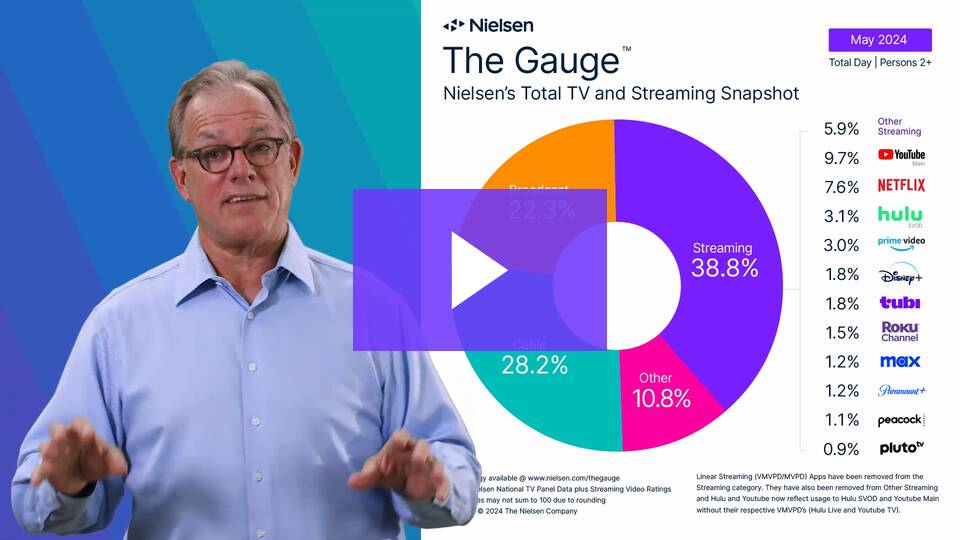
Nielsen’s May 2024 Report of The Gauge™: Young Sheldon Creates a Big Bang Across Platforms | Nielsen
The impact of the summer months will start to be felt in Nielsen’s upcoming July 16 gauge report, which measures June’s TV viewership.
Read the June report, here.
Related: How to Leverage Data to Attract and Retain YouTube Subscribers
[ad_2]
Source link
* This is a contributed article and this content does not necessarily represent the views of IBTimes.

Digital marketing has recently emerged as a crucial component for success. With the ever-increasing competition and changing consumer behavior, businesses must adapt and employ innovative strategies and harness innovative strategies that captivate and resonate with consumers to stay ahead of the curve.
This is specifically true as a recent report mentions 63% of businesses have increased their digital marketing budgets over the past few years. There has been a 14% growth rate in digital marketing budget spending across businesses between 2020 and 2021.
Mythili Banka, a trailblazer in the field, has emerged as a visionary, particularly through her exceptional omni-channel marketing strategies. With her extensive 13-year experience leading projects across various industries, she leverages data analytics and AI to drive customer-centric solutions such as recommendation engines to pave the way to better and more seamless customer experience.
The need for more efficient omni-channel customer service
As businesses now work in a more fast-paced and digitally interconnected world, there has been a constant challenge to provide more personalized and contextual customer service. According to Banka, traditional customer service, though effective in its time, is no longer sufficient in meeting the diverse needs of today’s consumers. Customer behavior and evolving expectations require businesses to adapt and innovate their customer service strategies.
Having access to vast amounts of information makes customers more connected and involved in the brands they patronize. Due to the availability of multiple communication channels and customers’ high expectations for personalized experiences, businesses find it increasingly difficult to cater to every need in a consistent and meaningful manner. Banka mentions that with businesses operating across multiple channels and touchpoints, maintaining a consistent and personalized customer experience has become increasingly challenging.
“This aspect is very important as failure to deliver on these expectations can lead to customer frustration, reduced loyalty, and even negative brand reputation,” Banka shares.
Noticing the opportunity in this vital challenge led Banka to develop innovative omni-channel strategies by leveraging technology and data insights. She has created a unified customer experience that transcends individual channels, integrating customer data, communication channels, and marketing efforts to deliver a cohesive brand experience at every touchpoint.
Banka’s vision for better omni-channel marketing
As a digital marketing expert and industry innovator armed with a Bachelor’s degree in Computer Science from Sastra University and a Master’s in Information Systems and Technology Management from University of Delaware, Banka possesses a strong foundation in both technology and business. Her extensive experience as a Director of Data Management has enabled her to spearhead digital transformations across industries, including telecom, finance, and retail.
Banka understands that businesses must adopt a holistic approach that integrates multiple channels and touchpoints, ensuring a seamless and consistent customer experience across all interactions. Her ability to help clients achieve their omni-channel customer experience vision through the development of recommendation engines using BPM technologies highlights her exceptional expertise in driving customer-centric solutions.
She shares, “Technology is not a replacement for human interaction, but rather a tool to enhance it. By leveraging data analytics and AI, we can provide personalized experiences that improve customer engagement and loyalty, ultimately leading to measurable business outcomes.”
Banka changes the game with omni-channel marketing
Banka’s success and recognition in the industry can be attributed to her impressive accomplishments and in-depth knowledge of cutting-edge technologies. She brings a wealth of expertise in leveraging data analytics, AI, and other platforms to drive transformative results.
One aspect that sets Banka apart is her steadfast emphasis on omni-channel marketing.
Her omni-channel techniques involve integrating various digital channels, including social media, email marketing, content marketing, and mobile apps, to create a cohesive brand presence and ensure consistent messaging throughout the customer journey so that businesses can engage customers across multiple touchpoints in a seamless and personalized approach.
Utilizing her unparalleled expertise as a Certified Pega Decisioning Architect, Banka has masterfully developed intricate design solutions that implement complex recommendation engines. These engines are meticulously crafted to optimize customer interactions, leading to heightened engagement and unwavering customer loyalty.
In an industry that evolves rapidly, Banka’s dedication to continuous learning ensures that her strategies remain at the forefront of innovation. By utilizing emerging technologies and implementing industry best practices, she continues to push the boundaries of digital marketing and provide her clients with a competitive edge.
Banka as a transformational leader
Banka’s expertise and innovative mindset haven’t gone unnoticed. Being a Director at the young age of 33 proves her expertise in synchronizing messaging, branding, and user experience across platforms has resulted in unprecedented success for her clients, making her a sought-after expert in the field.
At present, Banka’s stellar educational and professional achievements have earned her a coveted position in the esteemed India Book of Records. This recognition serves as a testament to her exceptional profile, characterized by a remarkable academic background and an exemplary career trajectory.
At the same time, Banka has received nominations for the Globee Women In Business, under the category of Transformation Leader of the Year, Committed Professional of the Year, and Globee Women in Business: Rising Start of the Year. These nominations attest to her excellence in the field, applying her extensive knowledge and experience to improve processes that drive convenience, efficiency, and growth.
As companies continue to prioritize personalized and contextual customer experiences, Banka’s visionary approach serves as an inspiration for businesses looking to achieve excellence in their customer service efforts and drive long-term success.
[ad_2]
Source link
There’s a war waging over artificial intelligence, with one side touting AI as the future, and the other arguing humans are always superior. We say, “Why not have both in your digital marketing tools?”
Artificial intelligence has become a staple across industries, streamlining tasks and boosting productivity. Even content marketing benefits from AI marketing tools.
However, despite its many benefits, AI has its limits. That’s why there needs to be a careful balance.
Learn how to use AI in content marketing and set limits to ensure you don’t compromise quality for convenience.
Key Takeaways:
- AI marketing tools work best when performing repetitive or predictable tasks.
- Use human content creators to add personal stories and unique perspectives to your content.
- Human content marketers ensure AI-generated content is accurate, unbiased, and personalized.
AI marketing tools can bolster digital marketing strategies, but they aren’t a magical cure for all marketing challenges. Here are a few ways AI can benefit content marketing.
Analyzing Large Amounts of Data
Data drives content marketing. It’s how modern marketers understand their audience, what topics customers search for, and what content is trending. Data also reveals how well content performs.
Manually analyzing data helps you see unique patterns and create new strategies. However, there’s simply too much data for people to process by themselves.
AI helps data analytics process more information to find patterns and analyze performance. Now, marketers can keep up with the growing amount of digital information.
Google has been using AI for data analytics for years already. For example, they use it to find relevant content in searches and reveal trends in Google Trends.
AI can also analyze your existing content to find new ways to optimize the content. For instance, it can scan similar content for keywords to help you remain competitive in search rankings. It can also identify improvement areas, like word count, images, and headings.
Streamlining Repetitive Tasks
While content marketing involves hours of writing and creativity, it also requires dozens of time-consuming, repetitive tasks. AI excels in repetitive environments where you can teach a tool a pattern it continues to copy.
Over half of marketers say creating content frequently boosts their ranking. However, keeping a content calendar with weekly or even daily ideas is time-consuming and mentally exhausting. AI helps marketers brainstorm to create ideas.

Image from SEMrush
Here are several ways AI can streamline your brainstorming:
- Identify content gaps among your competitors
- Input prompts into AI tools for several angles
- Research the industry and see the top trending topics and related terms
AI tools in digital marketing like Grammarly can also streamline editing by looking for common errors, giving content creators an extra level of assurance of top-quality work. Meanwhile, AI tools are transforming the ecommerce industry, enabling a seamless marketing-to-sales journey through automation.
Automating Content Scheduling
AI improves content scheduling since it allows creators to focus on research, optimization, and content creation. As creators produce content like blog posts, they can plan when it will post and forget about it.
Emails are also most effective when marketers automate them. That way, leads receive relevant email responses immediately after performing trigger actions. This keeps leads engaged.
Marketers can post on social media daily or even several times a day. Instead of remaining glued to social media, marketers can schedule posts and automatic replies until they can log on and address comments personally.
While AI has many strengths, there are several areas where human content creators and marketers are more effective than even the best AI tools. Here are some ways AI still requires human contribution.
How AI is Changing Marketing and SEO (And How to Use it in Your Business)
Creating Original Content
AI can streamline tasks like brainstorming or outlining, but humans will need to create the actual content. Artificial intelligence tools like ChatGPT draw from existing ideas to create content. These ideas can be outdated, repetitive, and even incorrect.
Human writers create original content from unique angles. They are authorities in their field that pull from personal experience rather than from other people’s ideas.
Google’s search algorithm also wants more original content using personal expertise and will penalize AI-generated content in searches. Only a human writer can offer true thought leadership content.
Connecting Personally with Leads
Most people can tell an AI-generated response from a personal reply. While AI aids in problem-solving and troubleshooting in customer service, marketing requires a personal touch.
Only human marketers and content creators can connect personally with leads. They can share personal stories, customized advice, and unique offers based on a customer’s individual situation. Customers respond much more positively to that personal touch.
Discerning the Best Content
There’s an old quote often attributed to Miles Kington that says, “Intelligence is knowing that a tomato is a fruit. Wisdom is not putting it in a fruit salad.”

AI may know many facts and can put together impressive content. However, correctness doesn’t mean quality.
Despite AI’s vast database of information, it often lacks wisdom and discernment. AI suggestions come from patterns according to what makes logical sense. But it doesn’t consider nuances like poor quality, biased, or outdated data. It also doesn’t note cultural climates or recent news that might impact what’s suitable for publication and what would be insensitive.
The Harvard Business Review published several instances where AI made decisions a human would not have made. For instance, an AI self-driving car hit a pedestrian because the person wasn’t walking where the AI learned they should be.
Human authors use their intuition to analyze AI suggestions and discernment to identify content opportunities that AI might miss due to a lack of reliable or consistent data.
AI works best alongside human marketers to streamline repetitive tasks and provide different ideas. But AI won’t replace marketers entirely.
Invest in quality marketing tools. Not just marketing tools that make marketing more manageable but also enhance your content marketing quality. These are AI digital marketing tools that work alongside your human content creators to create authoritative thought leadership.
[ad_2]
Source link
Poor fitness among recruits is costing the Army millions, study says Military Times
[ad_2]
Source link ]]>